
The Forgotten Architect of the Great Society
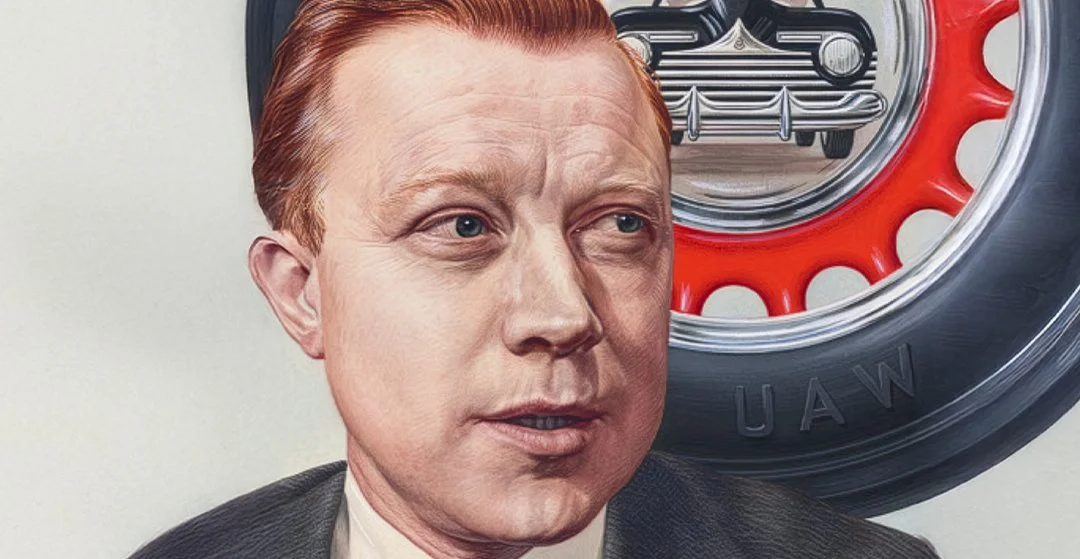
United Auto Workers leader Walter Reuther helped build America’s entitlement state
(National Portrait Gallery)
By Amity Shlaes
This article appears in the Winter 2026 issue of the Coolidge Review. Request a free copy of a future print issue.
This past fall, Americans experienced the longest government shutdown in history. Now we’re bracing for a partial shutdown. These days we feel like we’re trapped in a self-driving car careening toward financial disaster.
Who strapped us into the vehicle? Most lay blame on Lyndon Johnson, the president who signed the laws that established costly programs like Medicare, Medicaid, and food stamps as part of his Great Society. Johnson institutionalized, dignified, the tradition of entitlement that figures like Mayor Zohran Mamdani of New York build on today.
As Joseph Califano, Johnson’s aide in the 1960s, put it in his memoirs, “We are living in Lyndon Johnson’s America.”
Or perhaps Walter Reuther’s.
Reuther, pronounced “ROOTH-ER,” goes nearly forgotten today. But in the 1960s the name of the labor leader, and that of his union, the mighty United Auto Workers, could be heard most nights on the news. As UAW leader, Reuther, of course, literally worked with autos. He is worth recalling because, more even than Johnson’s, his life explains how we got trapped in the entitlement car—and also, perhaps, how to get out of it.
“Which Side Are You On?”
Reuther’s family were immigrants who settled in West Virginia, German socialists. At night, father Valentine preached his vision of America to his children: a place made up of classes. Workers, he said, needed to challenge employers and wrest concessions from them.
You had to take sides, as in the Florence Reece song, which asks: “Which side are you on?”
That our industries could afford the battle was also the presumption of Valentine’s sons, Walter, Roy, and Victor. And not an illogical one, given that Detroit at the time they arrived, the late 1920s, looked like the city of the future. The auto industry was the heart of our economy.
Of course, there was a dark side to life in the assembly line revolution, as in the Charlie Chaplin film Modern Times. Shifts ran thirteen hours; companies drove workers like horses; in many cases, there were no benefits.
The question was what would improve conditions for both companies and workers. One answer, then typically American, was that the problem could solve itself over time. If companies mistreated their workers, the workers would decamp to friendlier companies. Then the wrongdoing bosses would reform. Those workers who wanted to advance would turn to school, not strikes.
The other answer was European. Only powerful action from the federal government could halt injustice to lower earners and enable them to advance. Only strikes would yield adequate pay. This was the answer supported by social democrats like the Reuther brothers.
Walter—red haired, pugnacious, and appealingly honest—found his starting point in the auto industry, his first goal being to level the field between autoworkers and what appeared to be perma-giants: Ford, General Motors, and Chrysler.
Come 1935 the government did do something: Congress backed, and President Franklin Roosevelt signed, a labor law more powerful than any in force today: the Wagner Act. The act gave unions the power to organize. It also mandated that employers bargain with unions, and that workers join. The law established the National Labor Relations Board, a kangaroo court whose judges to this day favor class war over individual freedom. Big industry, citizens discovered after the act’s passage, now operated in a new country: Unionland.
Reuther seized the opportunity with the alacrity of Mamdani or AOC. First, he stoked the class war, labeling the factory floor a “glorified, gold-plated sweatshop.”
Leading a dramatic series of strikes that often make the pages of our schoolbooks, Reuther and his brothers secured leadership of a then-new union, the United Auto Workers. Would-be assassins wounded them. A bullet aimed at Reuther’s brother Victor missed by only a quarter of an inch.
But the Reuthers prevailed, and within a few years they unionized the Big Three, even the holdout, Ford. The rapidity of it all perturbed Congress, which in 1947 edited down the Wagner Act, establishing a provision that allowed states to opt out of heavy unionization. In what we call a “right to work” state, a company didn’t have to go along with union demands. But in Michigan, companies did. And Michigan was where cars were made.
For a time, in the 1950s, the institutionalized contest between employers and unions seemed to function. Workers got their own homes, and their own cars; they were the best paid in the world. They got health care and pensions.
But as economist John Cochrane suggests, the 1950s prosperity was part mirage. Detroit could afford lavish benefits only because Detroit confronted no competition. Europe and Asia were just recovering from the war.
Partnering with the Kennedys
By the 1960s, Reuther began to pursue his ultimate goal: replicating what he’d done in Detroit, nationwide. He was well positioned to take on this work. In the early 1950s, he had served as president of not only the UAW but also the much larger Congress of Industrial Organizations. In 1955 he led the CIO’s merger with the American Federation of Labor.
Seemingly overnight—with the same speed as Turning Point USA in our day, but larger—the unions also became a political force, a voting bloc whose desires politicians of any background hesitated to question. In those days, union dues supported political action, regardless of whether individual dues payers wanted that to be so.
Reuther needed partners in Washington, and he turned to the Kennedys, a clan who found in the Reuthers a mirror of themselves.
The data suggest it was union votes that won John F. Kennedy the close 1960 election. Kennedy joked about that in a 1962 speech to unions: “Last week, after speaking to the Chamber of Commerce and the presidents of the American Medical Association, I began to wonder how I got elected. And now I remember.”
The first area in which the Kennedys and Reuther worked together was civil rights. Reuther supported Martin Luther King Jr., marching side by side with the reverend in the South. When MLK landed in the Birmingham jail, bail was set at an exorbitant $160,000. Who had such a sum? Attorney General Robert F. Kennedy turned to Reuther. Reuther found the cash and union men took the money down to Birmingham.
Another area where Reuther operated was among students. Today even conservatives tend to think of the 1960s student movement as spontaneous. Our textbooks often discuss a 1962 conference at Port Huron, Michigan, where students produced a generational manifesto, the “Port Huron Statement.” Some of those at Port Huron built out Students for a Democratic Society, eventually violent.
What the same texts rarely treat is the role of Reuther, who operated behind the scenes in a fashion that to us evokes George Soros. Sharon Jeffrey, one of the students, was the daughter of Reuther’s key aide, Mildred Jeffrey. Mildred Jeffrey arranged the Port Huron cabins where the student activists stayed. The unions sponsored the event. When the activists went to work promoting their vision in cities, Reuther’s shop gave them grants. Attendee Tom Hayden, for example, received a $5,000 payment to start an Economic Research and Action Project in Newark, New Jersey. “Whenever we were in trouble or needed money,” Hayden later recalled, “the call would go out to Sharon’s mother.”
Birth of the Great Society
After Kennedy’s death in November 1963, Reuther could have lost support from the White House. But within days of the assassination, he knew he had not. The new president, Johnson, called Reuther and said, “I need you.”
That need perhaps explains why Johnson chose Reuther’s stronghold, Michigan, to announce his—and already to a good extent Reuther’s—Great Society, a vast reform agenda. At commencement in Ann Arbor in 1964, and with Reuther in attendance, Johnson promised to change America “in our cities, in our countryside, and in our classrooms.”
In some ways, Johnson proved a better partner than Kennedy, for Johnson liked Reuther’s big plans for social democracy. What’s more, the Master of the Senate had the capacity to make Reuther’s vision law: Johnson, it was said, pushed through laws the way other men ate chocolate chip cookies. Not only civil rights laws but also Medicare, Medicaid, and food stamp expansion came in a rush. Housing pressed then as now; Reuther drew the draft for Johnson’s Model Cities program at his kitchen table.
Right-to-Work repeal: lost in the mix
Johnson promised other changes: to “cure” poverty and to close the right-to-work loophole. Yet somehow the right-to-work repeal got lost in the mix. It did not, in the moment, seem as important as more dramatic Great Society icons like Medicare.
To the chagrin of Johnson and Reuther both, voters didn’t like many of their Great Society measures. After the new civil rights legislation, there were riots in the cities, even, in 1967, in Reuther’s own Detroit. To Reuther’s shock, African American workers in the UAW were not friendly. The black workers didn’t say, “Praise Reuther.” They said, “Behead the Redhead.”
The old students Reuther had funded were not grateful, either. Johnson supported the war in Vietnam, so Reuther had to. The activists did not understand that. At the Democratic National Convention in 1968, Reuther might have expected the student movement to support labor’s choice as candidate, Hubert Humphrey. Instead, Walter’s old protégés tangled with Chicago’s humorless police, resulting in a sideshow so violent that it cost the party the general election.
Another factor that Reuther missed was foreign competition. In the very days Reuther was struggling at the Chicago convention, some of Japan’s early Corollas were rolling onto the docks in California.
Unintended Consequences
The pair, Reuther and Johnson, found themselves going down together. In fact, Reuther literally, tragically, went down. In 1970 a plane carrying him to Black Lake, Michigan, crashed when the altimeter failed, killing both Reuther and his wife. So it came to be that Reuther did not live to see the consequences of the programs he had worked so hard to support. Nor did Johnson, who died in 1973.
The pair’s early passing was perhaps a blessing for them. For in the 1970s, 1980s, and 1990s, competition from foreign companies weakened Detroit. The wages and benefits that everyone had assumed the domestic industry could afford proved unaffordable. The Midwest region that Reuther so loved, that had been America’s future, got a new name: the “Rust Belt.”
The same dynamic that afflicted autos played out on a national scale. The 1970s emerged as the opposite of the 1950s. Nothing went right. Welfare, and SNAP’s precursors, did not “cure” poverty; they institutionalized it. Crime despoiled the structures built under Model Cities. Union membership plummeted, and unions lost their political purchase.
When the economy finally did power back, the reason, ironically, likewise involved Reuther and Johnson.
With the right-to-work loophole still open, jobs migrated away from Detroit, generating growth in the Southwest, or Florida—anywhere the law made unions weaker. These models suggested another form of Great Society—the better one.
But following those models will be possible only if younger Americans consider Johnson’s and Reuther’s record—all of it.
Amity Shlaes chairs the Coolidge Foundation, is the author of Great Society, and is a fellow of National Review Institute. She is at work on a history of the Gilded Age.

This article appears in the Winter 2026 issue of the Coolidge Review. Request a free copy of a future print issue.