
Enduring Myths about the JFK Tax Cut
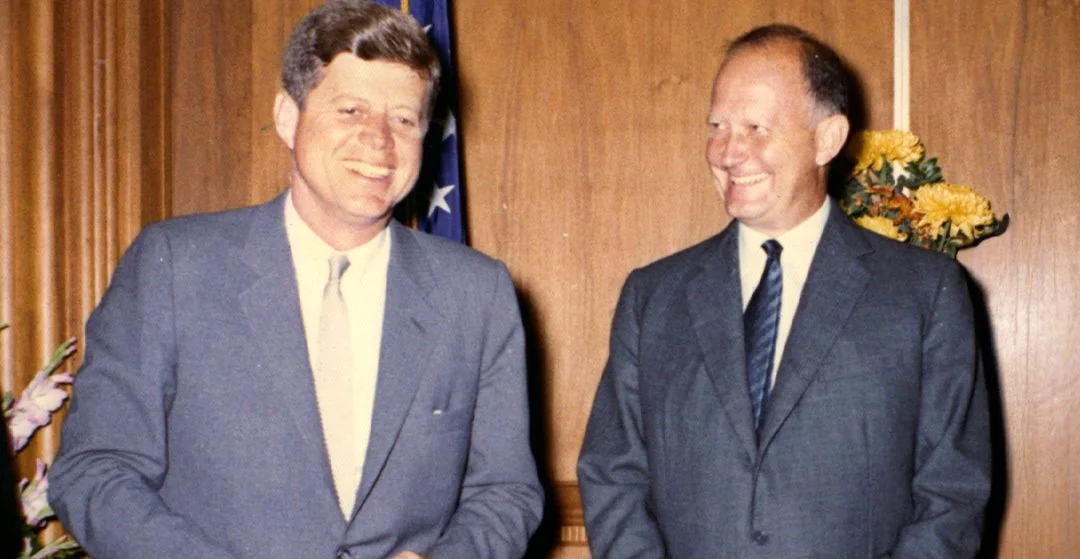
President Kennedy with his point man on tax-rate cuts, Treasury Secretary C. Douglas Dillon (JFK Library)
By Brian Domitrovic
This article appears in the Winter 2026 issue of the Coolidge Review. Request a free copy of a future print issue.
In February 1964, President Lyndon Johnson signed into law a historic tax cut. It reduced every income tax rate by about a quarter, on average. The twenty-four rates had previously ranged from 20 percent to 91 percent. Now they went from 14 percent to 70 percent. And the maximum corporate tax rate fell from 52 percent to 48 percent.
The law served as a memorial to President John F. Kennedy, who had introduced the legislation and brought it near to passage before his assassination in 1963.
“The 1964 tax bill was one of the major liberal measures of the decade,” Allen Matusow wrote in his classic history of liberalism in the 1960s, The Unraveling of America (1984). Kennedy had “entered office virtually an economic illiterate,” but by the end, thanks to the influence of professors on his economic staff, he “was practically a Keynesian.”
Matusow’s account reflects the standard historical interpretation of the Kennedy tax cut. According to this view, the tax cut was a successful experiment in “Keynesianism.” That is, the government caused an increase in consumption, leading businesses to produce more goods and employ more workers.
Yet the details of the tax cut’s conception and implementation do not accord with Keynesianism. Those responsible for the law prioritized supply. They created incentives for Americans, and especially high earners, to work more, take risks, and shift assets out of tax-protected vehicles. JFK’s marginal rate cut recalled classical priorities on taxation and sound money.
Drags on Growth
Americans had faced high income tax rates since before the New Deal. The Revenue Act of 1932, which President Herbert Hoover signed into law, took the top rate from 25 percent to 63 percent. The law also installed fifty-five graduated income tax brackets, meaning that every extra bit of income a person earned faced a higher tax rate. As the years passed, tax rates kept climbing. The top rate reached a peak of 94 percent in 1944 before settling at 91 percent in 1954.
Kennedy was clear about why he wanted to cut tax rates: they were a drag on economic growth. In his December 1962 speech before the Economic Club of New York, he said: “I am talking about the accumulated evidence of the last five years that our present tax system…exerts too heavy a drag on growth…; that it siphons out of the private economy too large a share of personal and business purchasing power; that it reduces the financial incentives for personal effort, investment, and risk-taking.”
To Kennedy, these effects—especially those decreasing the incentives for Americans to earn more—were inimical to growth. The tax system had locked the nation into economic stasis.
“Get This Country Moving Again”
The growth statistics bore out Kennedy’s view. During Dwight Eisenhower’s presidency, from 1953 to 1961, economic growth had averaged 2.5 percent per year in real terms, well shy of the pre–Great Depression standard of at least 4 percent. America experienced three recessions under Ike, including one that hit as Eisenhower’s vice president, Richard Nixon, unsuccessfully challenged Kennedy for the presidency.
During the 1960 campaign, Kennedy promised to “get this country moving again.” The Democratic platform that year targeted annual growth of 5 percent. Once in the White House, Kennedy focused on a comprehensive reduction in tax rates to achieve that growth.
Kennedy’s chief subordinate in designing and promoting the tax cut was his treasury secretary, C. Douglas Dillon. A Republican, Dillon had chaired the Wall Street firm Dillon Read. His assistant for tax policy, Stanley Surrey, joined the administration after serving as a Harvard Law professor. In the 1950s, Surrey had become a strenuous advocate for comprehensive tax-rate cuts in the name of reducing tax sheltering.
With Surrey’s help, Dillon crafted the tax-rate cut. The treasury secretary became the bill’s principal advocate when Kennedy introduced it to Congress in January 1963. In September, Kennedy’s bill passed the House of Representatives. After the assassination, Dillon stayed on as treasury secretary under Johnson. He saw the bill through passage in the Senate and Johnson’s signing in early 1964. He remained in the cabinet until April 1965, at which point the cuts had been phased in.
From 1961, the year JFK took office, through 1966, economic growth averaged nearly 6 percent per annum in real terms, more than double the growth rate that had prevailed under Eisenhower. Moreover, prices remained stable, with inflation averaging a little more than 1 percent.
As for the federal budget, it was effectively in balance as the Kennedy tax-rate cuts went into effect. The deficit in 1965 stood at just over $1 billion in a $118 billion budget. That deficit amounted to only a fifth of a percentage point of national output. In 2025, by comparison, the deficit represented nearly 6 percent of output.
Kennedy, Not Keynes
The common claim that the Kennedy tax-rate cut was Keynesian—a means primarily of increasing consumer purchases and demand, and thereby growth—finds little support in the evidence. A cut in progressive tax rates has mostly non-Keynesian characteristics.
All tax brackets benefited from Kennedy’s cuts. But of course, the effect was sharper the more money one made. Kennedy and his advisers understood that the highest earners had the greatest propensity to save or invest from marginal income, and to take risks to gain more such income. In short, stimulating consumer demand was not their primary objective. The Kennedy tax-rate cuts focused mostly on incentives, not consumption.
Consider how the law affected the highest and lowest earners. Someone in the top tax bracket had faced the 91 percent rate on the last dollar of income. Starting in 1965, that rate dropped to 70 percent. The high-income individual, in other words, now kept thirty cents of that dollar rather than nine cents, more than tripling take-home marginal income. By contrast, a person in the lowest tax bracket had paid 20 percent on the last dollar of income. When the rate dropped to 14 percent, the person kept eighty-six cents of that dollar as opposed to eighty cents.
Kennedy’s Keynesian advisers, such as Council of Economic Advisers head Walter Heller, insisted for years afterward that the Kennedy tax cut was their idea and that it followed demand-side logic. The problem with this view is that Kennedy assigned work on the tax cut to Dillon and Surrey. What’s more, the president rejected the Council of Economic Advisers’ preference for a temporary, revocable tax cut. “I am not talking about a ‘quickie’ or a temporary tax cut,” Kennedy said to the Economic Club of New York. “Nor am I talking about giving the economy a mere shot in the arm, to ease some temporary complaint.”
The Council of Economic Advisers also wanted greater cuts, on a percentage basis, for lower earners. Kennedy nixed that idea, too. His focus on rate cuts for the highest earners itself signals his emphasis on supply over demand. Top earners have a higher propensity to save and invest, and a lower propensity to consume.
On decision after decision, the president made sure the treasury perspective was the one represented in his legislation, as Larry Kudlow and I detail in our book JFK and the Reagan Revolution (2016).
Kennedy’s across-the-board marginal rate reduction was meant to ensure the individual initiative that drives economic growth.
LBJ’s ERROR: TAX HIKES TO FUND BIG SPENDING
But Lyndon Johnson understood little of the logic behind the tax-rate cut he signed in February 1964. He wanted to do away with it, and after a modest interval he made his aims clear. In his State of the Union speech of January 1966, he pledged, “I will not hesitate” to ask Congress for tax increases given his big spending on Great Society programs and the war in Vietnam. In 1968, Johnson won a 10 percent “surcharge,” a tax that applied to individuals and corporations alike.
In 1969, the year the tax increase went fully into effect, came the first recession in eight years. Inflation jumped to 6 percent. Globally, investors reacted by shunning the dollar and making the gold redemption price of $35 per ounce, which had prevailed since the 1930s, untenable. By 1972, the United States had come off the gold standard for good. Runaway inflation in the 1970s exposed Americans to bracket creep, whereby cost-of-living increases in income triggered higher tax rates. The economy sank into stagflation.
GOOD AS GOLD
Kennedy had insisted that the $35 gold redemption price was nonnegotiable. As a candidate in 1960, he vowed not to devalue the dollar. And in a 1963 address to the International Monetary Fund, he reiterated his determination “to maintain the firm relationship of gold and the dollar at the present price of $35 an ounce.”
To ensure that global holders of capital favored the dollar over gold, Kennedy and Dillon agreed that the American economy must be spirited, especially in terms of after-tax returns on investment and productive work. Kennedy thus broke a generation-old tradition of high tax rates not merely to spur enterprise and growth but also to buttress that most classical form of monetary systems, the gold standard.
Once Kennedy’s tax-rate cuts went into effect, the dollar held sound against all metrics. Consumer prices remained steady, the federal budget went within a rounding error of balance, and the U.S. economy experienced sustained growth that we have not seen consistently in the sixty years since.
Despite what so many historians insist, America’s incredible mass prosperity in the early and mid-1960s had little to do with Keynesianism.
Brian Domitrovic is the Richard S. Strong Scholar at the Laffer Center. He is the author or coauthor of several books, including JFK and the Reagan Revolution, Econoclasts, and, most recently, Free Money: Bitcoin and the American Monetary Tradition.

This article appears in the Winter 2026 issue of the Coolidge Review. Request a free copy of a future print issue.