
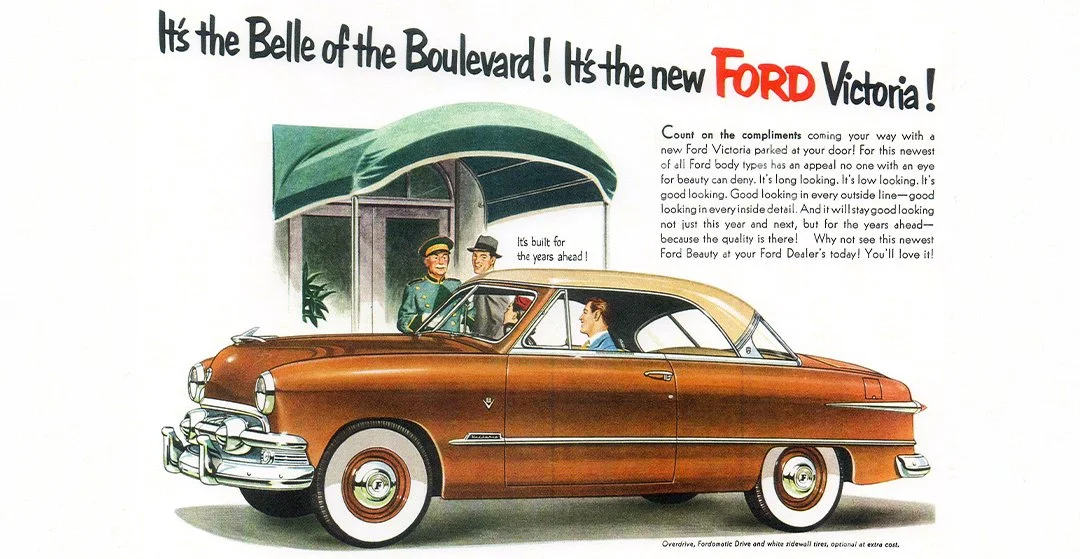
Like many other parts of the 1950s, cars of that era evoke nostalgia—though the reality is that we’re far better off today
By John H. Cochrane
This article appears in the Winter 2026 issue of the Coolidge Review. Request a free copy of a future print issue.
When was the best year for the U.S. economy?
Many people say it must fall sometime in the 1950s, when, as the fable goes, the economy was growing robustly, manufacturing was strong, there were good union jobs for not very skilled people, and a man (sorry, it was a man) could buy a house and support a family on such a job.
Not so fast.
Look at standards of living. Real gross domestic product per capita sat below $19,000 in 1955. In 2025 it approached $69,500. These figures are expressed in 2017 dollars, thus accounting for inflation. They show that the average American is about 3.7 times better off today than in 1955. It’s not even close.
Yes, GDP grew faster in the 1950s. Real GDP per capita grew 28 percent from 1949 to 1959, and only 18.3 percent from 2009 to 2019. Slowing growth is a major economic problem today. Be that as it may, you eat levels, not growth rates. We might not be getting even better off as fast as we were then, but we’re still 3.7 times better off.
How about jobs? In August 2025, 163 million people were employed in the United States; in August 1955, 63 million. In other words, America created 100 million jobs over those seven decades. This growth occurred even as manufacturing shrank and machines took over. People found better—and better-paying—jobs. Has any evangelist for union jobs of the 1950s considered how dirty, dangerous, and mind-numbing it was to work on an assembly line? In 2025 the unemployment rate, the fraction of workers looking for a job, stood at 4 percent, just about what it was in the 1950s and what economists think of as a normal labor market.
The great 1950s union labor market was great only if you were a white man, and usually one with connections. Women, African Americans, other minorities, and immigrants faced bleak prospects. One of the great achievements of the U.S. economy since the 1950s has been to expand the labor force as well as opportunities for high-paying jobs. Civil rights, the emancipation of women, and the increasing acceptance of gays, foreigners, Catholics, and Jews (not so true in the 1950s)—these are nothing to sneeze at. The unions made good jobs for white men, relative to other jobs at the time, in part by excluding others.
What about those easy-to-buy houses? The average house in the 1950s was about 1,000 square feet. The famous Levittown houses were 750 square feet. Today, the average house is about 2,500 square feet, even though the average number of people in it declined from 3.4 in 1950 to 2.5 in 2024. People are choosing larger and better homes.
To men of my age, 1950s cars evoke nostalgia. But they were awful, unsafe rust buckets compared to today’s boring SUVs.
The Myth of an Egalitarian Utopia
GDP isn’t everything, though it is a lot. Was health care cheaper in the 1950s? Yes, though for many diseases, including heart conditions and cancer, treatment then consisted of asking whether you wished to see a priest, a minister, or a rabbi to send you off to the next world. Life expectancy at birth has increased by a full decade, rising from 65.6 to 75.8 for men and from 71.1 to 81.1 for women.
Pollution in the 1950s was atrocious, especially in those industrial areas so beloved by nostalgic left-wing professors. The fraction of people living in extreme poverty has plummeted, even as the goalpost keeps moving. And we all benefit from nearly free technological marvels undreamed of in the 1950s. Most homeless people have cell phones.
Our prosperity is, in fact, widely shared, though the inequality warriors would have you believe otherwise. Most research on income inequality doesn’t account for taxes and transfers, especially in-kind transfers. Consumption inequality is much lower than income or wealth inequality, and has expanded a good deal less. You just can’t have that many vacation homes. Wealth inequality largely consists of high stock market values in a low-interest-rate environment. Just how much social harm is Elon Musk’s huge holding of Tesla stock doing, remaining invested in the company and producing cars?
Some observers regard the 1950s as a sort of egalitarian utopia because the rich faced high tax rates. Yes, the highest federal income tax rate stood at 91 percent for most of the decade. But people confronted with sky-high tax rates go talk to their lawyers fast. Even the far-left economists Thomas Piketty, Emmanuel Saez, and Gabriel Zucman found that the top 1 percent of American households paid on average 42 percent of their income in taxes in the 1950s. Six decades later, at a time of supposedly stark inequality, that number had fallen only slightly, to 37 percent.
These figures account for all forms of taxes. In the 1950s, the top 1 percent paid, on average, an effective rate of just 16.9 percent in federal income taxes, as the Tax Foundation documents. How could they pay so little when the top federal tax rate reached 91 percent? The answer is: loopholes—many, many loopholes. Celebrities incorporated themselves and bought oil wells for the write-offs.
Misplaced Nostalgia
Much has changed since the 1950s, of course. There was no federal food-stamp program in the 1950s; as of 2024, more than 41 million Americans received supplemental nutrition assistance. Back in the 1950s, there was no Medicare, Medicaid, or Obamacare. Social Security benefits were much less generous. Today, a homeless person in San Francisco can receive cash payments of up to $714 per month. Depending on your perspective, this expansion of the welfare state may strike you as great progress or perhaps an area of concern, given the large increase in healthy adults who do not work.
Public schools and state universities of the 1950s were arguably much better than they are today. In the 1950s, only about one in twenty children was born out of wedlock; by 2023, 40 percent of births were to unmarried women. Meanwhile, the overall birth rate has plummeted. The failure to build public infrastructure makes life unpleasant in many ways, especially in cities beset by problems of traffic, parking, and basic livability.
So yes, we have troubles. But would you turn back the clock? No way. The 1950s was not Grease.
When was the best year for the U.S. economy? The answer: 2025. With 2024 a close second.
John H. Cochrane, an economist specializing in financial economics and macroeconomics, is the Rose-Marie and Jack Anderson Senior Fellow at the Hoover Institution. His Substack is The Grumpy Economist.

This article appears in the Winter 2026 issue of the Coolidge Review. Request a free copy of a future print issue.