
The Outsider Who Took on FDR
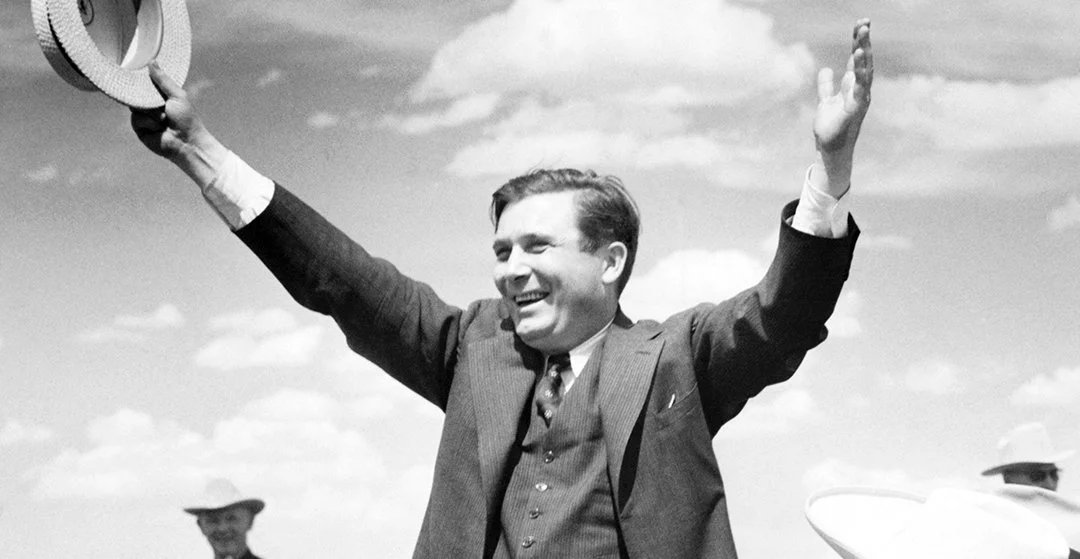
On the campaign trail in 1940, Wendell Willkie makes his case against Roosevelt’s New Deal
(Alamy)
By Senator Todd Young
This article appears in the Summer 2026 issue of the Coolidge Review. Request a free copy of a future print issue.
On a September evening in 1940, a torchlight parade marched through the streets of Rushville, a small town in east-central Indiana. Led by the local high school band and accompanied by an elephant named Meena, thousands of well-wishers arrived at the Baltimore & Ohio Station and gathered to hear a Hoosier speak from the rear platform of a railcar.
The speaker wasn’t just any Hoosier. He hailed from Rushville himself. And he was the Republican Party’s nominee for president.
Wendell Willkie was launching his campaign for the White House, about to depart on a journey to America’s Pacific Coast that would see him traverse more than seven thousand miles.
From the platform at Rushville, Willkie discussed his opponent, President Franklin D. Roosevelt.
The Republican candidate denounced Roosevelt’s class war, which he called a doctrine of “economic sabotage.” The greatest compliment Willkie could give the president was: “He does not understand the laws of economics, government finance, or the forces at work in the world today.”
With that, fireworks streaked in the sky, spelling out two phrases.
The first: “God Bless America.”
The second: “Win with Willkie.”
An Unlikely Republican
We spend a great amount of time discussing the presidency and the men, no matter how obscure, who have held the highest office in the land. But we can also learn from some of the people who hoped to win it but never did. Chief among them is Wendell Willkie.
Willkie was not your run-of-the-mill Republican. His parents were both lawyers, and it was said that the Willkie family’s library in his hometown of Elwood was the best in Indiana. His father, Herman, read Shakespeare to young Wendell before bed.
Herman Willkie was a progressive supporter of William Jennings Bryan. As a student at Indiana University, Wendell was a leftist himself. He was a delegate to the 1932 Democratic National Convention and eventually supported FDR.
How, then, did Willkie come to run against Roosevelt eight years later?
In part because he left Indiana, launching a successful corporate career. Willkie served as a lawyer for Firestone in Akron, Ohio—where, it should be noted, he fought to keep the Ku Klux Klan off the city’s school board. Then he moved to Manhattan, where he became counsel and then president of Commonwealth and Southern, a utilities holding company.
By the end of the 1920s, utilities had electrified cities, replacing kerosene lamps with electric lights. Amity Shlaes has called it a “miracle industry.”
But as the decade ended, the stock market crashed. The Great Depression came, and, in 1933, FDR arrived in the White House. An era of “bold, persistent experimentation” began. The primary subject of this experimentation was business.
And New Dealers singled out one business for torture: utilities. The Justice Department pursued utility leaders in court, Congress passed legislation to divide up their companies, and the government directly competed with utilities by establishing the Tennessee Valley Authority and Rural Electrification Administration.
Willkie at first assumed he could work with government. His negotiations with David Lilienthal, one of the TVA heads, disabused him of this idea. So did clashes with Roosevelt in the White House.
“Mr. Willkie, I am one of your customers,” the president said during one meeting.
“We give you good service, don’t we?” Willkie replied.
As time passed, the New Deal experimentation grew more radical, and Roosevelt doubled down on his assault on American businesses. In many instances, the Supreme Court sided with the experimenters. So Willkie’s Commonwealth and Southern eventually surrendered and sold part of itself to the TVA.
But Willkie, now a Republican, wouldn’t be silenced.
In 1938 he appeared as a guest on the national radio program America’s Town Meeting of the Air. He used the opportunity to speak out against the New Deal. Willkie told listeners, “For several years now we have been listening to a bedtime story.” The New Dealers, he said, have been “telling us that the men who hold office in Washington are, by their very positions, endowed with a special virtue, that they are men of far vision and of exceptional ability and character.”
Willkie had previously called the TVA “the most useless and unnecessary of all the alphabetical joy-rides.” He also quipped that the federal government’s Tennessee Valley program “waters five states and drains the nation.”
No other foe of the New Deal had spoken so powerfully on behalf of economic freedom as Willkie. And none warned so eloquently about the dangers of reckless government intervention.
A Voice for Free Enterprise
As Willkie shared this message, he gained traction. A former Democrat who had never held elective office, he became a dark horse candidate for the 1940 Republican nomination. A surge of support at that summer’s party convention—“We Want Willkie,” demonstrators chanted—earned him the GOP nod.
During the fall campaign, Willkie argued that free enterprise, not central planning, would revive America’s fortunes. The first brought prosperity. The second amounted to “government above the people, without the people, and despite the people.”
Willkie moderated his stance over the course of the election, even declaring his support for a New Deal institution, the National Labor Relations Act. Still, he presented a clear alternative to FDR. He argued against the New Deal’s class warfare and burdensome government programs. He argued for freedom, opportunity, and individualism.
Country Before Party
Willkie’s message did not carry the day, but it won over millions of Americans. In an election he lost, he received more votes than any Republican before him, even Herbert Hoover in 1928. He ran more than eight percentage points better than 1936 GOP nominee Alf Landon, who had offered voters a watered-down version of the New Deal. Willkie brought debate back to the center of American life.
More than that, Willkie demonstrated statesmanship. By the summer of 1940, Britain stood alone in the fight against Nazi Germany. The Neutrality Acts forbade the United States from exporting weapons to a nation at war, but President Roosevelt devised a plan to get American destroyers to Britain in exchange for British naval bases. Roosevelt’s advisers understood that the deal could hurt him in the election, given widespread isolationist sentiment. So FDR reached out to Willkie through intermediaries, trying to get his opponent’s support for the deal. The GOP candidate indicated that he favored sending the ships, though he said he wouldn’t lobby congressional Republicans on the president’s behalf. FDR felt “reassured that Willkie would not make the destroyer-bases deal a major campaign issue,” writes historian David M. Kennedy.
Despite pressure from isolationist elements of his party, Willkie did not publicly condemn sending ships to Britain. The GOP nominee did, however, criticize the method FDR used to make the deal. When the president first sought Willkie’s endorsement, he had said he would work with Congress. But Roosevelt ended up making the trade by executive order.
After the election, Willkie supported Lend-Lease, another Roosevelt program that provided much-needed aid to Winston Churchill and cash-strapped Britain. Willkie’s statesmanship afforded Roosevelt the opportunity to fortify America’s allies, build the arsenal of democracy, and eventually save Western civilization.
These positions cost Willkie, angering some people in his own party. He sought the Republican presidential nomination again in 1944 but proved an also-ran.
A Hoosier Makes History
As Willkie stood on that train platform in September 1940, he told his fellow townspeople, “I am coming back to Rushville, and I think I will come back as president of the United States.”
This did not come to pass, of course. But something else Willkie said from the back of that train stays with us. He told the crowd, “It has come to the lot of a boy born in Indiana to carry the burden which may result in changing the course of the history of mankind.”
Wendell Willkie did change that course, by changing the discourse. With Willkie’s commonsense words ringing in their ears, Americans after World War II showed less tolerance for the kind of extreme anti-business policies they had accepted during the Depression.
And we should be forever grateful for that.
Todd Young is the senior U.S. senator for Indiana. A graduate of the United States Naval Academy, he earned an MBA from the University of Chicago, a master’s degree from the University of London’s School of Advanced Study, and a law degree from Indiana University.
This article appears in the Summer 2026 issue of the Coolidge Review. Request a free copy of a future print issue.