
The Man Who Stopped Harry Truman
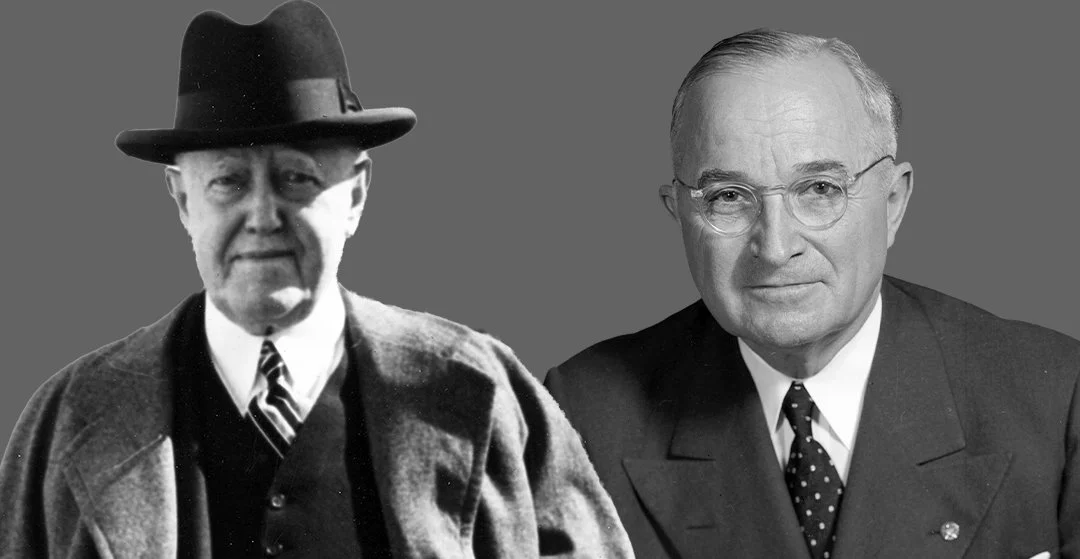
John W. Davis (left) challenged his fellow Democrat Harry Truman at the Supreme Court
By Garland S. Tucker III
This article appears in the Summer 2026 issue of the Coolidge Review. Request a free copy of a future print issue.
The Great Depression changed the American economic system. The reason for the change was not so much the economic challenge of the downturn as the federal government’s response to it: intervention. Few foresaw the Depression’s depth or duration, or accurately diagnosed the causes. Shockingly few credible figures maintained pressure on the government throughout. One who did was a brilliant attorney who happened to be a lifelong Democrat. The man’s name was John W. Davis.
The government’s economic interventions began with a Republican, Herbert Hoover. Under President Hoover, the successor to Calvin Coolidge, deficit spending soared. Davis argued that Hoover “made an unprecedented departure when he assumed that the National Government is charged with the responsibility of the successful operation of the country’s economics and the maintenance of a satisfactory standard of life for all classes in the nation.” Davis added, “Nothing but mischief…can come from any government attempting tasks which lie beyond its power to accomplish.”
Because Hoover was a Republican and Davis had been the Democratic nominee for president in 1924, observers then and later wrote off the critique as one party leader sniping at the opponent. This perception was false, however. Davis spoke out of conviction, not partisan politics. For above all Davis was a Jeffersonian, a believer in limited government.
Davis’s Jeffersonian wing of the Democratic Party remained strong enough in 1932 that even Franklin Roosevelt campaigned on promises of a balanced budget and fiscal responsibility.
The day after Roosevelt’s 1933 inauguration, Davis published an essay in the New York Times. In it he warned: “The world is in more danger of being governed too much than too little…. A centralized and distant bureaucracy is the worst of all tyranny.”
“Wild Reach for Governmental Power”
It soon became clear to Davis that Roosevelt did not share this philosophy and would reach far beyond anything Hoover had imagined. FDR exhibited little concern for the value of private property. The Roosevelt administration quickly confiscated private gold under the spurious contention that the confiscation would help rebalance the monetary system.
Davis saw what was happening, and what would happen in the future. In late 1933 he wrote that his party’s prize project, the New Deal, represented a “wild reach for governmental power and a dream of a regimented economy under the control of a super state.” He went public with his opposition, helping found the American Liberty League to oppose New Deal excesses. Though he remained a Democrat, he endorsed Roosevelt’s 1936 opponent, Republican Alf Landon.
Landon lost, but Davis persevered. The former solicitor general of the United States had a weapon: the courts.
Davis argued against such New Deal measures as the Frazier-Lemke Act, the Public Utility Holding Act of 1935, the original Agricultural Adjustment Administration, and the National Labor Relations Act. Six times he represented corporations or individuals in tax cases. He also challenged the constitutionality of government regulations affecting electric utilities, oil companies, and railroads. In three cases he defended corporations against antitrust charges.
Small wonder that inside FDR’s White House, Davis became known as “Public Enemy Number One.”
After FDR died, his policies continued under the next president, Harry Truman. Davis again turned to the law to halt the worst of the government interventions. The result was one of the most important chapters in U.S. constitutional history.
Truman Oversteps
In 1951, Truman faced a problem. Collective bargaining between the nation’s steel companies and labor unions had reached a stalemate. With America at war in Korea, the president feared that a strike could deprive the military of critical matériel and disrupt price stability at home.
Truman had an available remedy: he could prevent a strike by invoking the emergency provisions of the Taft-Hartley Act. But Truman opposed this legislation, which limited the New Deal Wagner Act by curtailing the power of labor unions. Taft-Hartley had passed over Truman’s veto in 1947.
So the president sought another way to shut down a strike.
In April 1952, Truman announced that he was seizing control of the nation’s steel mills. Legally, the action was unprecedented. A president was seizing private property without congressional authorization. In spirit, however, seizing the mills was very much in keeping with the New Deal: using an emergency as license for property seizure.
Truman thought he could get away with the action. As historians later revealed, he privately consulted the chief justice of the United States before the seizure. Truman had appointed Fred M. Vinson to the Supreme Court in 1946. The two men had been friends for years, and Truman had made Vinson his treasury secretary before elevating him to the Court. Vinson assured Truman that seizing the steel mills was constitutional. The chief justice’s private advice on a matter likely to come before the Supreme Court was, by the way, “altogether irregular and improper,” as one legal historian writes.
Truman miscalculated. Several members of Congress introduced resolutions to impeach the president. Lawmakers from both parties denounced executive overreach and warned of a shift toward dictatorship. Senator Pat McCarran of Nevada, another Democrat, said that if the government could simply take over an industry, “then we have lost the democracy that we have long loved.”
As counsel to U.S. Steel and special counsel to Republic Steel, Davis had already delivered his private legal opinion: “There is not the slightest doubt that the President’s action is…without legal warrant—constitutional or statutory. It is an act of pure usurpation.”
The Supreme Court soon agreed to hear the steel companies’ case against the Truman administration, which became known as Youngstown Sheet & Tube Co. v. Sawyer. The steel industry’s battery of lawyers selected Davis alone to argue before the Court.
At the time, Davis was seventy-nine years old. But he had the knowledge and the record to try the case. By that point he had argued 138 cases before the Supreme Court, more than any other modern American lawyer. The fact that the steel industry’s attorneys chose Davis to represent them signaled the reverence in which his peers held him.
On May 12, 1952, clad in his traditional formal morning suit, Davis rose before the Supreme Court. He spoke for eighty-seven minutes, arguing that President Truman had violated the Constitution by claiming powers that the executive did not possess. The steel seizure, Davis said, represented a “reassertion of the kingly prerogatives which have been the foundation of every struggle against sovereignty that has existed in Anglo-Saxon history.”
As he concluded, Davis invoked Thomas Jefferson to remind the justices that even the holder of the nation’s highest office remained subject to constitutional limits: “In questions of power, let no more be said of confidence in man, but bind him down from mischief by the chains of the Constitution.”
One news reporter covering the Youngstown case wrote that Davis seemed to “personify the spirit of constitutionalism,” and that his “voice might have been that of history itself.”
Immutable Principles
Given the case’s urgency, the Supreme Court delivered its ruling in only three weeks. Chief Justice Vinson’s advice to Truman proved mistaken. By a vote of six to three, the Court struck down the president’s seizure of the steel mills.
The Youngstown decision was a landmark ruling. The case remains a staple of law school curricula and is still cited in judicial opinions. The decision reinforced what Davis called “immutable” constitutional principles: the federal government is “one of limited and granted powers,” “ours is a government of laws and not of men,” and life, liberty, and property “are all alike protected from seizure without due process of law.”
In the decades since Youngstown, all three branches of government have at times tested or exceeded the limits of their constitutional authority. But outright seizures of entire industries became taboo, even for progressive politicians.
Davis changed the course of history. He showed that party mattered less than principle. In his final years, after Youngstown, Davis told the novelist John Dos Passos that he was unwilling to “concede defeat of the Jeffersonian principles.” He acknowledged that this refusal had rendered him a “Democrat in exile.”
We don’t know about Davis’s feat in Youngstown because he also defended school segregation in a companion case to Brown v. Board of Education. But he did so not out of bigotry but rather on the basis, again, of a principle: the rights of local and state governments under the Constitution.
Davis’s New Deal arguments endure as a reminder and a warning. He articulated why unchecked government power threatens individual liberty and undermines the conditions necessary for a free and prosperous society.
Garland S. Tucker III, a longtime Coolidge Foundation trustee, is the author of 1924: Coolidge, Davis, and the High Tide of American Conservatism.
This article appears in the Summer 2026 issue of the Coolidge Review. Request a free copy of a future print issue.