
How America Prospered Before the Income Tax
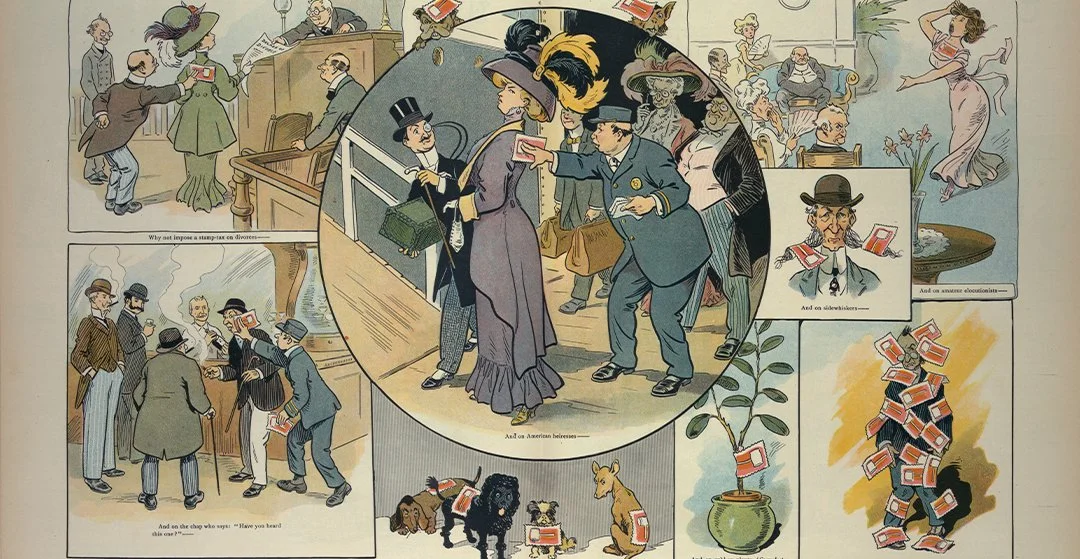
“Uncle Sam’s Income,” a 1909 cartoon from Puck magazine
By John Tillman
This article appears in the Summer 2026 issue of the Coolidge Review. Request a free copy of a future print issue.
Taxing labor has deterred American growth and prosperity. It has exacerbated income inequality. Most importantly, it is immoral.
Ratified in 1913, the Constitution’s Sixteenth Amendment enabled the federal government to levy an income tax. That amendment should be repealed. It conflicts with the Thirteenth Amendment, which bans slavery and involuntary servitude. When you work until May every year to pay off your burden to the government, you are in a form of involuntary servitude.
Repealing the federal income tax would unleash the ability to save, invest, and build. It would restore individual sovereignty by allowing Americans to keep the full fruits of their labor.
It would also unleash capital formation throughout the economy. Every business startup needs capital to fund growth. Before the Sixteenth Amendment, Americans saved much more of their income. The average savings rate in the nineteenth century was somewhere between 10 percent and 14 percent; today the rate is about 4 percent to 7 percent.
Without an income tax, savings drove capital formation. A hardworking, ambitious person could save enough money to start a business. My grandfather came to this country in the early 1900s and worked as a dishwasher in a restaurant. Within a few years, he had saved enough to open his own Greek restaurant. Eventually he owned several restaurants.
The income tax makes it much more difficult to accumulate the capital necessary to start a small business. America still leads much of the world in capital formation, but imagine what the country might look like had the Sixteenth Amendment never been adopted. Income taxes limit people’s ability to save and invest in their future, their family’s future, and their community’s future.
The income tax system also makes it harder for working-class and poor people to climb the economic ladder. Rising marginal tax rates are known as “progressive,” but they’re actually regressive. By taxing additional earnings at higher rates, the system punishes those who apply themselves. The progressive system is a deterrent to reducing income inequality.
Our Pre-Tax Eden
Look at the late 1800s and the early 1900s, when there was no federal income tax to interfere with capital formation.
On December 17, 1903, the Wright brothers achieved the first powered flight. How did Wilbur and Orville Wright fund their experiments? By selling bicycles.
In 1892 the brothers formed the Wright Cycle Company. Initially they repaired and resold other people’s bicycles, but soon they began selling hundreds of different bike models and component parts. Being amateur engineers and designers, they built their own bikes and started selling them in 1896. They funded this expansion from positive cash flow.
The brothers proved to be innovators. They refined bicycle design, engineering, and manufacturing through their relentless pursuit of improvements. They developed wooden handlebars that better absorbed the bumps of rutted, unpaved roads. They added springs under seats and leaf springs on front wheels for greater comfort. They sealed wheel-bearing hubs to keep out dust and dirt, improving performance and durability.
The Wright brothers also became fascinated with flight. They studied birds, designed gliders, and built powered aircraft using engines of their own construction. And they financed all of it with the profits from their bicycle business.
Meanwhile, Samuel Langley—the politically connected secretary of the Smithsonian Institution—received a $50,000 grant from the federal government to develop an airplane. Many others were racing toward powered flight, too. But the ones who got there first were these obscure, self-funded bicycle makers from Dayton, Ohio. The Wright brothers succeeded through ambition, curiosity, and perseverance.
Imagine the Wright brothers operating under today’s marginal tax rates. Could they have self-funded years of research, design, and manufacturing to produce the first successful airplane? Probably not.
Yet their achievement transformed the world. The brothers formed a successful airplane manufacturing company. Wilbur led the firm until his death in 1912, and Orville eventually sold the business. After several corporate iterations, the enterprise still exists today. The Curtiss-Wright Corporation makes high-end parts in defense, aerospace, and heavy industries. The company makes nearly $3.5 billion in annual revenue.
In other words, the seed capital from the pre-income-tax era still shapes our world more than a century later. Part of America’s national defense rests on a company the Wright brothers founded.
Reinvesting Profits, Exponential Expansion
While entrepreneurs like the Wright brothers drew capital from their own profits, many others raised outside money to launch their businesses.
Consider Henry Ford. In the 1890s Ford worked as an engineer for the Detroit Edison Company, where he met Thomas Edison. The great inventor encouraged Ford’s experimentation with gasoline-powered automobiles, including a design known as the “Quadricycle.”
In 1899 Ford started the Detroit Automobile Company with backing from a wealthy lumber merchant. After leaving that business, he started a new venture in late 1902 with coal dealer Alexander Malcomson. Together, Ford and Malcomson raised $28,000 by selling stock in what became Ford Motor Company.
The business flourished with the introduction of Henry Ford’s inexpensive Model A automobile. The company earned a quarter-million-dollar profit in its first year and paid a 100 percent stock dividend to early investors. Ford and Malcomson reinvested profits into the business.
Ford Motor Company went on to revolutionize transportation and manufacturing through innovation and cost reduction. It also employed tens of thousands of people, providing generous wages.
Now imagine if Ford’s silent partner had been the federal government, taking a big chunk of those profits through taxes. Ford and Malcomson would have had far less capital available for reinvestment and expansion.
Today, Ford Motor Company generates nearly $190 billion in annual revenue and employs hundreds of thousands of people worldwide.
Unleashing American Capital
How does capital formation work today, when federal and state income taxes, payroll taxes, sales taxes, and property taxes all drain the resources available to start and grow a business?
Outside funding has become much more prominent. Angel investors and venture capitalists now put billions behind entrepreneurs and their ideas. But even with a progressive tax structure, most small business startups still begin the way Orville and Wilbur Wright did: through personal savings.
It’s just harder to do so now. I know from experience.
In the late 1980s I was making good money. Having grown up poor, I enjoyed spending it. One day, though, I realized that this lifestyle was unsustainable. I decided to save aggressively to start a business. I sold my car, moved into a basement apartment with a roommate, and reduced my monthly spending to $800.
At the time, the marginal tax rate stood at 28 percent. Over four years, I saved the equivalent of $357,000 in today’s dollars. But had the tax rates from the time of Henry Ford and the Wright brothers existed, I could have saved $566,000.
Instead, the federal and state governments became my business partners. They took roughly a third of my income, delaying my ability to launch and grow my business.
High marginal rates didn’t just hurt me. They also hurt government revenue. Why? Because within eighteen months of my company’s founding, my employees paid far more in federal taxes in a single year than I had paid during the four years while I was saving to start the business. And the tax revenue from the company’s employees went up every year.
That’s why cutting marginal rates creates growth in federal revenue: successful businesses create more taxpayers.
Ultimately, though, the best solution is to repeal the Sixteenth Amendment altogether. That may seem politically impossible. But remember, many policies and legal changes now taken for granted would have seemed unimaginable just a decade or two ago.
John Tillman is a leading voice for free-market ideas. He is the CEO of the American Culture Project and the founder and CEO of Hall of Giants, a cultural initiative dedicated to celebrating entrepreneurs and their role in advancing the human condition.
This article appears in the Summer 2026 issue of the Coolidge Review. Request a free copy of a future print issue.