
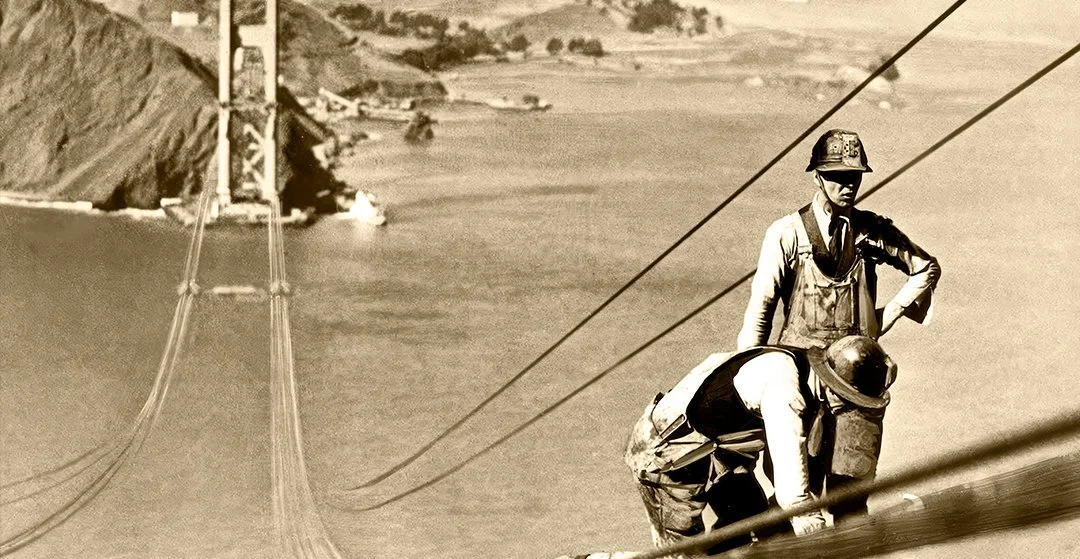
Two construction workers on the Golden Gate Bridge, 1935
(San Francisco Public Library)
By Alexander J. Field
This article appears in the Summer 2026 issue of the Coolidge Review. Request a free copy of a future print issue.
The 1930s, the years of the Great Depression, are remembered for double-digit unemployment, breadlines, and bank runs. Few realize that this was also the most technologically progressive decade of the twentieth century.
Against the backdrop of the Great Depression, U.S. productivity improved dramatically, leaving the economy’s potential output far higher in 1941 than it had been in 1929.
This finding challenges the standard macroeconomic history of the United States. It leads us to rethink the connections between the 1930s, mobilization for the Second World War, and postwar prosperity.
Why Productivity Surged
Why did productivity improve in the 1930s?
Productivity should not be confused with production. Production measures output, whereas productivity measures output relative to inputs.
Labor productivity is output per worker or per hour, and its level governs our material standard of living. Total factor productivity measures output relative to a combined index of labor and physical capital services—the flow of services from equipment and buildings. Growth of total factor productivity offers a rough measure of how fast a society’s scientific, technological, and organizational knowledge improves.
Labor productivity increases when total factor productivity goes up. It also rises when physical capital services grow faster than labor hours.
Between 1929 and 1941, both labor and total factor productivity in the private nonfarm sector increased at a compounded rate of almost 3 percent per year. That was the main cause of the large rise in actual and even larger rise in potential output.
In most other eras, growth in output also reflects increased availability of inputs—more worker hours, more physical capital. But private-sector input growth was effectively absent between 1929 and 1941.
What, then, accounts for such a large increase in U.S. productivity during this era? I identify three main contributors.
First, U.S. factories completed the shift to electric power. Most of this transition had occurred in the 1920s, and it allowed a complete redesign of the American factory. Out were the overhead shafts and belts that were the signature of the nineteenth-century factory. In were small fractional-horsepower electric motors and single- rather than multiple-story industrial buildings. The shift to the use of electricity for the internal distribution of power brought huge leaps in manufacturing productivity across the board.
Second, during the 1930s the United States significantly increased spending on research and development. R&D employment stood at 6,274 in 1927. By 1933, after four of the worst years of the Depression, it had climbed to 10,918. And in 1940, after another seven years of double-digit unemployment, that number stood at 27,777. The private sector both refined existing products and developed new ones. Wallace Carothers, a Harvard chemistry professor recruited by DuPont, invented nylon. Meanwhile, Philo T. Farnsworth—backed by venture capital—developed the technology that would become the signature new consumer product of the postwar era: television.
Third, the country built out its public infrastructure. The 1930s brought the opening of the U.S. route system; the first controlled-access highways, such as the Pennsylvania Turnpike; and hundreds of municipal airports. New York built LaGuardia Airport and, with New Jersey, the George Washington Bridge and Lincoln Tunnel. California built the Golden Gate and San Francisco–Oakland Bay Bridges. The decade also witnessed massive hydroelectric and flood control projects like the Hoover and Grand Coulee Dams. These public investments created new opportunities for entrepreneurs in many sectors of the economy, especially in transportation and distribution.
Manufacturing benefited from large productivity increases in the 1920s and slower but still impressive advances in the 1930s. During the Depression years, much of the rest of the economy experienced productivity growth. Improvements were notable in communications, wholesale and retail distribution, aircraft and other advanced manufacturing sectors, and electrical and chemical engineering. If you were a chemist or an engineer during the Depression, you kept your job, unlike construction workers, for example.
Wartime Mobilization
It is commonly and correctly understood that the Second World War ended the Depression in this sense: the huge increase in government spending closed the persisting gap between actual and potential output. But the conventional wisdom also holds that mobilization for the war laid the foundations for the golden age of U.S. economic growth: 1948–1973. According to this line of thinking, the U.S. economy learned by doing as it produced military durables like Liberty Ships and B-24 bombers, and that learning improved productivity in the postwar period.
Here some corrections are needed.
If the learning narrative held true, we should expect industrial productivity to have improved during the war years. In fact, productivity in manufacturing plummeted between 1941 and 1945. It improved somewhat between 1945 and 1948, but when we compare 1941 and 1948—a peacetime-to-peacetime measure—we see that from the standpoint of productivity advance, the war was a detour.
The main reason is that economic mobilization forced a sudden, radical, and ultimately temporary change in the product mix, requiring manufacturers to shift from making goods in which they had a great deal of experience to those in which they had little. Learning only partially and temporarily compensated, and most of the knowledge the United States gained during the war was specific to products that we ceased making shortly after VE or VJ Day.
The United States also experienced other supply shocks during the war. In 1942 the Japanese imposed a damaging rubber famine when they overran the supposedly impregnable fortress of Singapore and took over all Southeast Asian exporting sites for natural rubber. America lost access to 97 percent of its supply of a strategic material for which it had effectively no domestic sourcing. Similarly, German U-boats shut down the fleet of 250 tankers that brought petroleum and petroleum products from East Texas and Louisiana to the Eastern Seaboard, responsible for 40 percent of U.S. consumption.
We tend to think that once Pearl Harbor was attacked, the United States quickly moved to operating 24 hours a day, 365 days a year. The reality was that businesses often had to halt or delay production owing to shortages—of raw materials, subassemblies, goods such as heat exchangers, and, by mid-1943, labor. These shortages led to producer hoarding, which made the situation worse.
The war was indeed a triumph of production. The U.S. manufactured more than 300,000 piston-driven aircraft between 1940 and 1945, a feat we will never replicate. But it was not a productivity triumph. The United States was able to meet the demands of war production as well as it did in part because potential output had increased so much during the 1930s.
The Myth of War-Built Prosperity
In 1948 the United States stood astride the world like an economic colossus. But it’s an illusion to attribute this status primarily to learning during the war.
The large productivity advantage America enjoyed in manufacturing was already evident in 1941, reflecting prewar learning in the making of cars, refrigerators, and a wide range of other goods.
Between 1941 and 1945, America’s productivity advantage over other countries widened, but this mainly reflected damage to other nations that the United States largely escaped. In Japan, almost every city—not just Hiroshima and Nagasaki—was devastated by firebombing. Germany suffered massive destruction in cities such as Hamburg and Dresden. Britain had to liquidate its overseas economic empire to pay for the war, and the Soviets lost twenty million people. During the three decades after the war, what the French call Les Trentes Glorieuses, the OECD countries mostly closed this productivity differential.
The years of the Great Depression proved disastrous for millions of Americans, but they helped the United States become the arsenal of democracy, supplying its own armed forces as well as those of its allies. Growth during the prewar period also provided the foundations for American postwar leadership, as well as the country’s economic advance in the 1950s and 1960s.
Alexander J. Field is the Michel and Mary Orradre Professor of Economics at Santa Clara University. Dr. Field is the author of several books, including A Great Leap Forward: 1930s Depression and U.S. Economic Growth and The Economic Consequences of U.S. Mobilization for the Second World War.

This article appears in the Summer 2026 issue of the Coolidge Review. Request a free copy of a future print issue.