
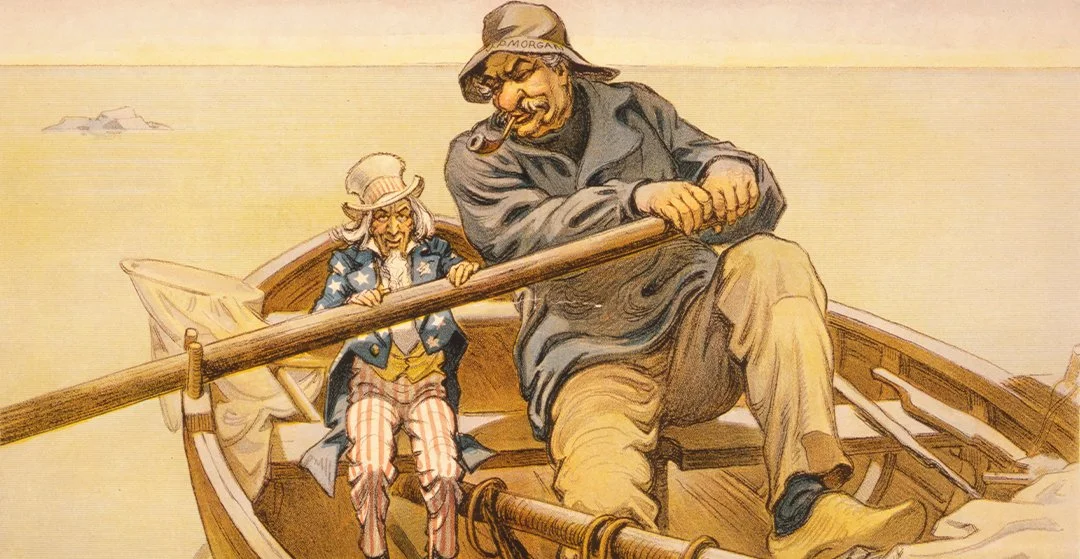
J. P. Morgan lends Uncle Sam a hand
(Puck magazine, Library of Congress)
By Robert F. Bruner
This article appears in the Summer 2026 issue of the Coolidge Review. Request a free copy of a future print issue.
In October 1907, the financier J. P. Morgan was in Richmond, Virginia. He was there to attend a conference of the Episcopal Church, of which he was a senior benefactor and a church leader. But then he received word from his partners to hasten back to New York City. A failed stock market speculation had led to the collapse of two brokerage firms and runs on several trust companies and banks.
Morgan got the call because he was a rescuer, a fixer. He had resolved many bankruptcies and had even found a way to fund the federal government during a financial crisis twelve years earlier.
By 1895, the U.S. Treasury’s gold reserve had plummeted. An 1890 law had committed the government to redeeming the Treasury’s silver certificates in gold coin at a rate of sixteen ounces of silver to one ounce of gold. When rising silver production led to a decline in the price of silver relative to gold, speculators saw an arbitrage opportunity: buy silver on the market and exchange it for gold at the U.S. Treasury.
It was Morgan who reminded President Grover Cleveland of a law that permitted the president to issue bonds for the purchase of gold. Morgan enlisted a syndicate of investors to buy the bonds, providing the government funds to top up its gold reserve.
Cleveland later wrote that although Morgan and “other bankers and financiers who were accessories in these transactions may be steeped in destructive propensities, and may be constantly busy in sinful schemes, I shall always recall with satisfaction and self-congratulation my association with them at a time when our country sorely needed their aid.”
Now, in 1907, Morgan would need to save the American financial system a second time.
Panic
The Panic of 1907 began after four decades of extraordinary economic growth. In fact, from 1896 to 1907, the United States experienced arguably the greatest growth in the country’s history—something like 7.5 percent annually. Debt expanded as well. This economic and debt expansion strained America’s fragile financial system.
Then came the San Francisco earthquake of April 18, 1906, which triggered massive insurance claims and demands for money and credit to rebuild the city. Credit conditions worsened; an economic recession began; and big organizations—even New York City—had trouble financing their regular operations.
In October 1907, speculators tried to corner the market on the United Copper Company’s stock. Their failed effort damaged banks, trust companies, and brokerage firms. Shares traded on the New York Stock Exchange plunged. The banking system began to teeter.
The classic remedy for a financial crisis is to restore confidence by convincing market participants of solvency and by flooding the system with liquidity. That is exactly what J. P. Morgan set out to do when he returned to New York from Richmond.
Morgan’s Tough Love
Morgan assembled business and financial leaders at his mansion on Madison Avenue. He also secured an agreement with Treasury Secretary George Cortelyou for the federal government to supply about half the funding for liquidity injections. Cortelyou gave Morgan the discretion to allocate these funds, making the New York financier the engineer of the rescue.
Morgan didn’t throw money around. Before offering infusions of cash or gold, he undertook tough-minded examinations of institutions’ financial condition.
Morgan sent in auditors to determine which firms were genuinely insolvent as opposed to merely illiquid. In any financial crisis, liquidity—the flow of money through the economy—drops sharply. This illiquidity sparks fears of insolvency. If your debts exceed your ability to service those debts, you are insolvent.
Distinguishing between illiquidity and insolvency often proves difficult during a crisis. That’s especially true because insolvency can become a self-fulfilling prophecy: issues of illiquidity lead depositors to fear bank failures, and the resulting runs on banks cause those failures.
But Morgan and his auditors concluded that the financial system, and many institutions within it, remained essentially sound. Morgan supplied the solvent institutions with cash, allowing them to meet withdrawals. He organized rescues for many banks and trust companies, the New York Stock Exchange, and even New York City itself, which faced a set of maturing loans.
Not every institution received relief. Morgan chose not to intervene in support of the Knickerbocker Trust Company, one of the nation’s largest. Morgan’s diligence team couldn’t confirm the Knickerbocker’s solvency. A banker working with Morgan told reporters that the Knickerbocker lacked marketable collateral. He also said its credit had been “so heavily impaired” that the institution might soak up a huge portion of the available relief funds—if it could even survive. Morgan used that money to support other institutions. He opted against rescuing the Knickerbocker because, the New York Times reported, he “did not care to assume the responsibilities of previous poor management.”
Allowing this large institution to fail was an act of tough love. It signaled to the rest of the U.S. economy that Morgan would support only those institutions that could show themselves to be solvent.
In just three weeks, Morgan’s actions stanched the panic. Financial exchange, lending, and investing all resumed. Although a recession continued into the following year, the financial system had averted collapse.
Private Rescue, Public Response
Initially, Morgan received accolades for the rescue effort. But a second narrative soon arose. Political opponents claimed that Morgan’s actions were not so selfless, that he made money from the rescues, that his syndicates and rescues were collaborations in restraint of trade, and that he caused the panic in order to discipline his commercial adversaries. It’s true that Morgan’s firm earned interest on rescue loans (they were not gifts). But in researching the book The Panic of 1907, Dr. Sean Carr and I could find no archival evidence of a conspiracy to monopolize finance or cause the panic.
Still, the claims gained a hearing, particularly after Democrats won congressional majorities in the 1912 elections. Progressive and populist legislators lost no time in investigating Republican remedies to the panic and the business and financial elites who allegedly monopolized resources for private benefit.
Democrat Woodrow Wilson was also elected president in 1912. In his first year in the White House, Wilson pushed through the legislation to establish the U.S. Federal Reserve System. The creation of the Fed came at the high tide of the Progressive Era. It also marked a response to the Panic of 1907.
Unlike Grover Cleveland in the 1895 crisis, progressives and populists could not see beyond their disdain for moguls like Morgan. The financier’s actions in 1907 made him a lightning rod for those who structured the Federal Reserve Act.
With the creation of the Fed, the United States shifted from relying on free markets for signals about resource allocation to relying on central planners, experts, and politicians. Going forward, reform efforts focused less on the nature of the country’s currency and more on the sufficiency of credit and the structure of the financial industry. And the Fed’s unusual governance made the central bank vulnerable to institutional capture by a political establishment intent on monetizing debt.
J. P. Morgan’s interventions in the Panic of 1907 illustrate that private market actors can lead effective responses to financial crises. But the political response to Morgan’s actions has made such private rescues almost unthinkable.
Robert F. Bruner is dean emeritus, university professor emeritus, and distinguished professor of business administration emeritus at the Darden Business School of the University of Virginia. Dr. Bruner is the coauthor of The Panic of 1907.
This article appears in the Summer 2026 issue of the Coolidge Review. Request a free copy of a future print issue.