
When the Private Sector Went to War
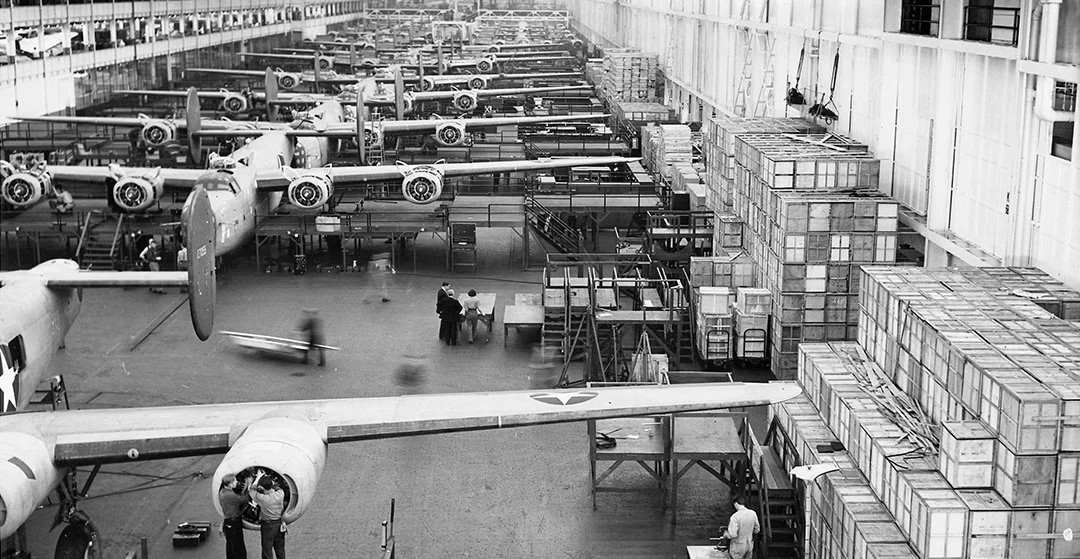
Ford Motor Company built a massive factory that, within less than sixteen months, was turning out a new B-24 bomber every hour
(National Archives)
By Arthur Herman
This article appears in the Summer 2026 issue of the Coolidge Review. Request a free copy of a future print issue.
Imagine you are the president of the United States. Across the Atlantic, the world’s most aggressive totalitarian power has unleashed a terrifying new form of warfare. Using mass mechanized armor supported by tactical airpower, its armies are sweeping across Europe, devastating even major military powers.
Now imagine that your own military cannot compete with this force. The United States has the world’s nineteenth-largest army—smaller than Portugal’s, smaller than Hungary’s. Your military advisers warn that if this totalitarian power landed on American shores, the U.S. Army could do little to stop it from overrunning the country.
What do you do?
This was the situation President Franklin D. Roosevelt confronted in May 1940.
The previous September, Nazi Germany had invaded Poland, forcing Warsaw to surrender in less than four weeks. Eight months later, Adolf Hitler launched the Blitzkrieg, a mechanized tidal wave of planes, tanks, and armored cars. German forces swept aside everything in their path: Luxembourg, the Netherlands, Belgium, and even France.
On May 15, just five days after the Blitzkrieg began, Britain’s new prime minister, Winston Churchill, sent President Roosevelt a telegram. “The small countries are simply smashed up, one by one, like matchwood,” Churchill wrote. “You may have a completely subjugated, Nazified Europe established with astonishing quickness.”
Soon German forces reached the English Channel and cut off the British army in France. Unless British troops could retreat to the closest port still not in German hands, Dunkirk, they would have to surrender. Churchill began to plan for a German invasion of Britain.
Roosevelt knew that if both France and Britain fell, Nazi Germany would control the European continent—and face few obstacles to projecting its power across the Atlantic. “If five German divisions landed anywhere on the coast,” Army Chief of Staff George Marshall told the president, “they could go anywhere they wished.”
The United States needed a rapid military buildup. But neither Roosevelt nor his advisers knew where to begin.
The Indispensable Man
On May 23, President Roosevelt called Bernard Baruch, who had rescued America’s chaotic war mobilization program during the First World War. FDR wanted Baruch to do it again. But the wealthy financier declined, despite his close relationship with Roosevelt.
The sixty-nine-year-old Baruch understood that this mobilization effort would be far more difficult. In an even shorter period, the United States would need to build a modern air force, a two-ocean navy, and vast fleets of transport ships. Someone else would need to take charge.
Whom should Roosevelt call instead?
Baruch knew the perfect person: William S. Knudsen, president of General Motors.
A Danish immigrant, Knudsen had worked his way up from the shop floor to running production at Ford Motor Company’s Highland Park plant. He was still in his thirties when Henry Ford put him in charge of the company’s wartime production during the First World War. At Ford and then General Motors, Knudsen showed himself to be a genius of industrial production. “My business is making things,” he said.
Knudsen met Roosevelt in the White House on May 30, as the Dunkirk evacuation was under way. Knudsen agreed to leave behind his large corporate salary to earn a dollar a year spearheading America’s rearmament. His family and his boss at General Motors were stunned. Why would a lifelong Republican abandon a successful career to work for a Democratic president when the United States wasn’t even at war? Knudsen explained his decision simply: “This country has been good to me, and I want to pay it back.”
Roosevelt had publicly announced his goal of producing fifty thousand planes a year. Hitler mocked the figure as fantasy, scoffing, “What is America but beauty queens, millionaires, stupid records, and Hollywood?” But Knudsen calculated that the United States could far exceed the president’s goal, not just with airplanes but also with tanks, trucks, ships, machine guns, and ammunition.
Knudsen told Roosevelt it would take eighteen months to retool and refit America’s factories and shipyards. After that, the United States would produce war matériel on a massive scale. But the president would need to give him and his colleagues in American industry broad authority to run the mobilization effort.
Many New Dealers recoiled at the idea of handing so much power to corporate executives. Some Roosevelt advisers viewed mobilization as an opportunity to complete the New Deal by turning all sectors of American society into a vast, centrally managed cooperative enterprise. But Roosevelt went against his best New Deal instincts and handed the mobilization problem over to Knudsen and America’s industrial leaders.
The decision led to a miracle of mass production.
The Engine of Victory
Knudsen began the mobilization effort in June 1940. Eighteen months later, on December 7, 1941, the Japanese attacked Pearl Harbor. Knudsen’s calculations proved accurate. By the time aerial torpedoes fell on Pearl Harbor, the United States had already transformed much of its industrial base, and American military production was approaching that of Nazi Germany, which had had almost a decade’s head start.
The results were staggering. America became the arsenal of democracy, rolling out 86,000 tanks, 2.5 million trucks, 500,000 jeeps, 286,000 warplanes, 8,800 naval vessels, 5,600 merchant ships, 434 million tons of steel, 2.6 million machine guns, and 41 billion rounds of ammunition. By 1944, the United States was producing a plane every five minutes, 150 tons of steel every minute, and eight aircraft carriers every month.
How did Knudsen and his colleagues unleash such extraordinary production? Three principles defined their approach.
First, Knudsen sought out the most successful and innovative companies. Businesses would need to produce goods they had never made before. General Electric had to learn how to manufacture ten thousand bazookas in thirty days. Chrysler needed to mass-produce tanks. Ford Motor Company had to devise a process for building complex B-24 bombers. The United States needed firms with exceptional engineers and manufacturing systems.
Second, Knudsen focused on results, not process. To make mobilization work, he persuaded the Roosevelt administration to discard the federal government’s cumbersome procurement process. The existing rules were so complicated and expensive that few businesses wanted government contracts. Companies responding to requests for proposal even had to pay for their own prototypes. In the summer of 1940, the Army sent out 186 requests for proposals; only two companies responded.
Under Knudsen, the government offered advances on contracts for war work, which allowed companies to retool factories and hire workers. In the contracts, the government agreed to cover all costs plus a fixed fee. This cost-plus contract became vital to the buildup in World War II and then in the Cold War.
Third, Knudsen insisted that war production remain voluntary. The federal government did not dictate what companies had to make or assign workers to factories or shipyards. Knudsen believed that giving this freedom to businesses and workers would allow companies to determine what they could produce most effectively—even if they had never made the product before.
Take the M1 carbine. Companies contracted to produce this semiautomatic rifle included the Underwood Typewriter Company, IBM, National Postal Meter, Quality Hardware, and even a Chicago jukebox manufacturer named Rock-Ola.
The Strength of American Industry
William Knudsen knew that to mobilize for the Second World War, the federal government needed to partner with the private sector. By removing unnecessary regulations and giving businesses the right incentives and the freedom to innovate, the United States unlocked astonishing war production.
Many New Dealers opposed Knudsen’s approach, but the industrialist convinced President Roosevelt of his plan—and it worked.
America’s mobilization for the Second World War remains one of the great industrial achievements in history. That experience should remind us of the private sector’s enormous capacity for innovation and production. If the United States could harness the drive and innovation of American business before, we can do so again.
Arthur Herman is a historian and a Pulitzer Prize finalist. He is the author of many books, including Freedom’s Forge: How American Business Produced Victory in World War II and, most recently, Founder’s Fire: From 1776 to the Age of Trump.
This article appears in the Summer 2026 issue of the Coolidge Review. Request a free copy of a future print issue.