
The West’s Overlooked Black Pioneers
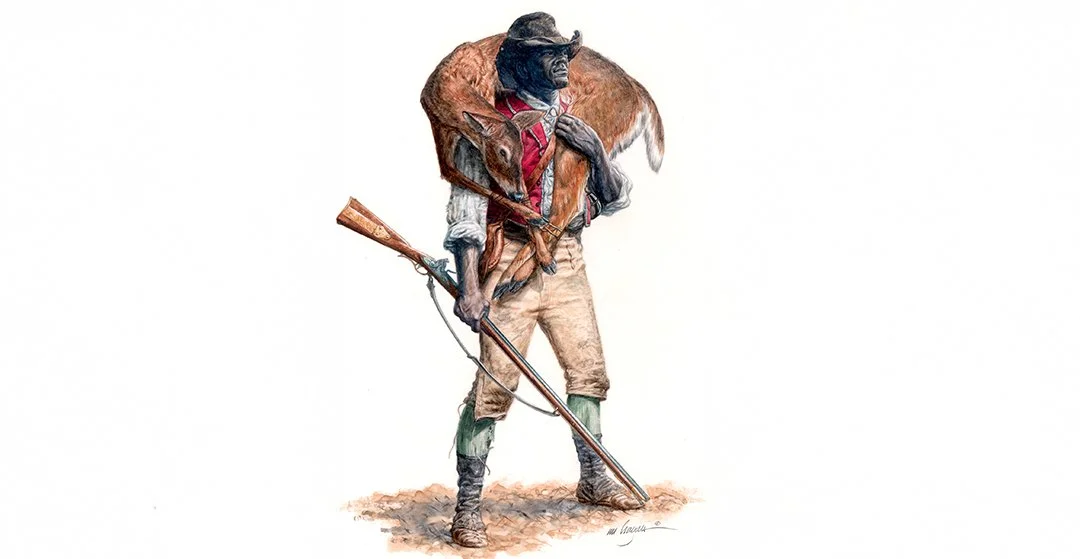
York, an enslaved man, became a trusted member of Lewis and Clark’s expedition party
(Painting by Michael Haynes)
By Amanda Bellows
This article appears in the Winter 2026 issue of the Coolidge Review. Request a free copy of a future print issue.
When you think of the American West, your mind might go to frontiersmen like Daniel Boone, Davy Crockett, and Kit Carson. These are the men long immortalized in films, television shows, and history books.
More recently, historians have offered a fuller picture of how Americans settled the West. For example, in Pioneers (2019), David McCullough recounts the history of the American West through the tales of five lesser-known settlers. And in Throne of Grace (2024), Bob Drury and Tom Clavin build their narrative around the pathfinder Jedediah Smith.
But a gap remains in our understanding of the men and women who sought freedom on the western frontier. Historians have largely overlooked the role that African Americans played as explorers and frontiersmen.
For African Americans, the frontier could be a place of hardship, but it also offered opportunity—a chance to construct new identities and exercise personal agency.
Consider the stories of three enslaved men who headed west to acquire skills as trappers, traders, and navigators during the first half of the nineteenth century.
Freedom Seekers
On May 21, 1804, Meriwether Lewis and William Clark set off on their expedition to find a water route to the Pacific. History remembers Lewis and Clark, as well as the navigator and interpreter their Corps of Discovery enlisted along the way: a young Shoshone woman named Sacagawea. But their party included an enslaved man named York as well.
York was born into slavery in late eighteenth-century Virginia, where nearly 40 percent of the population was enslaved in 1790. He grew up on a plantation owned by John Clark, the father of Corps of Discovery co-captain William Clark. In 1785 the Clarks moved to present-day Kentucky, which became a state in 1792. There, York would have gained important wilderness survival skills that served him well when he accompanied Lewis and Clark on their expedition.
Lewis, Clark, York, and the other members of their party began their journey in St. Louis, Missouri, which already served as a gateway to the West. The city, located near the intersection of the Mississippi and Missouri Rivers, had become a commercial center.
Not long after York passed through St. Louis, an enslaved child named James Pierson Beckwith, later called Jim Beckwourth, arrived there with his family. Like York, Beckwourth was born on a Virginia plantation to an enslaved woman whose identity has been lost to history. His father was a white slaveholder named Jennings Beckwith, who reared him. In 1810 the entire family relocated to St. Louis. Although most slaveholders prevented enslaved children from learning to read, Beckwourth received a few years of formal schooling before working as a blacksmith’s apprentice.
When Beckwourth reached young adulthood, he yearned to explore. In 1822 he joined an expedition seeking to mine lead in present-day Wisconsin. Jennings Beckwith legally emancipated his son from slavery sometime before 1824. But even that was not enough to fully protect Beckwourth from the prospect of reenslavement in the slave state of Missouri. Records reveal that Beckwourth’s father had to go to St. Louis’s courts on three separate occasions between 1824 and 1826 to affirm that he had completed a deed of emancipation for Beckwourth.
Determined to leave Missouri again, Beckwourth headed west in search of opportunity. In the fall of 1824 he set off for the Rocky Mountains, where he became a mountain man in a fur-trading operation. Beckwourth also lived among the Crow tribe.
Jim Hawkins was another freedom-seeking African American man who was enslaved in St. Louis during the early to mid-nineteenth century. Unlike Beckwourth, Hawkins did not leave an autobiographical account of his life. But his name appears in the published journal of Rudolph Kurz, a Swiss artist who traveled along the Upper Missouri River in the late 1840s. Kurz encountered Hawkins at the Fort Berthold Trading Post in present-day North Dakota. Although Hawkins worked at the trading post as a cook, he was, according to Kurz, still legally enslaved by a man in St. Louis to whom he sent a portion of his wages each year.
Prior to his meeting Kurz, Hawkins had lived farther upriver at the American Fur Trading Company’s Fort Union Trading Post. His life in the West seems to have been one marked by ambiguity regarding his legal status. “It is true he is free here,” remarked Kurz, “but the company must be responsible, more or less, for his life.”
New Freedoms Out West
Out west, York, Hawkins, and Beckwourth found new freedoms and exercised agency in surprising ways.
All three men bore firearms during a time when Louisiana Purchase Territory codes generally forbade enslaved people from possessing guns or other weapons. While crossing the continent with the Corps of Discovery from 1804 to 1806, York expertlyhunted bison and geese using his own rifle. Meriwether Lewis recorded that the firearm “belonged to Capt. Clark’s black man,” providing evidence that Clark did not merely loan him the weapon. The fact that York possessed a firearm while living among the predominantly white, male members of a military expedition attests not only to his skill as a marksman but also to the trust others placed in him.
Hawkins also carried a rifle for hunting on the frontier, where he traveled by boat for days along the Missouri River.
Beckwourth became a skilled hunter after leaving St. Louis. While he was in Wisconsin, the local Sauk and Meskwaki people taught him to hunt game. In his autobiography, he wrote, “Frequently they would accompany me on my excursions (which always proved eminently successful).”
Beckwourth further honed his skills in the Rocky Mountains, where he lived among the Crow people for seven years and became a chief within their nation. During his interactions with white traders on one notable occasion, he recalled “speaking nothing but the Crow language, dressed like a Crow, [and wore his hair] as long as a Crow.” Not a person there doubted his newly constructed identity, Beckwourth recorded.
Hawkins, Beckwourth, and York also learned how to navigate uncharted terrain and survive in remote areas under harsh conditions. Kurz wrote of one excursion when Hawkins damaged his boat; with no remaining provisions, Hawkins discovered “an abundance of wild cherries and carried a goodly portion of them to the skiff.” Uncertain of his location, Hawkins managed to “work his way through a wood full of bogs” to reach the top of a hill. There he spotted Fort Berthold in the distance and made his way home.
York became adept at givingmedical aid to Corps members. When Charles Floyd became severely ill with a gastrointestinal infection in August 1804, it was York who was principally “attentive to him,” Clark wrote in his journal.
Beckwourth, recalling his early travels through the Rocky Mountains in the mid-1820s, wrote of facing “perils, privation,” and even “death itself,” and of fighting “the wild beasts of the mountains.” These adventures only inspired him to continue exploring the western territories in the years ahead.
The Untold Story
York, Beckwourth, and Hawkins were all born into slavery. All three men began their journeys in St. Louis, using the city as a launching point for travels into the continent’s western interior. Out west, they learned how to thrive in the wilderness, and they exercised autonomy that would have been unlikely in the antebellum South.
Their stories are not nearly as well known as those of the pioneers celebrated in Hollywood. But like untold numbers of other African Americans, York, Beckwourth, and Hawkins found a measure of freedom in the American West during the early nineteenth century.
Amanda Bellows is the author of The Explorers: A New History of America in Ten Expeditions. She teaches history at the New School’s Lang College of Liberal Arts.

This article appears in the Winter 2026 issue of the Coolidge Review. Request a free copy of a future print issue.