
How Jefferson Crafted a Case Against Slavery
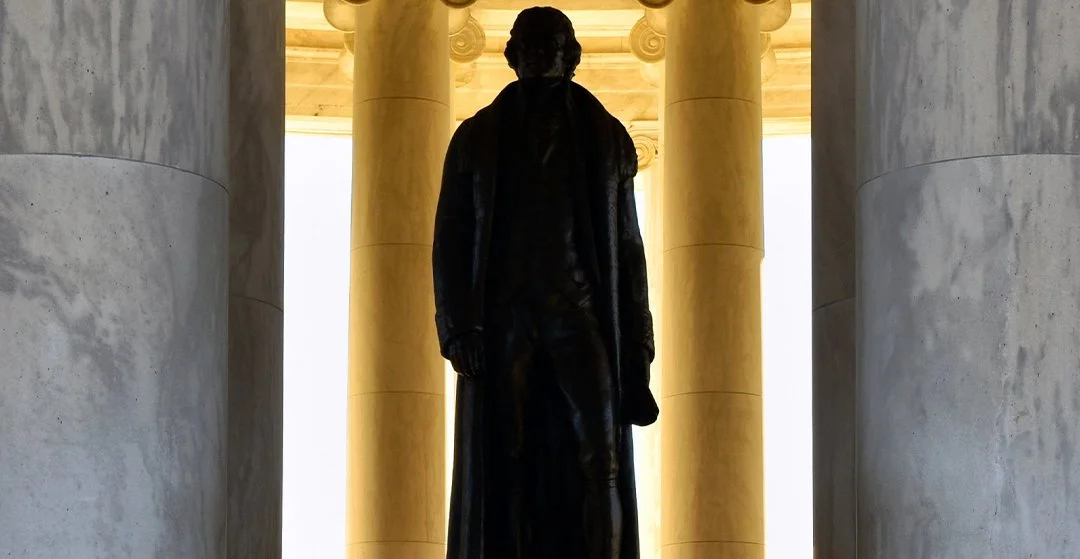
Jefferson has perhaps the most contested legacy of any Founder, shadowed by his contradictions, if not hypocrisy, on slavery
(Giuseppe Crimeni / Alamy)
By Cara Rogers Stevens
This article appears in the Winter 2026 issue of the Coolidge Review. Request a free copy of a future print issue.
Of all the Founders, Thomas Jefferson has perhaps the most contested legacy. He serves as inspiration to some and as exemplar of all that is wrong with America to others. Jefferson’s writings and actions suggest complexity at best and hypocrisy at worst. After all, the man who wrote, “We hold these truths to be self-evident, that all men are created equal,” enslaved hundreds of people.
Many historians interpret Jefferson’s 1787 book, Notes on the State of Virginia, primarily as a work promoting white supremacy. But evidence that remained hidden to scholars for two centuries suggests that Jefferson intended his book to have an antislavery influence.
Jefferson’s complex editing process concealed his changes. In many cases, he pasted new sections of text over old. But finally, in 1997, archivists began disassembling the manuscript. With every revision now digitized, we can trace the evolution of Jefferson’s thought.
The Case to Slaveholders
Among the many contradictions that characterize Jefferson, none stands out more than this slaveholder’s genuine interest in, and efforts toward, abolishing slavery.
As a student at the College of William and Mary and as an apprentice lawyer, Jefferson studied under William Small and George Wythe, two antislavery thinkers who shaped his views on the immorality of slavery. As a young legislator in Virginia, Jefferson pioneered efforts to facilitate both individual and statewide emancipation, although without success.
Jefferson began composing Notes in 1780, and he spent years revising the manuscript. In the mid-1780s, Virginia loosened legal restrictions on manumission. Dozens of people—many inspired by religion—freed their enslaved workers. Jefferson updated Notes to take advantage of this turn in public opinion. He argued for both emancipation and colonization.
As part of these arguments, Jefferson included several pages of reflections on race that will rightly disturb any reader today. But a closer examination of his revisions shows that, far from seeking to justify oppression, Jefferson was attempting to make his case to a prejudiced audience. He tacitly acknowledged their fears—and then leveraged those fears to encourage emancipation.
Why? Because he needed to convince white slaveholders to back his plan to spend taxpayer money on freeing, providing for, educating, equipping, transporting, and supporting Virginia’s enslaved people as they created their own country.
Consider what was happening in Virginia. In 1782 several anonymous contributors to The Virginia Gazette, and the Weekly Advertiser responded to religious appeals for emancipation by claiming that African-descended peoples were a threat. If freed, these writers argued, the enslaved workers would violently rise up against their white neighbors or would be “ravishing and cohabitating with our white women, and in a century or less, our offspring would be a mixed mongrel of mulattoes, of whites and blacks, bays, chestnuts, sorrels, and skewbalds.” These terms, normally reserved for horses, implied that mixed-race children would be less than human.
In an early form of John C. Calhoun’s “positive good” thesis, these writers claimed that slavery was necessary to allow white men the time to cultivate their own minds; civilization thus depended on slavery. They asserted that the “organs, passions, and appetites” of the enslaved marked them as savage. Racial differences were immutable, and therefore Africans and their descendants were fit for nothing more than “the state of slavery in which they have for a great length of time been held by us, with as much general happiness to themselves, as they seem susceptible of.”
Jefferson was almost certainly aware of the debate over slavery raging in the Gazette, to which he subscribed. He refuted each of the proslavery claims in his Notes.
First, Jefferson dealt with the objections to statewide emancipation. He described his three-step plan to emancipate all enslaved children born after a certain date, educate them, and finally expatriate them “to such place as the circumstances of the time should render most proper.” The state would provide supplies and protection until “they shall have acquired strength” sufficient to become an independent nation.
Proslavery arguments played on fears and racial prejudices by insisting that permanent slavery was the only way to prevent violent uprising or racial mixing. Jefferson’s emancipation plan removed slaveholders’ excuses for inaction. He assured them that they would not immediately lose their workforce and that they would not have to live in a mixed-race society after emancipation.
“daily exercised in tyranny”
Jefferson next turned to the biological argument for continuing slavery. While drawing on the reigning wisdom in scientific circles—with scientists and philosophers from Buffon to Raynal to Voltaire positing a racial hierarchy that placed black people on the lowest rung—Jefferson asserted that this inferiority was a “suspicion only,” rather than a certainty. Moreover, Jefferson opened the door to the possibility that black people were “made distinct” by circumstances. And if circumstances alone made people racially different, changed circumstances could remove those differences. “Further observation” was needed, Jefferson said—but even if racial differences were proven to be permanent, that would not justify slavery.
Whereas the Gazette’s proslavery writers contended that civilization depended on slavery, Jefferson insisted that white children raised in a slaveholding society were “nursed, educated, and daily exercised in tyranny.” That is to say, the institution of slavery corrupted the moral and political culture of Virginia. White children would become mini-tyrants, and the liberties of all citizens would come under siege if they believed that liberty was not a natural right, derived from an equal creation.
The “only firm basis” for the liberties of all men, Jefferson wrote, came from the conviction that “these liberties are of the gift of God.” Continued slavery would inevitably lead to a race war, he warned: “I tremble for my country when I reflect that God is just…. The Almighty has no attribute which can take side with us [slaveholders] in such a contest.”
These were strong words coming from a man not known for his religious beliefs. Here again, the public contest over slavery occurring in the Gazette gives insight into Jefferson’s strategy. In the edition published May 25, 1782, an essayist known only as “A Friend to Liberty” warned that practicing slavery while fighting for liberty was inconsistent. Since God was just, and slavery was unjust, Americans should ask themselves, “How can we expect he will decide [the Revolutionary War] in our favor?” To prevent “divine retribution,” Virginians must immediately “release our slaves from bondage.”
Jefferson’s “tremble for my country” passage echoed this language of divine judgment. He invoked a supernatural intervention in addition to his arguments on behalf of the peace, civilization, and republican future of the state.
“to Justify Slavery”
Thanks to the disassembled manuscript, we now see that Jefferson’s final draft of the Notes owes much to feedback from Charles Thomson. Thomson was the secretary of the Congress and, like Jefferson, a recently elected member of the American Philosophical Society.
After reading the manuscript in early 1784, Thomson told Jefferson, “though I am much pleased with the dysertation [sic] on the difference between the Whites & blacks & am inclined to think the latter a race lower in the scale of being, yet for that very reason & because such an opinion might seem to justify slavery I should be inclined to leave it out.”
In other words, Thomson approved of Jefferson’s racial analysis, but he worried that Jefferson might be misunderstood. Removing all racial commentary would be the safest way to argue for emancipation.
Jefferson did not fully follow Thomson’s advice, but he did make significant changes to the manuscript in the ensuing months. The sections on race that Thomson read were more definitive and negative; after receiving his friend’s feedback, Jefferson softened his claims. He added the qualification that his descriptions of racial differences were a “suspicion only,” needing more evidence. He also included examples of Africans’ racial equality or even superiority.
Most important, Jefferson made his opposition to slavery clear by doubling the length of his antislavery “Manners” chapter and adding his arguments about the corruption of Virginian children and the coming divine judgment. No matter his views on race, Jefferson did not wish to seem proslavery.
“The man must be a prodigy,” Jefferson wrote about Virginian slaveholders, “who can retain his manners and morals undepraved in such circumstances.” Not even Jefferson himself, as he perhaps knew, could live in a slave society without becoming corrupted in some way. Notes was Jefferson’s imperfect attempt to persuade his fellow white Virginians to make the economic and social sacrifices necessary to live out their republican beliefs.
To make that case, Jefferson appealed to the racial prejudices of his readers and used colonization as a solution to the supposed problems of racial difference.
Jefferson’s Long Game
Perhaps the clearest signal of Jefferson’s antislavery intentions with Notes came in 1785. Jefferson privately printed enough copies of his book “to be able to give one to every young man” at William and Mary, his alma mater. In a letter, he noted that the college was “the place where are collected together all the young men of Virginia under preparation for public life.” He added approvingly that these students were “under the direction” of his own mentor Wythe, whose opposition to slavery was “unequivocal.”
In another letter, Jefferson said that he hoped his “strictures on slavery” would persuade the future leaders to eventually abolish the institution entirely. The members of this younger generation, having grown up during the Revolutionary years, had “sucked in the principles of liberty as it were with their mother’s milk.” It was “to them I look,” said Jefferson, “to the rising generation, and not to the one now in power for these great reformations,” specifically “the emancipation of their slaves.”
Notes on the State of Virginia served an important purpose in this long game Jefferson was playing. Five years later, Jefferson explained his philosophy: “The ground of liberty is to be gained by inches, that we must be contented to secure what we can get from time to time, and eternally press forward for what is yet to get. It takes time to persuade men to do even what is for their own good.”
Cara Rogers Stevens is an associate professor of history at Ashland University. Her first book, Thomas Jefferson and the Fight Against Slavery, won the Herbert J. Storing Book Prize and was a finalist for the Center for Presidential History’s Book Prize, the Journal of the American Revolution’s Book of the Year, and the George Washington Prize.

This article appears in the Winter 2026 issue of the Coolidge Review. Request a free copy of a future print issue.