
The Mystery of the Missing Depression
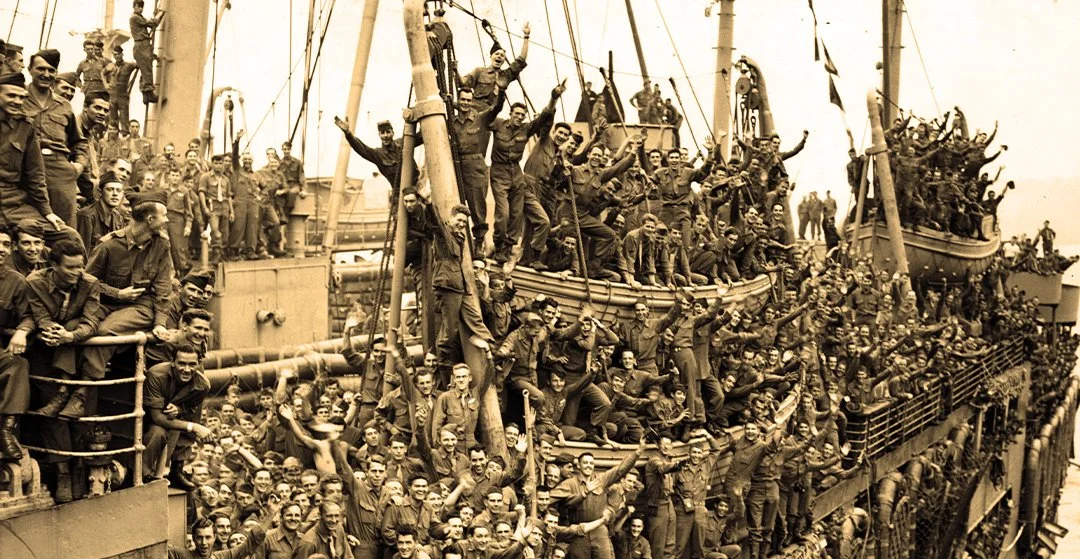
When World War II ended, the U.S. needed to find work for the millions of troops returning home. To economists at the time, mass unemployment and unrest seemed inevitable.
By John E. Moser
This article appears in the Winter 2026 issue of the Coolidge Review. Request a free copy of a future print issue.
In 1943 a young economist in Franklin Roosevelt’s administration issued a warning. If the Second World War ended quickly and America rushed “to demobilize our armed forces, to liquidate price controls, to shift from astronomical deficits,” then the country would endure “the greatest period of unemployment and industrial dislocation which any economy has ever faced.”
The name of the apocalyptic economist was Paul Samuelson. Others in his trade also took a dark view. The following year, Gunnar Myrdal wrote an article for The Atlantic. Myrdal noted that at least 14.5 million people would soon be released from the armed forces, defense-based industry, and government. If they could not find work, he predicted “a high degree of economic unrest” and even an “epidemic of violence.”
But business leaders did not share the pessimism. In May 1944, Fortune polled executives on whether their companies’ prospects after the war would be better than, worse than, or about the same as they were before the war. More than half said better; only 8.5 percent said worse.
When the war did end in 1945, official figures seemed to vindicate the pessimists. The most important of these was the general measure of economic activity, what we call gross domestic product, or GDP. From 1945 to 1946, the official reports said, real GDP fell 20.6 percent. That was the worst contraction in American history, even worse than that of 1932, the most difficult year of the Great Depression. The Federal Reserve’s Index of Industrial Production dropped by more than a third.
Meanwhile, the U.S. government slashed spending—from $96.9 billion in 1944 to $24.2 billion in 1948. But income taxes remained sky-high, with a top marginal rate of 91 percent. And the Federal Reserve raised interest rates to combat inflation that came with the end of wartime price controls. According to the Keynesian economic thinking of the time, these contradictory fiscal and monetary policies should have produced a major depression.
But the U.S. economy did not collapse. No years-long downturn like the Great Depression emerged. Indeed, no one seems to remember a severe postwar contraction. Why not?
The short answer is that mass unemployment did not materialize. Even as total military-related employment fell from 25.75 million to only 3.23 million, the unemployment rate rose only modestly, from 1.9 percent to 3.9 percent. This seems nothing short of miraculous. What explains the mystery?
The Conventional Answers
One common argument suggests that the United States avoided mass unemployment because women left the workforce. But this effect has been overstated.
Of the 4.9 million women who entered the workforce during the war, 2.4 million remained. Only 16 percent of women working in 1944 were involved in industries directly connected to war production, and more than 90 percent of the women in non-war-related industries kept their jobs in 1946.
Women made up 32 percent of the workforce after the war—down from 37 percent during the fighting, but above the 28 percent level of 1940. By 1950, they accounted for 35 percent of workers.
Another explanation says that the G.I. Bill removed huge numbers of returning soldiers from the labor force. But in September 1946 only about 800,000 veterans—around 9 percent—were in college. Even if all of them had sought work and failed to find it, the unemployment rate would have risen by only 1.4 percentage points.
In any case, the G.I. Bill offered generous unemployment benefits—$20 a week for up to fifty-two weeks—that encouraged many veterans to delay looking for work. Roughly half of the 1.8 million unemployed were veterans. In January 1946 nearly 20 percent of veterans indicated that they were “taking vacations” before returning to civilian work.
The most widely accepted explanation attributes the postwar recovery to pent-up consumer demand. The Council of Economic Advisers first advanced this argument in December 1946, reporting, “We have a postponed consumer demand, enterpriser ambitions, and purchasing power which hold the potential of some years of great activity.”
But this explanation faces problems, too. Consumer spending rose by about $14 billion from 1945 to 1946, offsetting no more than 20 percent of the decline in government spending. The true surge in consumption came in late 1946 and 1947, but, as economists Richard Vedder and Lowell Galloway write, “Unemployment was low, long before any ‘pent up demand’ had an opportunity to play a role.”
Also, if prosperity resulted from postponed consumer demand, it should have ended within a few years. A brief recession in 1949 did bring unemployment up to 7.9 percent, but by 1951, joblessness had come down to 3 percent.
Finally, the “pent-up demand” explanation assumes that consumers went on a spending spree using the savings they had been forced to accumulate during the war. The rate of savings did decline: from 25.5 percent in 1944, to 9.5 percent in 1946, to 4.3 percent in 1947. But total savings grew: from $151.1 billion in November 1945, to $161.6 billion in December 1946, to $168.5 billion at the end of 1947.
Americans were spending more not because they were drawing down their savings accounts but because they were earning enough both to save and to spend.
The “Dollar-a-Year Men” vs. the “Long-Haired Boys”
The best answer for why the economy did not return to Depression conditions is that businesses and consumers had confidence in the future. Americans had endured a decade and a half of Depression, New Deal experimentation, and then a planned wartime economy. During the war, the federal government had controlled virtually all economic activity through a confusing and constantly changing set of rules. Americans looked forward to an economy with far fewer controls and more predictability.
Business leaders had argued against central planning long before Pearl Harbor. In 1939, Roosevelt’s newly appointed War Resources Board, headed by former U.S. Steel chairman Edward R. Stettinius Jr., reported to the president: “American businessmen, like all Americans, are accustomed to democratic procedures. More effectiveness can be obtained through voluntary cooperation than through force. We recommend that wartime powers be vested in specially-created wartime agencies which will be automatically demobilized when the war is over.”
During World War II, more than ten thousand business executives volunteered to serve as “dollar-a-year men” in federal war agencies. They did so not only to contribute to the war effort but also to help stop the administration from keeping the economy under permanent state control after the fighting stopped.
When the war ended, however, a new generation of New Deal reformers wanted to extend federal control over the economy. These advisers sought to expand the size and scope of government, with robust federal spending designed to keep the country at full employment.
In January 1945 a group of Democratic senators sponsored the Full Employment Bill, which would commit the country to a massive work relief program. The bill reflected the bold ambition Roosevelt had outlined in January 1944. In his State of the Union address, FDR proclaimed a “second Bill of Rights” that included the “right to a useful and remunerative job.” But the Full Employment Bill languished. Conservatives in Congress opposed the bill, and Roosevelt remained aloof from the struggle, preoccupied with wartime matters and his own failing health.
Roosevelt died in April 1945, leaving Harry Truman to address the problems of converting to a peacetime economy. Although Truman had supported the New Deal as a senator, he distrusted many of Roosevelt’s intellectual advisers, whom he dismissed as “the long-haired boys” or “the Harvard crowd.” Some of the more radical members of the cabinet, such as Harold Ickes and Henry Wallace, did not last long in the Truman administration.
Truman did not endorse the Full Employment Bill. A scaled-back version passed in 1946 as simply the “Employment Act.” The law’s only concrete provisions created the Council of Economic Advisers and the Joint Economic Committee.
The postwar rejection of government planning freed businesses and individuals from federal controls and restored confidence.
An End to Crowding Out
The results were impressive. While the official GDP fell sharply from 1945 to 1946, private GDP soared—rising 29.5 percent, the highest rate ever recorded.
Gross private investment bounced back as well. Private investment had fallen from $19.37 billion in 1941 to only $7.4 billion in 1943, the presumed height of wartime prosperity. In 1946 it jumped to an unprecedented $33.13 billion.
Wartime government spending clearly had crowded out private investment.
Businesses also enjoyed high profitability. With the Revenue Act of 1945 reducing the top corporate income tax rate and repealing the excess-profits tax, aggregate corporate profits jumped from the $10–$11 billion range between 1941 and 1944 to $15.5 billion in 1946, $20.2 billion in 1947, and $22.7 billion in 1948.
Wall Street rebounded strongly, too. Even as official GDP fell by an unprecedented amount, the stock market rose 18 percent. In September 1945 the Dow Jones finally returned to 1937 levels. It would take until 1954 to surpass the dizzying heights of 1929, but business clearly believed America had entered a new era of opportunity.
One puzzle remains, though: How could official GDP register the largest decline in U.S. history without producing any of the expected consequences? How could that steep drop coincide with low unemployment, business growth, and booming private investment?
Dubious GDP
Economic historian Robert Higgs suggests an answer: wartime GDP figures were fundamentally unreliable. After all, government spending accounted for nearly half the economy, and prices were set by Washington agencies rather than the laws of supply and demand. Thanks to wage and price controls, it was almost impossible to measure the effects of inflation. In such an environment, Higgs argues, economic figures were no more reliable than those issued by the Soviet Union.
It is entirely possible, then, that GDP during the war years overstated the country’s economic performance. In that case, the huge drop from 1945 to 1946 simply reflected a shift from inflated numbers to accurate ones. In other words, the supposed contraction of 1946 may never have existed outside federal accounting tables.
If that is true, then we must also revisit the standard narrative that World War II brought an end to the Depression—but that is a subject for another time.
John E. Moser is a professor of history at Ashland University. He is the author of four books, including The Global Great Depression and the Coming of World War II.

This article appears in the Winter 2026 issue of the Coolidge Review. Request a free copy of a future print issue.