
Lafayette’s Triumphant Return to America
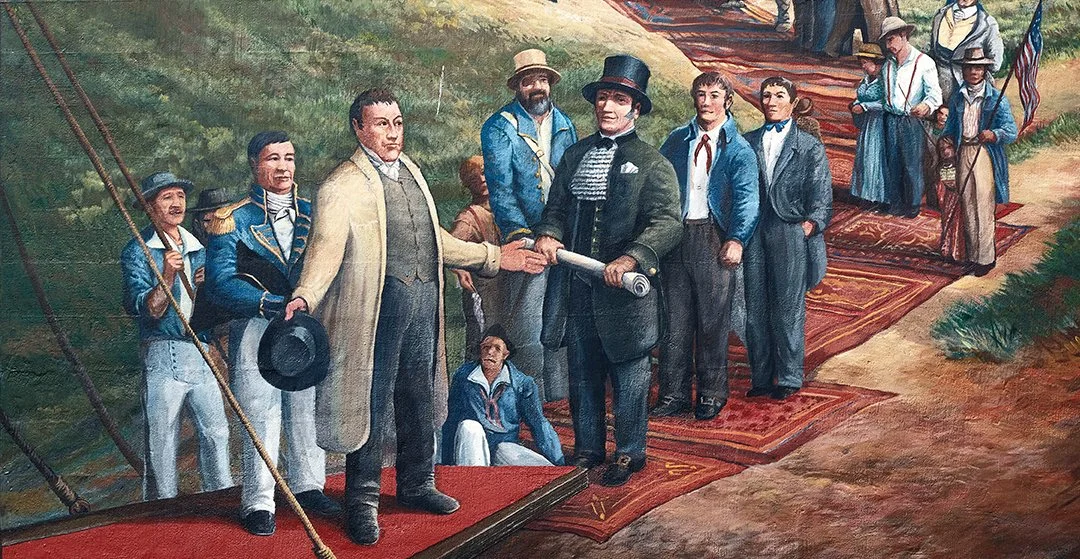
The Marquis de Lafayette’s arrival in Maysville, Kentucky, during his triumphant return to America, May 1825
By Jack Gill
This article appears in the Summer 2026 issue of the Coolidge Review. Request a free copy of a future print issue.
In May 1825, in Lexington, Kentucky, days of rain had softened the dirt roads into muddy slop, yet enthusiastic crowds still gathered. Among them were Revolutionary War veterans, old men, who had come to see a guest, a hero of that great war—the Marquis de Lafayette.
Lafayette’s visit to Lexington came three-quarters of the way through a grueling thirteen-month, six-thousand-mile journey across all twenty-four existing states. The farewell tour came nearly fifty years after Lafayette had helped secure American independence. He was met with adulation at every stop.
The greeter welcomed Lafayette to Lexington with reverent words: “We have been taught, from our earliest youth, to place you in our hearts, by the side of the immortal Washington.” He concluded, “Welcome, Lafayette, thou son of freedom, welcome, thrice welcome, to the land of thy early glory.”
Glory was not an exaggeration. This French aristocrat had played a pivotal role in America’s Revolutionary War—on the battlefield and as a diplomat. Even among other Revolutionary War heroes, Lafayette’s commitment to and love of America stood out.
As John Quincy Adams later said, “Pronounce him one of the first men of his age, and you have yet not done him justice.”
An Aristocrat Risks All for Liberty
Marie-Joseph Paul Yves Roch Gilbert du Motier, Marquis de Lafayette, was born into a noble French family of immense wealth and a long tradition of military service. In 1777, at just nineteen years old, he was so captivated by the ideals of the Declaration of Independence that he purchased a ship, left comfort behind, and set sail to join the American Revolution.
He went without the permission of his king, Louis XVI, and without saying goodbye to his wife. Writing to her as he sailed, he explained that he was going “as the defender of that liberty which I idolize.” He added, “The welfare of America is intimately connected with the happiness of all mankind; she will become the respectable and safe asylum of virtue, integrity, tolerance, equality, and a peaceful liberty.”
For Lafayette, the American Revolution was a fight to save a new nation founded on enlightened principles of human rights. His idealism and enthusiasm led him to offer his services to the Continental Congress without pay, an offer they—tired of inept foreign volunteers—were initially hesitant to accept. However, his wealth granted him access, and his sincerity and dedication endeared him to General George Washington, whom Lafayette would address as “my adoptive father.”
Reflecting on Lafayette’s conviction, John Quincy Adams proclaimed: “To the moral principle of political action, the sacrifices of no other man were comparable to his. Youth, health, fortune…he gave them all for toil and danger in a distant land, and an almost hopeless cause; but it was the cause of justice, and of the rights of humankind.”
Lafayette proved his commitment to America on the battlefield, literally bleeding for the cause. Like many French aristocrats, Lafayette had military training but no practical fighting experience. Despite his inexperience, the Americans almost immediately made him a major general in the Continental Army.
During the Battle of Brandywine in September 1777, Lafayette pushed to join the fight, convincing General Washington to send him into his first real battle. The next day, Lafayette wrote to his wife: “Our Americans, after holding firm for a considerable time, were finally routed. While I was trying to rally them, the English honored me with a musket shot, which wounded me slightly in the leg.”
Despite the loss, Washington was so impressed by Lafayette’s courage that he wrote to Congress, noting that the young marquis “possesses a large share of bravery and military ardor,” and recommended him for a higher command.
By age twenty, Lafayette commanded 2,200 American troops. At Barren Hill, Monmouth, and Valley Forge, he consistently proved his bravery and skill. His belief that all men were created equal was also evident in his leadership. He lived and ate with the enlisted men, sharing their hardships. He treated all, including enslaved soldiers and the Oneida Indians, with respect. His inclusive vision of liberty set him apart among his contemporaries.
Lafayette’s final major Revolutionary War engagement was the Siege of Yorktown in 1781, the battle that effectively ended the war. At Yorktown, he commanded American troops blocking British escape routes, coordinated with French forces, and led assaults that tightened the noose around General Cornwallis’s army. While many contributed to the victory, Lafayette’s role received special praise in the American press. One newspaper reported, “The general who contributed most to the success of this great enterprise is without contradiction the Marquis de Lafayette.”
Winning France—and the War
Lafayette’s contributions extended beyond what he did on the battlefield. His work soliciting help from France was equally crucial.
In 1779, after his early campaigns, Lafayette had been granted leave to return to France, seeking additional support for the American cause. Working with Benjamin Franklin and John Adams, he leveraged his aristocratic connections and the respect he had earned on the battlefield to persuade King Louis XVI to send more troops, supplies, and naval power to America. Franklin wrote to Washington that Lafayette’s “Zeal for the Honour of our Country” and “firm Attachment to our Cause” were instrumental in securing French aid.
When Lafayette returned to America in 1780, the French support he helped obtain, including six thousand soldiers and a powerful naval fleet, bolstered American morale and provided the military strength needed for the final stages of the war. Alexander Hamilton said of Lafayette, “The United States are under infinite obligations to him beyond what is known…. The French army now here…would not have been in this country but through his means.”
Lafayette loved America, and his contributions to the Revolution were as significant as any American patriot’s.
America’s Marquis
In 1781, after securing American victory, and still only twenty-four years old, Lafayette sailed back to France. The French Revolution would bring him prison and pain, leaving him with a complex legacy in his homeland. But his actions during the American Revolution forever earned him a place in the hearts of Americans.
America’s veneration for Lafayette was unmistakable during his farewell tour, not least in Kentucky. Governor Joseph Desha wrote that Lafayette’s “name and deeds” were incorporated in and identified with the state’s history. Lexington lay within Fayette County, named for the marquis in 1780, and soon after his visit, the Lexington Female Academy was rechristened in his honor.
A Kentucky congressman captured his state’s high regard for Lafayette when he proclaimed that the general’s “character and name have united all hearts and hands” and declared the name Lafayette “inseparable from the cause of liberty throughout the universe.”
When he passed away in 1834, the United States mourned “our marquis” as if he were the last surviving Founding Father—because, in many ways, he was.
The young, passionate, and charismatic Lafayette reminds us that the idea of America as a nation of liberty transcended its shores, inspiring hope among people across the world who, like Lafayette, believed in the universal cause of human rights.
During his farewell tour, Lafayette proudly declared, “I am an American, after all.”
Jack Gill, a 2026 Coolidge Scholar, is a senior at Paul Laurence Dunbar High School in Kentucky. He wrote this essay for a contest sponsored by the Sons of the American Revolution, winning the state prize for Kentucky.

This article appears in the Summer 2026 issue of the Coolidge Review. Request a free copy of a future print issue.