
The Gamble That Changed How America Shops
By Hendrik Meijer
This article appears in the Summer 2026 issue of the Coolidge Review. Request a free copy of a future print issue.
In the 1960s, Americans witnessed the rise of a new form of commerce: mass retailing—the sale of a wide variety of goods to a wide variety of people.
This type of store traces its roots to the markets and bazaars of the Middle Ages and to the great department stores of nineteenth-century Europe. In the early twentieth century, self-service chain grocery stores such as A&P, Kroger, and Safeway transformed food shopping in the United States. As fewer Americans lived on farms, grocery stores expanded from a few shelves of canned goods into larger operations offering fresh produce and a wide selection of products. Chain stores cut prices by eliminating credit accounts and home delivery. By the Great Depression, the old general store or corner grocery—with a clerk behind the counter entering purchases into a ledger book—had become nearly obsolete.
An Opening for Innovators
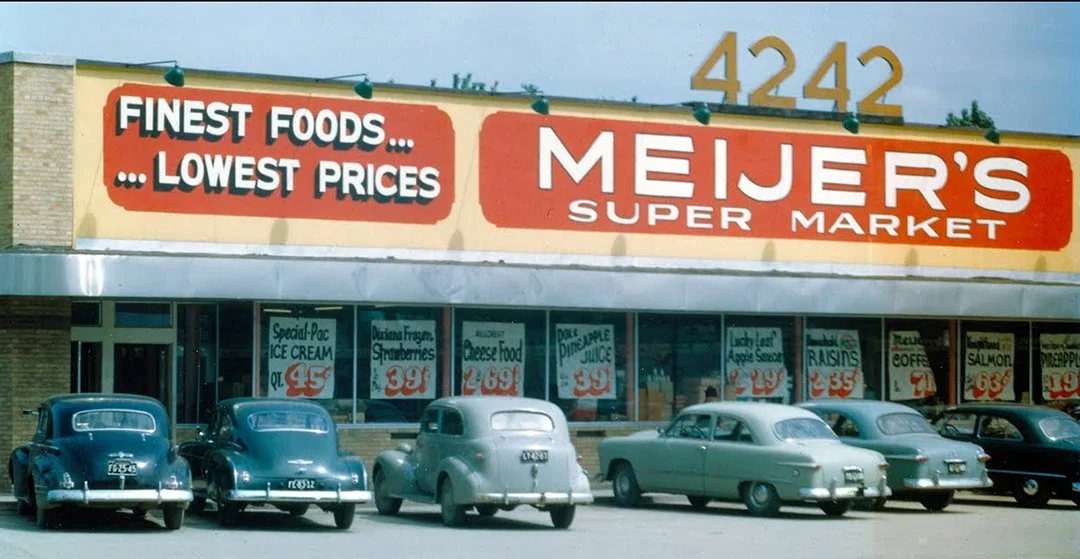
My grandfather Hendrik Meijer entered the grocery business in 1934. A Dutch immigrant with only a sixth-grade education, he worked as a barber in Greenville, Michigan. He owned a vacant storefront next door to his barbershop and had borrowed money from the local bank to outfit it, but he couldn’t find a tenant.
The bank declined to foreclose on the loan, reluctant to take on more worthless real estate during the Depression. My grandfather had to find a way to generate revenue. So he bought $328 worth of groceries on credit.
Soon he realized that to survive, he needed to compete with the chain stores on price and variety. He expanded the store, called Meijer’s. Then he opened another location, and then another.
With prosperity rising after World War II, change accelerated. The growth of suburbs and automobile ownership meant that millions of Americans could drive to stores offering lower prices and greater variety. Many more households had refrigerators and freezers, too. This meant that families could stock up on milk, meat, ice cream, and an expanding assortment of frozen foods. Supermarkets became showcases of innovation, introducing shopping carts, automatic doors, and conveyor-belt checkout systems.
Other American retail channels failed to innovate as quickly. Prices at department stores and specialty stores remained out of reach for many Americans, even as the middle class expanded. Legal constraints often kept these high prices in place. Many states had what were called fair trade laws, which allowed manufacturers to dictate the minimum retail price. Consumers’ alternatives were limited: small local shops, mail-order catalogs from companies like Sears and J. C. Penney, or the forerunners to today’s dollar stores, such as S. S. Kresge and Ben Franklin.
Entrepreneurs would need to write the next chapter in American retailing.
The Rise of Discount Stores
The great old textile factories of New England, heavily unionized, were shutting down as the industry moved to the Carolinas in search of cheaper labor. In the cavernous real estate they left behind, a new retail phenomenon emerged: closeout and overrun sales. These discounted offerings appealed to consumers while allowing manufacturers to recover value from unsold inventory.
Entrepreneurial merchants emulated the self-service strategies of the supermarket. They piled merchandise into great displays and expected customers to browse, select, and transport items themselves. In the 1950s some discount stores expanded into chains, including Miracle Mart, Arlan’s, E. J. Korvette, Caldor, and Zayre. These retailers challenged fair trade laws, which became unenforceable across much of the country.
The rise of discount retail caught the attention my grandfather and my father, Fred. By 1960 they had built a chain of a dozen supermarkets. Their newest store sat on the corner of 28th Street and Kalamazoo Avenue in Grand Rapids, Michigan. They had vacant land next door, and they believed that a discount store alongside a modern supermarket would attract customers and help both businesses. But none of the discount chains showed interest in opening a store there.
At that point, a consultant proposed an alternative: my father and grandfather should open their own discount store. The consultant explained that they didn’t need expertise in clothing, shoes, or toys because they could simply lease departments to independent merchants. My father and grandfather would function mainly as landlords, the consultant claimed. How hard could that be?
The Gamble
In 1961 the Meijer company broke ground on a hundred-thousand-square-foot addition. Construction was already well under way when my father and grandfather realized that if they were running the whole enterprise, they didn’t need to separate the two businesses. They merged the two concepts under one roof, with a single array of checkout lanes.
The resulting superstore, called Thrifty Acres, opened in 1962. It featured a full supermarket alongside a pharmacy and sections for shoes, appliances, accessories, jewelry, housewares, hardware, toys, sporting goods, home fixtures, furniture, and clothing for men, women, and children.
Success was by no means assured. I still remember my seventh-grade math teacher mocking the notion that anyone would buy a bra and a head of lettuce on the same shopping trip. My father and grandfather knew they were taking an enormous gamble. They were heavily in debt. During construction, they even poured an extra-thick concrete floor. That way, if their superstore concept failed, at least the building could be used as a car dealership.
The consultant proved to be wrong about letting tenants run different departments. The situation became chaotic. Each tenant had his own ideas on everything from pricing to quality to return policies. My father and grandfather scrambled to buy out the tenants’ leases. They also sent a colleague to New York’s Garment District to learn the apparel business.
The Meijers faced a steep learning curve, but they made the Grand Rapids store work. Soon enough they added more Thrifty Acres locations.
Retail Revolution
The year the first Thrifty Acres opened marked a turning point in American retail history. Also in 1962, the dime-store chain S. S. Kresge opened the first Kmart. The Dayton department stores in Minneapolis opened the first Target. And in Arkansas, Ben Franklin franchisee Sam Walton opened the first Walmart.
The following year, the French retailer Carrefour opened its large-format “hypermarket.” The Meijer company adopted the term hypermarket in the 1970s and 1980s, until Walmart imitated Meijer and popularized the label supercenter.
What began as a risky experiment in Grand Rapids has become, particularly through Walmart’s national reach, a preferred way of shopping for most Americans. One-stop shopping and discount offerings are no longer revolutionary; they are part of the fabric of American life.
And of course, innovation has not stopped, in retail or anywhere else in the economy. Innovation is not a once-in-a-generation event; it is a daily opportunity. For the sake of American prosperity, it needs to stay that way.
Hendrik Meijer is executive chairman of Meijer Inc. in Grand Rapids, Michigan. He joined the family retail business as a grocery clerk at age eleven.
This article appears in the Summer 2026 issue of the Coolidge Review. Request a free copy of a future print issue.