
How the Fed Turned Makers into Takers
By James Freeman and Vern McKinley
This article appears in the Summer 2026 issue of the Coolidge Review. Request a free copy of a future print issue.
Historian Burton W. Folsom Jr. has described the difference between market entrepreneurs and political entrepreneurs. Market entrepreneurs compete to serve consumers by creating products that are better and cheaper than the alternatives. Political entrepreneurs compete to lobby politicians for subsidies and set-asides that are expensive for consumers and taxpayers.
Unfortunately, in the early twentieth century, U.S. bankers were encouraged to transition from the former to the latter.
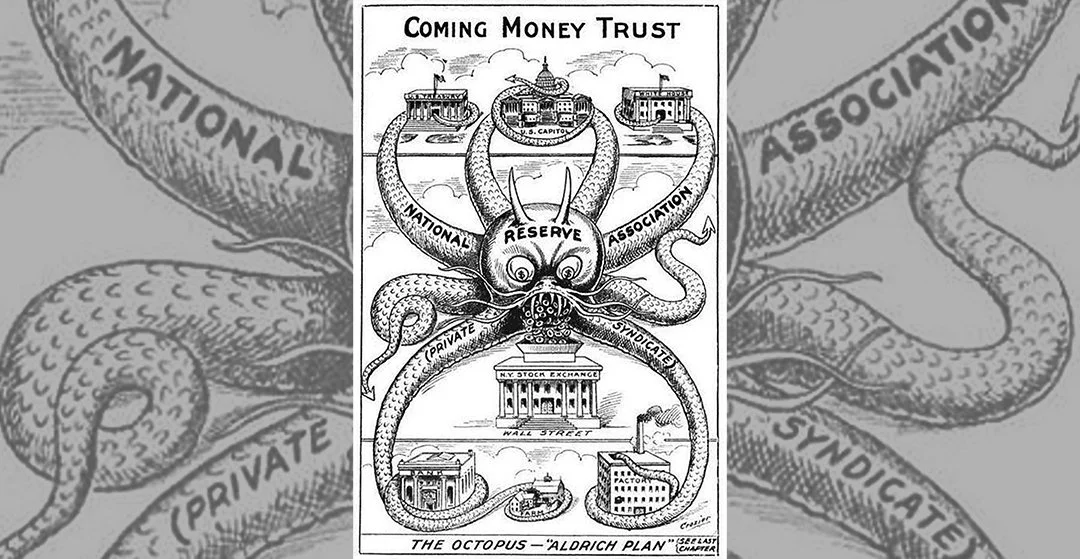
Federal law and regulation had long been major sources of instability in the financial system. But for the country’s largest banks, the creation of the Federal Reserve in 1913 constituted a dramatic shift away from market discipline and toward the recklessness that inevitably rides along with a government safety net.
Nowhere was this transition, with its sad consequences, more striking than at the institution we now know as Citigroup.
By 1900, National City Bank, as it was then known, was the largest bank in the country and getting larger. Before the government started standing behind it, City was so strong that it frequently came to the rescue of other financial houses. During financial panics, nervous customers would withdraw their money from other banks and bring their cash straight over to City.
And no wonder. It was a bank that even came to the rescue of U.S. presidents.
Bailing Out Government
In 1895, during his second term in the White House, Grover Cleveland needed private help to maintain the Treasury’s gold reserves. The trouble began when foolish officials in Washington, just like some foolish officials at the Federal Reserve today, decided that inflation was a good thing. They started printing money to buy silver. An 1890 law had moved the United States from a gold standard to a situation in which U.S. currency could be exchanged for either gold or silver. This caused investors, especially in London, to get nervous and start redeeming their U.S. Treasury paper for gold. U.S. gold reserves plummeted.
Cleveland’s Treasury Department made an emergency request to J. P. Morgan for a bond offering in which the subscribing banks would pay for their bonds in gold. But even the great Morgan couldn’t squeeze enough orders out of his syndicate of banks to maintain the credibility of U.S. currency.
Fortunately for Morgan, Cleveland, and the United States, there was City.
City’s brilliant president, James Stillman, had gathered so many deposits from John D. Rockefeller’s Standard Oil that City had become known as the oil bank—even though Rockefeller never liked Stillman. One might also have called City the gold bank, given the volume of the yellow metal in City’s basement that Stillman used to wow visitors.
City to the Rescue
In telling the story many years later, Stillman may have exaggerated his tale about instantly summoning gold from abroad, but it illustrates the strength of City during a financial storm. Stillman described how he reassured Morgan:
Morgan was upset…. He nearly wept, crying: “They expect the impossible.” So I calmed him down and told him to give me an hour; and by that time I cabled for ten millions from Europe for the Standard Oil and ten more from other resources and came back. I told him: “I have twenty millions.” I told him the sources. He became perfectly bombastic and triumphant, as the Savior of his Country. He took all the credit.
Perhaps even the great market entrepreneur J. P. Morgan sometimes saw the benefits of political entrepreneurship.
Another City rescue came after Gilded Age Washington made a big bet on the Union Pacific Railway—just as some politicians in our own time find it hard to resist investments in high-speed rail projects.
During the Panic of 1893, the failing Union Pacific entered receivership. A battle of banks ensued over plans to recapitalize it, and much of the debate centered on how to treat the government’s $45 million in claims. City, Stillman, and William Rockefeller provided money and management to help keep the trains running and begin a turnaround. Stillman was placed on a committee responsible for overseeing the bankruptcy, and he used City to support the recapitalization, for which the bank earned fees and shares in the revived railroad. City also acted in part as an agent of the U.S. government.
City profited from the deal, but so did taxpayers. The government would soon receive $58 million in settlement money from the railroad. In 1897, Washington deposited $24 million of that money in City, making the bank the nation’s largest government depository.
City later helped finance the Spanish-American War.
Stillman’s Standards
City’s success didn’t mean that it was a lot of fun to work for Stillman. His scrutiny of loans was exacting. “His all-seeing eye raked the portfolio,” biographer John Winkler wrote in 1934. “Further credits were refused firms bearing honored names if even so much as a smudge were on their credit record, [and] devilishly embarrassing personal questions had to be answered before [Stillman] would consider a loan.”
Winkler noted that after Stillman took over the bank in 1891, some employees learned “to their sorrow” that Stillman was passionate about efficiency and organization. “With the thoroughness of a microbe hunter, he probed into details,” wrote Winkler. “Every man was…snapped into place. Punctuality was rigidly enforced. The lunch hour was cut to thirty minutes, the working day lengthened. Even the most minute items of overhead, such as the cost and distribution of pads and pencils, were thoroughly scrutinized.”
Stillman was not exactly a people person, and certainly not the type of nurturing mentor demanded by some of today’s Gen Z and Millennial employees. Even in that era, some City workers “rebelled and were promptly fired,” Winkler observed. The biographer continued:
Others cooperated with the new management and their salaries were raised modest amounts. Yet not a single surviving veteran of those days recalls that President Stillman ever praised a job well done. He ruled absolutely by fear and was thoroughly ruthless in his rebukes when a job was poorly done. The result was that, within an incredibly short time, his men were models of efficiency who would as soon have considered defying the devil as disobeying a Stillman regulation.
Stillman’s ruthless exercise of prudent lending and cost control was the recipe for bank safety and soundness.
The Fortress Crumbles
As progressivism gained ground, Stillman seems to have figured that City’s next president would need to understand the ways of Washington. So in 1902 he hired a Treasury official named Frank Vanderlip to a senior position at City. Vanderlip knew little about banking or financial instruments, but he had been drawn to politics from a young age. Stillman retired in 1908, and Vanderlip succeeded him. There would be no more Stillman-style oversight of City employees because Vanderlip had no idea what many of them were doing.
In 1910, Vanderlip was among the bankers who drafted the initial design for what would become the Federal Reserve, at a meeting on Georgia’s Jekyll Island. This meeting has long fed conspiracy theories. Some of the most powerful men in finance pretended to be on a duck-hunting trip. They even traveled to the meeting under false identities. Vanderlip later wrote about the gathering in his memoirs: “Despite my views about the value to society of greater publicity for the affairs of corporations, there was an occasion, near the close of 1910, when I was secretive, indeed, as furtive as any conspirator.”
Stillman, the exacting executive who often came to the rescue of other institutions via private clearinghouses, was suspicious of the idea of centralizing U.S. bank reserves and thought it might be bad for banking. But the prudent banker who built a financial fortress in the marketplace was no longer City’s president.
Now the political Vanderlip was in charge, and he was an active participant in creating the Fed. This lender of last resort was created by the Federal Reserve Act of 1913—along with a new ability for banks like City to open overseas branches. Now backed by a government-created safety net, City wasted no time in embracing all sorts of new risks.
Among the most absurd of Vanderlip’s gambles was the opening of a City branch in the Russian city of St. Petersburg, then known as Petrograd, in January 1917.
You can guess how well that one turned out.
It was one of City’s many misguided foreign adventures. Faced with an increasingly hostile board of directors at City, Vanderlip resigned as president in 1919.
The following year, City’s borrowings from the Federal Reserve Bank of New York soared to $95 million, more than the bank’s capital of $88 million. In its very recent past City had been strong enough to bail out the U.S. Treasury. Now, just seven years after the creation of the Fed, City was receiving more funding from the government than from its own shareholders.
That’s how quickly government intervention can turn makers into takers.
James Freeman and Vern McKinley are the authors of Borrowed Time: Two Centuries of Booms, Busts, and Bailouts at Citi, from which portions of this article are drawn. Freeman is assistant editor of the Wall Street Journal’s editorial page and author of the weekday “Best of the Web” column. McKinley is a consultant, an attorney, and a financial policy analyst.
This article appears in the Summer 2026 issue of the Coolidge Review. Request a free copy of a future print issue.