
How Black Americans Liberated Themselves
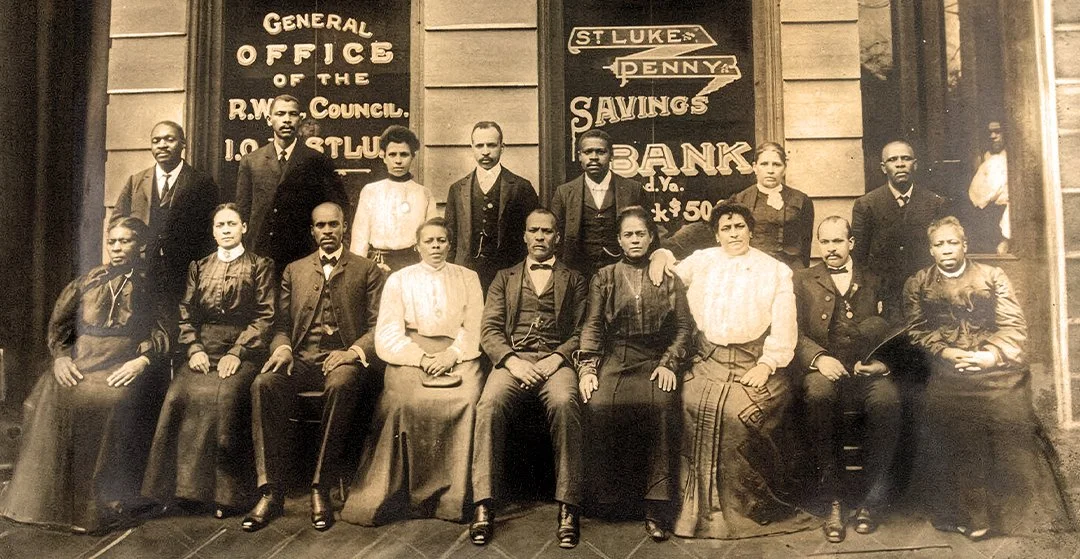
“Let us have a bank that will take the nickels and turn them into dollars,” said Maggie L. Walker, the first African American woman to charter and serve as president of a bank.
(National Park Service / Maggie L. Walker National Historic Site)
By Marcus M. Witcher
This article appears in the Winter 2026 issue of the Coolidge Review. Request a free copy of a future print issue.
Conventional wisdom credits the federal government with lifting Black Americans from slavery, segregation, and discrimination to economic, educational, and political gains. The Thirteenth, Fourteenth, and Fifteenth Amendments, ratified after the Civil War, ended slavery and sought to protect the rights of Black Americans. A century later, the Civil Rights Act of 1964 and the Voting Rights Act of 1965 reaffirmed the promises of those amendments.
True enough. But the relationship between the government and Black Americans is more complicated than this recitation of facts suggests. The government failed African Americans far more often than is usually acknowledged.
For decades, the federal government refused to enforce the Reconstruction amendments. Many federal policies limited the progress of Black Americans—sometimes unintentionally, sometimes intentionally. Lawmakers hesitated to embrace sweeping civil rights legislation until African Americans pressed them to do so, largely through Martin Luther King Jr.’s nonviolent direct action.
From Reconstruction onward, Black Americans overcame many obstacles thrown in their path. They used the capitalist marketplace to build the businesses, organizations, institutions, and associations that would form the foundation for the successful civil rights movement.
The Power of Civil Society
The fight for equal rights began immediately after the Civil War and accelerated during the Jim Crow era. Frederick Douglass, Booker T. Washington, and later the NAACP attempted to use education, the market, and the judicial system to reaffirm the economic, political, and civil rights of Black Americans.
There were few successes, but there were successes. According to economic historian Robert Higgs, Black Americans tripled their per capita income from 1870 to 1914. Likewise, they undertook one of the most successful literacy campaigns in the history of the world. In 1870, only 20 percent of Black Americans were literate. By 1910, the figure had reached 70 percent. It was an incredible achievement.
These economic and educational gains enabled Black Americans to create a robust civil society—institutions that educated and supported future leaders of the civil rights movement. The Black church featured prominently among these institutions. So did mutual aid societies such as the Black Elks, which trained Black Americans in the history of the United States, discussing the Declaration of Independence, the Constitution, and the civil rights amendments. The Elks also trained many lawyers who would one day staff the NAACP. Further, they and other mutual aid societies provided material, educational, and emotional support for Black businessmen and women who were trying to figure out how to use the market to truck, barter, exchange, and get ahead.
These organizations proved essential to the civil rights movement later on. As sociologist Theda Skocpol concludes, Black fraternal societies “developed the collective and strategic capacity to mobilize human and financial resources on behalf of the widespread, popularly rooted protests that, in the 1950s and 1960s, finally broke the back of legal racial segregation in America.” The chief counsel for the NAACP Legal Defense and Educational Fund, Thurgood Marshall, “publicly declared that without Masonic financial assistance, many of the NAACP’s victories before the Supreme Court would not have been possible.”
Where did these organizations earn their money? It wasn’t from government programs—it was through the marketplace. Black Americans were extraordinarily entrepreneurial. They engaged in the market and flourished. They created vibrant and prosperous communities, even in the American South. Unfortunately, government—at both the state and federal levels—didn’t protect their rights to life, liberty, and property for much of the late nineteenth and twentieth centuries. This resulted in tragedies like the 1921 destruction of Black Wall Street in Tulsa.
As the fight for equality gained momentum in the 1950s, it was entrepreneurs, pastors, and the leaders of mutual aid societies who carried the torch. John H. Johnson, the publisher of Jet and Ebony magazines, built a publishing empire through the market, and he used his wealth, power, and publications to show the world pictures of Emmett Till’s mangled body. Those photographs, and the subsequent acquittal of Till’s murderers by an all-white jury, led T. R. M. Howard—a doctor and entrepreneur in his own right—to take up the cause of Till and racial justice.
Howard received an invitation from a young reverend, Martin Luther King Jr., to address Montgomery’s Dexter Avenue Baptist Church. Rosa Parks, a seamstress and an official of the local NAACP chapter, heard Howard’s call to arms and four days later was arrested. Parks recalled that Howard’s speech was the “first mass meeting that we had in Montgomery.” As the historians David and Linda Beito note, Parks “emphasized that Till’s murder was central to her thinking at the time of her arrest.”
It would take a decade of peaceful protest, activism, and some agitation for lawmakers to ingrain in law the promise of the Declaration and the intention of the Thirteenth, Fourteenth, and Fifteenth Amendments. The Civil Rights Act of 1964 and the Voting Rights Act of 1965 should be celebrated, but Black Americans, using the market and their constitutional rights of free expression, deserve credit for making those landmark laws happen.
How the Government Harmed Black Americans
Remember, too, that the federal government’s own policies created or exacerbated conditions that the mid-twentieth-century civil rights movement arose to protest. Rachel Ferguson and I detailed this harm in our 2022 book, Black Liberation Through the Marketplace: Hope, Heartbreak, and the Promise of America. Federal policies centered on housing and highway construction destroyed thriving Black communities.
During the Great Depression, the Federal Housing Administration was established to insure mortgages made by private lenders. The goal was to expand home ownership, but the FHA also promoted “homogeneous neighborhoods.” In practice, this meant that the government would not extend insurance to Black Americans who wanted to purchase homes in white neighborhoods. The FHA’s underwriting manual explained: “If a neighborhood is to retain stability it is necessary that properties shall continue to be occupied by the same social and racial classes. A change in social or racial occupancy generally leads to instability and a reduction in values.”
The federal government created maps of city neighborhoods with particular colors representing their creditworthiness. Red signified the worst neighborhoods. The government labeled many racial and ethnic neighborhoods as “hazardous” and therefore unfit to receive home loans. This “redlining” increased economic disparities and depressed the number of Black Americans who owned their homes.
In 1949 the federal government made the situation worse with the passage of the American Housing Act, which provided for “urban renewal”—a policy that Black Americans referred to as “negro removal.” Planners attached the term slums to unattractive apartment buildings and ramshackle houses filled with minorities and had them destroyed. Many of these communities had been vital cultural and economic centers for poor but upwardly mobile working-class people.
In the 1950s, Black Americans were employed at a higher rate than whites (because of the prevalence of Black women working outside the home); Black marriage rates were at an all-time high; and the combined income of Black married couples was on the rise. Such indicators should have been enough to make them good bets for banks. But in part because of redlining and the FHA’s lending policies, private banks had little incentive to extend credit to Black families.
The Damage Done
The construction of the federal highway system became a disaster for many Black communities. President Dwight D. Eisenhower signed the Federal Highway Act into law in 1956. The law had the unintended (at least by Eisenhower) consequence of displacing more than a million Americans—a disproportionate number of them Black.
Racist city planners routed highways to ensure “vanilla suburbs” and Black ghettos. They ran the highways right through vibrant Black neighborhoods, displacing the residents, usually without compensation. Alfred Johnson of the American Association of State Highway Officials recalled, “Some city officials expressed the view in the mid-1950s that urban Interstates would give them a good opportunity to get rid of the local ‘n——town.’”
The federal government’s push to construct highways without adequate oversight obliterated vibrant Black communities with unique identities, cultures, and civil societies. The top-down government programs of the Great Society and beyond could not re-create the robust neighborhoods the highway builders had destroyed.
Later federal policies increased the damage done to Black Americans, even if the negative effects were unintentional. The Great Society’s welfare programs created destructive incentive structures and contributed to the decline of the Black family. The War on Drugs, launched during the Nixon administration, has disproportionately targeted Black men.
Black Americans had been on an upward trajectory until the 1960s, but then their progress stalled. Although the majority of Black Americans are middle class today, a disproportionate number live in poverty. This unacceptable result has arisen, in no small measure, owing to harmful federal policies.
For far too long, Black Americans could not look to the federal government in the struggle for civil rights and equality. Their most reliable means for lifting themselves out of poverty and fighting discrimination has come from the market and from the rights guaranteed in the Constitution. Far from being liberated by government, Black Americans liberated themselves.
Marcus M. Witcher is a teaching assistant professor of economic history at West Virginia University. He is the author, coauthor, or coeditor of several books, including Black Liberation Through the Marketplace.

This article appears in the Winter 2026 issue of the Coolidge Review. Request a free copy of a future print issue.