
A New Theory About the 1924 Presidential Election
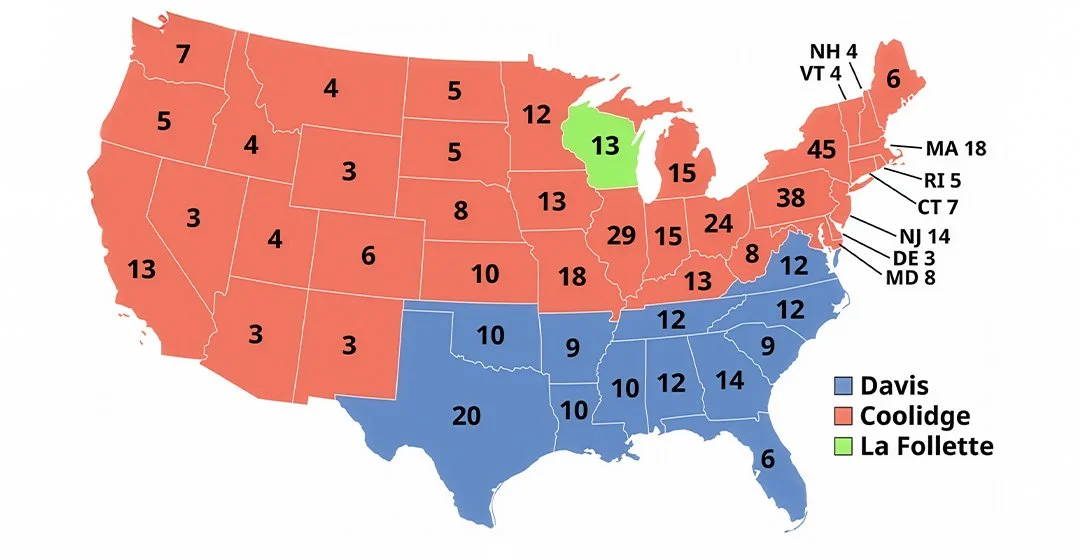
In the 1924 election, President Coolidge won 35 of the 48 states
By the Editors
From the distance of more than a century, a political scientist has taken a fresh look at the 1924 presidential election.
In an article published last year in Presidential Studies Quarterly, Christopher Devine questions the conventional wisdom about how and why the incumbent, Calvin Coolidge, won that election in a landslide. Coolidge had assumed the presidency little more than a year earlier, after the unexpected death of Warren Harding. In 1924’s three-way race, he received more votes than the other two candidates combined and carried thirty-five of the forty-eight states.
As Devine points out, most historians say that a robust economy was by far the biggest reason Coolidge won. Strong economic conditions did work in the president’s favor. But Devine notes that many historians adopt a form of economic “determinism.” In this very common view, Coolidge “does not deserve credit for winning the 1924 election.” Rather, “thanks mostly to the economy, it just happened to him.”
That argument is too simplistic, Devine suggests. He presents both qualitative and quantitative evidence to challenge the standard narrative of the 1924 campaign.
Old Assumptions, New Data
For his empirical analysis, Devine examines “county-level political, economic, and demographic data” alongside county-by-county voting results. Using these data, he tests three common explanations for the election’s outcome:
Did Coolidge win primarily because of the economy? Scraping the data, Devine concludes that the answer is largely yes. And he shows it’s misleading to claim that—as one history textbook put it—Coolidge merely rode “the crest of a wave of economic prosperity for which he was given undeserved credit.” Devine demonstrates that from behind the scenes, Coolidge “took an active role in coordinating campaign messaging” that showcased the administration’s and Republicans’ achievements. For example, Coolidge worked closely with his running mate, Charles Dawes, to keep the famously free-range vice-presidential candidate focused on the economic message. “In the matter of economy and tax reduction,” Dawes declared, “the Federal Government is headed in the right direction.” Moreover, as Devine reports, Dawes argued that the administration’s work to stabilize Europe via the Dawes Plan spared America from “the depths of an inevitable and great depression” while also ensuring that “the whole world enters upon a period of peace and prosperity.”
Did third-party candidate Robert M. La Follette hurt Democratic nominee John W. Davis more than Coolidge? Devine concludes that this effect appeared only in the Great Plains and the Mountain West. It probably wasn’t large enough to change the election’s outcome.
Did internal divisions cost the Democratic Party votes in 1924? The Democrats were so fractured that they needed 103 ballots to choose a nominee at their convention. Devine says it would be hard to imagine that such disarray did not hurt Democrats in the election. Yet he notes that quantitative evidence on the reasons for Democratic losses in 1924 is hard to find because “scientific polling did not exist in the 1920s.”
Seeking an alternative approach, Devine looks at patterns of defection from the Democratic Party by state. He finds that northern states that voted to defeat the anti-Ku-Klux-Klan plank at that year’s Democratic National Convention—in other words, states whose delegations supported the Klan—saw heavier defections in the general election. From that, Devine extrapolates to suggest that Coolidge “benefited from the resurgence of the Ku Klux Klan—or, perhaps one might say, Democrats lost ground because of it.”
Separately, Devine finds that in the North, Coolidge won roughly two percentage points more of the vote in counties where a local Klan affiliate existed. Did Klan fans and members view Coolidge as the best Klan advocate in the field of candidates?
After all, as Devine points out, “Coolidge was the only presidential candidate who refused to denounce the Ku Klux Klan directly and explicitly during the campaign.”
That’s technically accurate, but here additional context is important.
First, the Democrats and La Follette’s Progressive Party ignored the Klan in their party platforms, just as the Republicans did.
Second, Coolidge’s son passed away over the summer of 1924, and for several months, he allowed others to speak for the party. At an event in Augusta, Maine, in late August, Dawes denounced intolerance and said, “I have told you why I am opposed to the Klan.”
Mourning or not, Coolidge was a shrewd enough politician to see little value in chiming in and explicitly addressing a topic that was roiling his opposition. Staying above the fray would have seemed the wiser path.
That doesn’t mean President Coolidge ignored African Americans and their rights. Quite the contrary. He had such a strong record on civil rights that former Baltimore mayor Kurt Schmoke calls him “one of the country’s early civil rights pioneers.” In his first annual message to Congress in December 1923, Coolidge proposed—and later persuaded Congress to pass—a significant appropriation to fund Howard University’s medical school.
Coolidge also spoke forcefully for racial justice in that first message to Congress. He called for federal legislation “against the hideous crime of lynching,” reminding lawmakers that the constitutional rights of Black Americans were “just as sacred as those of any other citizen.”
Coolidge continued to speak out during the 1924 election year. In the spring he delivered the commencement address at Howard—a highly visible anti-racist message.
That summer, Coolidge replied to a voter who had written to complain that a Black candidate was running for Congress “in this, a white man’s country.” The president rebuked his correspondent, saying he was “amazed to receive such a letter.” Coolidge continued: “Our Constitution guarantees equal rights to all our citizens, without discrimination on account of race or color. I have taken my oath to support that Constitution. It is the source of your rights and my rights. I propose to regard it, and administer it, as the source of the rights of all the people, whatever their belief or race.”
Coolidge released the letter publicly, ensuring that it appeared in newspapers nationwide.
On August 21—the same day Democrat John W. Davis condemned the Klan—the White House released a letter from Coolidge to the president of the National Negro Business League. In it, Coolidge reaffirmed his pledge to defend the rights of Black Americans.
Had Coolidge been courting Klan support, it would have been strange for him to write these letters, let alone publish them widely.
The Klan Fades Away
The truth is that the Klan probably was not a decisive factor in the later months of the 1924 election. Supporters of pro-Klan Democrat William McAdoo, one of the potential nominees, were not generally deterred from backing the Progressive La Follette. Davis’s anti-Klan statement reassured eastern Democrats but did little to deter Klan sympathizers in the Democrats’ “solid South.”
The reason for lack of interest in the Klan might be found in Devine’s excellent evidence on economics: the country was doing well and knew whom to credit. Klan marches, especially one in Washington, D.C., in 1925, gained plenty of publicity, but they did not, apparently, reflect broad popularity. As recovery solidified later in the decade, the KKK indeed began to fade from the national stage.
Editors’ note: This article has been revised and updated since its original publication.