
The Quiet President Who Started 2 Lasting Christmas Traditions
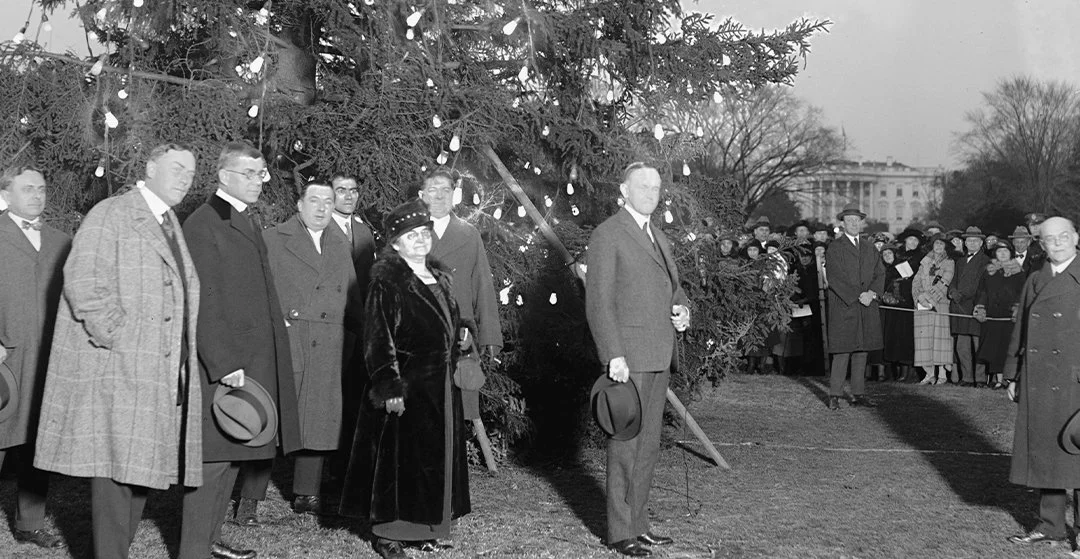
President Coolidge lighting the first National Christmas Tree, 1923
By the Editors
Calvin Coolidge inaugurated two important presidential traditions related to Christmas.
In 1923, Coolidge became the first president to light the National Christmas Tree. Then, four years later, he wrote the first official presidential Christmas message to the American people.
“President Coolidge and his family helped make Christmas a truly public White House tradition,” the White House Historical Association observes. The first tree lighting attracted more than six thousand people to the Ellipse and drew extensive media coverage. Thanks to burgeoning mass communications—“radio, illustrated magazines, and newsreel coverage”—“the First Family’s celebration of Christmas became a vital part of our national yuletide festivities.”
The public display on the Ellipse wouldn’t have been possible without another new technology: outdoor electric lighting. The first National Christmas Tree, a forty-eight-foot balsam fir from Coolidge’s home state of Vermont, featured more than 2,500 multicolored light bulbs. The event’s sponsors included the Society for Electrical Development and the Electric League of Washington. These organizations were, the National Park Service notes, “eager for a public, national, and presidential display of the wonders of electricity.”
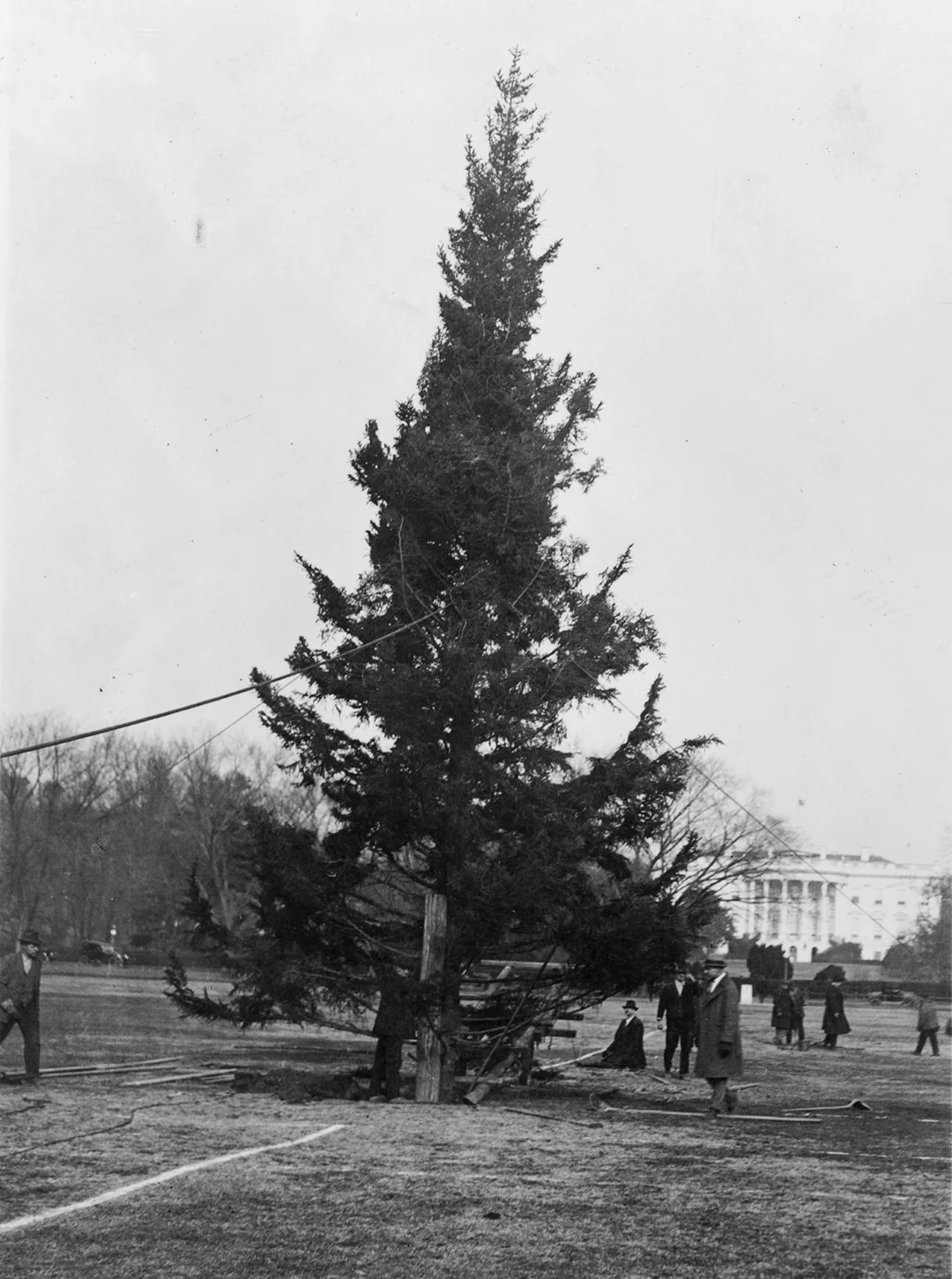
This forty-eight-foot balsam fir from Vermont became the first National Christmas Tree
Christmas Is a State of Mind
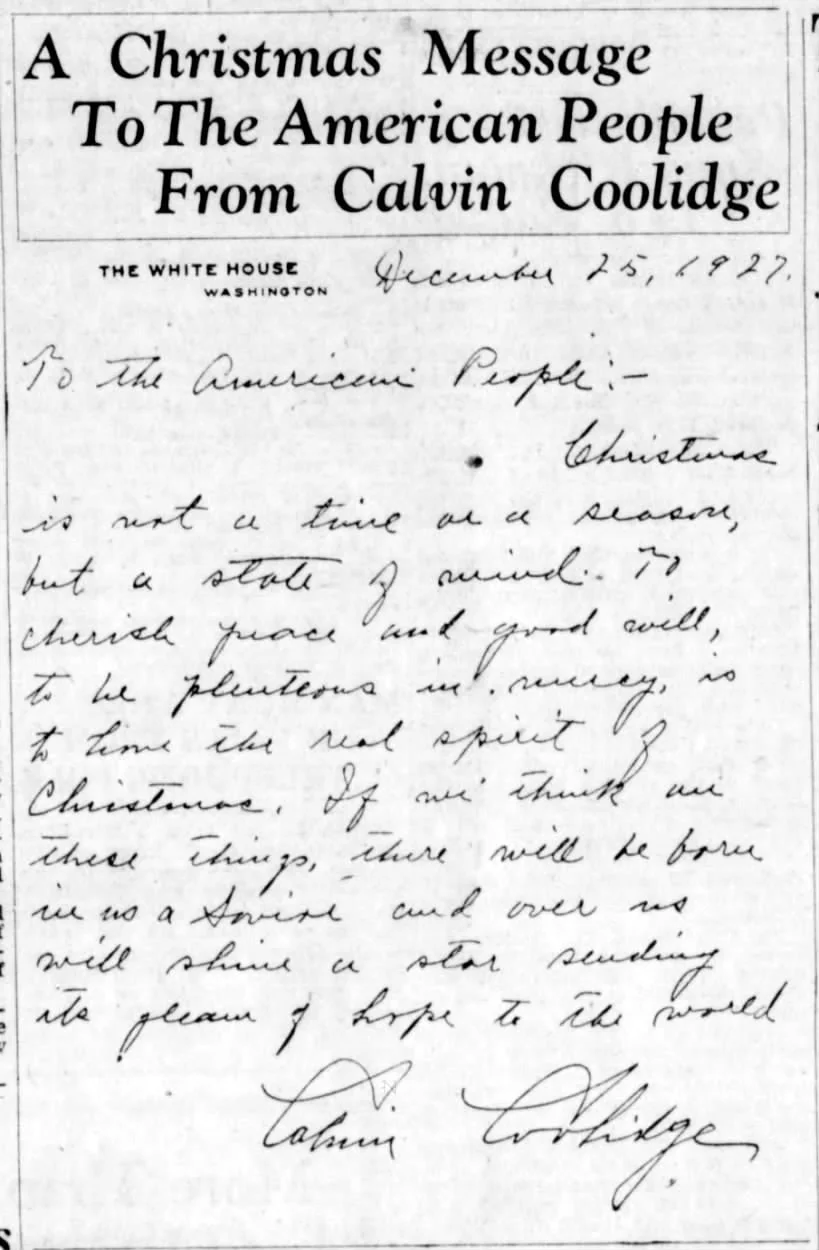
President Coolidge’s 1927 Christmas message, the first such official presidential message
President Coolidge’s 1927 Christmas message was decidedly simpler: a handwritten note of about sixty-five words. Coolidge followed his own advice to “be brief.” But as was so often the case, he packed a lot of meaning into his words:
To the American People:—
Christmas is not a time or a season, but a state of mind. To cherish peace and good will, to be plenteous in mercy, is to have the real spirit of Christmas. If we think on these things, there will be born in us a Savior and over us will shine a star sending its gleam of hope to the world.
Calvin Coolidge
Here again, though, mass communications spread the message far and wide. Newspapers around the country reprinted Coolidge’s message on their front pages.
To Americans today, Coolidge may seem old-fashioned, a vestige of another age. But he showed a passion for modern technology, including the then-new medium of radio. Indeed, the historian Jerry L. Wallace calls Coolidge “our first radio president.”
Even before entering the Oval Office, Coolidge became a radio pioneer. And Christmas offered the occasion for technological experimentation.
In 1922, Vice President Coolidge delivered a Christmas Eve message over the radio. The broadcast itself was notable: only seven months earlier, Warren Harding had become the first president to speak on the radio. But what made Coolidge’s Christmas Eve message even more significant was that it was prerecorded. The broadcast took advantage of a new invention for recording known as the pallophotophone.
You can listen to a portion of Coolidge’s 1922 Christmas Eve message (start at the 00:41 mark). And read along with the transcript.
The Spirit of Christmas
By lighting the National Christmas Tree and writing an official Christmas message to the American people, Coolidge began two presidential traditions that endure to this day.
These traditions seem appropriate Coolidge legacies. Christmas was special to Coolidge, an opportunity to reflect on hope, goodwill, and peace. “Christmas represents love and mercy,” he wrote in his postpresidential syndicated newspaper column of December 24, 1930. “Christmas holds its place in the hearts of men because they know that love is the greatest thing in the world. Christmas is celebrated in its true spirit only by those who make some sacrifice for the benefit of their fellow men.”