
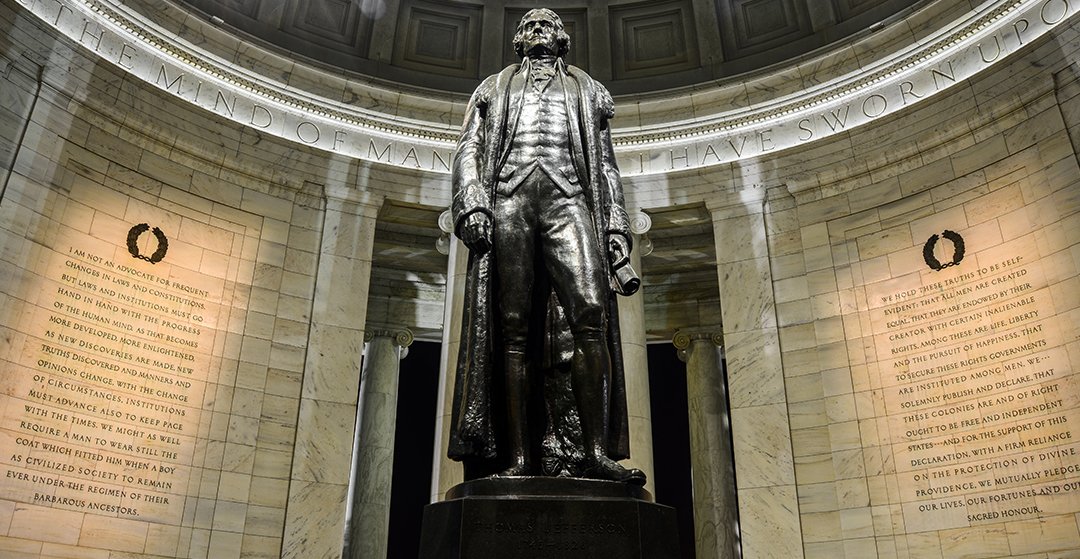
“The greatest sentence ever written” is carved on a wall at the Jefferson Memorial—though the line is slightly misquoted there
By M. C. Murphy
This review appears in the Summer 2026 issue of the Coolidge Review. Request a free copy of a future print issue.
The Greatest Sentence Ever Written
by Walter Isaacson (Simon & Schuster, 2025)
America’s semiquincentennial year could not pass without a little something from a prominent writer or two to mark the occasion. Walter Isaacson has done his part with The Greatest Sentence Ever Written.
The sentence in question is the second line of the Declaration of Independence, beginning, “We hold these truths to be self-evident, that all men are created equal, that they are endowed by their Creator with certain unalienable rights, that among these are Life, Liberty, and the pursuit of Happiness.” The sentence goes on for another seventy-five words in the style périodique, using a series of linked clauses that cascades to the full meaning at the end. The entire sentence addresses the purpose of government and the right of people to change their government.
But Isaacson limits his book to the sentence’s first part, the famous part. In doing so, he delves into what Thomas Jefferson, John Adams, Benjamin Franklin, and the other members of the drafting committee meant by certain words and phrases.
Take “all men.” Isaacson recognizes that the terms man and men have often been used to encompass all humankind, but he argues that the Founders did not intend this broad meaning in the Declaration’s second sentence. Rather, Isaacson writes, “they consciously and intentionally did not mean in most instances to include women, slaves, Native Americans, and in some cases even non–property owners.”
The Founders’ Promissory Note
Isaacson may be right about most or even all signers of the Declaration, but that has not diminished the power of the universal idea that “all men are created equal.” Nor has the fact that forty-one of the fifty-six signers owned slaves, as Isaacson tells us.
The prejudices among those men are less relevant than the words themselves, which have held new and broader meanings from generation to generation. Consider the famous insights of Abraham Lincoln and Martin Luther King Jr.
In the Supreme Court’s Dred Scott decision of 1857, Chief Justice Roger Taney insisted that black Americans were “beings of an inferior order” who should be excluded from the Declaration’s claim that “all men are created equal.” Lincoln condemned this argument, saying it did “obvious violence to the plain unmistakable language of the Declaration.”
Clearly, Lincoln acknowledged, not all Americans “were then actually enjoying that equality.” But the Founders “meant to set up a standard maxim for free society, which should be familiar to all, and revered by all; constantly looked to, constantly labored for, and even though never perfectly attained, constantly approximated, and thereby constantly spreading and deepening its influence, and augmenting the happiness and value of life to all people of all colors everywhere.”
More than a century later, King stood before the reflecting pool in Washington, D.C., and said, “I have a dream that one day this nation will rise up and live out the true meaning of its creed: ‘We hold these truths to be self-evident, that all men are created equal.’ ”
To King, the Declaration constituted a “promissory note to which every American was to fall heir,” by which “all men—yes, black men as well as white men—would be guaranteed the unalienable rights of life, liberty, and the pursuit of happiness.”
Short on Details
As to the phrase “Life, Liberty, and the pursuit of Happiness,” Isaacson shows us that the words derived from the fundamental rights that John Locke identified in his social contract theory: life, liberty, and property.
How did “property” become “the pursuit of Happiness”?
By way of George Mason.
Mason wrote the Virginia Bill of Rights, which was adopted just three weeks before the Declaration of Independence. In it, Mason included this statement: “That all men are by nature equally free and independent and have certain inherent rights, of which, when they enter into a state of society, they cannot, by any compact, deprive or divest their posterity; namely, the enjoyment of life and liberty, with the means of acquiring and possessing property, and pursuing and obtaining happiness and safety.”
Isaacson concludes: “In Jefferson’s formulation, ‘the pursuit of happiness’ is just a simpler way to say all of that. It is your right—and your opportunity—to seek fulfillment, meaning, and well-being however you personally see fit.” That may be so, but philosopher-statesmen of the time often perceived happiness as attainable through wealth, property, and security.
Of course, The Greatest Sentence Ever Written is designed to summarize the main ideas behind the Declaration’s second sentence, not to probe deeply into the scholarship on the subject. Coming in at only forty-eight pages, plus twenty-six pages of appendices, this slim volume is written in an engaging, conversational style and does not include source notes.
Yet one would not mind knowing the origin of some statements in the book. For example, Isaacson says that Franklin crossed out Jefferson’s phrase “sacred and undeniable” and replaced it with “self-evident.” Pauline Maier, in her masterly American Scripture: Making the Declaration of Independence, would go only so far as to speculate that “perhaps” Franklin made the change.
Our Common Ground
Quibbles aside, the reader will find inspiration in the words of the framers and their desire to form a new nation based on “reason, not the dictates or dogma of religion,” as Isaacson writes. The writer encourages a revival of the spirit of 1776 as we face new challenges. The Declaration’s famous sentence “defines our common ground,” Isaacson writes, and “we must continue to fight” for “the rights and aspirations that we all share.”
The final words in this review go to Calvin Coolidge, who, though not mentioned in the book, was the only president born on the Fourth of July and a student of the Declaration. Whereas Isaacson portrays the framers as men of the Enlightenment, influenced by Locke, David Hume, and other European thinkers, which they certainly were, Coolidge said they were inspired by the religious sermons and teachings of Jonathan Edwards, George Whitefield, and other clergy of the colonies. As Coolidge suggested, the influences on the Founders may be more wide-ranging than many historical narratives indicate. These influences are worth pursuing.
But another Coolidge thought can bring together those of us who debate the Founding. In his powerful address “The Inspiration of the Declaration,” delivered in Philadelphia on July 5, 1926, Coolidge proclaimed, “Whatever else we may say of it, the Declaration of Independence was profoundly American.”
M. C. Murphy is the author of Calvin Coolidge: The Presidency and Philosophy of a Progressive Conservative (McFarland, 2023).
This article appears in the Summer 2026 issue of the Coolidge Review. Request a free copy of a future print issue.