
Gratitude, Not Glory: Why Lincoln Rejected Triumph at Gettysburg
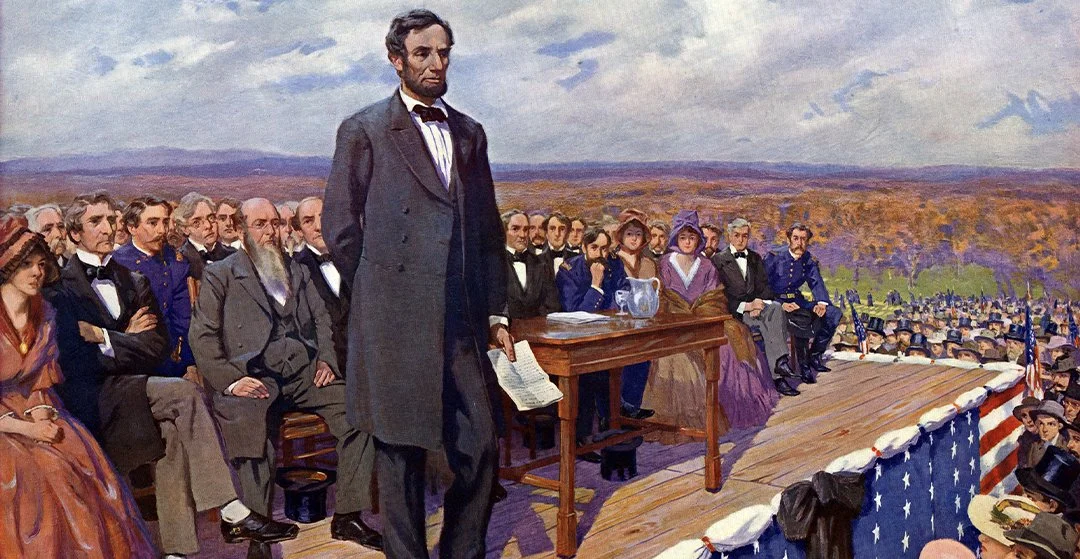
Lincoln’s impromptu remarks of July 7, 1863, foreshadowed the president’s address at Gettysburg four months later
(Wikimedia Commons)
By Andrew F. Lang
This article appears in the Winter 2026 issue of the Coolidge Review. Request a free copy of a future print issue.
A few days after July 4, 1863, loyal citizens descended on the White House. They were exhausted by months of terrible news from the battlefront. Still, they rejoiced at the glad tidings dribbling in from a sleepy though now-blood-drenched Pennsylvania town called Gettysburg. The telegraph offices also clattered joyful bulletins that the Confederate-held Mississippi River fortress at Vicksburg had finally fallen. The exuberant occasion demanded remarks from the president.
The crowd expected their hardened captain to glory in triumph. But Abraham Lincoln did no such thing. He had spent the better part of the past year pondering God’s imperceptible will. Why had this dreadful war come, he wondered, and how might the republic quell the unholy rebellion? Lincoln could not fully answer these questions. He gambled earlier in the year that a committed war against slavery might find God’s favor. Perhaps, though perhaps not. But now the nation’s loyal legions had delivered twin blows against the aristocratic slave drivers. Had Providence finally smiled on the cause of Union?
Though the people came to celebrate, Lincoln declined their cheers. “I will not say I thank you for this call,” he responded. “But I do most sincerely thank Almighty God for the occasion on which you have called.” The “occasion” was the near-mystical coincidence of Union battlefield victories falling on the nation’s birthday. Some “eighty odd years” previously, the president mused, for the first time in the history of the world, an inspired cohort had “assembled and declared as a self-evident truth that ‘all men are created equal.’” The Union’s gory triumphs “now, on this last Fourth of July just passed,” forestalled the Confederate attempt “to overthrow the principle that all men are created equal.” The past and present were bound as one, the founding spirit of the departed fathers living through their devoted offspring.
In offering public thanksgiving, Lincoln conveyed his sense of gratitude. In its classical conception, gratitude is the thankful recognition of unearned good, expressed in the reciprocal will to act in accordance with that good. “This one virtue is not only the greatest,” wrote Cicero, “but is also the parent of all the other virtues.” Lincoln saw gratitude as essential to sustaining a free republic.
The president’s impromptu statement also presented gratitude as a theological virtue. With its recognition of universal human equality, the Declaration of Independence bound the generations with covenantal, eternal truths. It could hardly be mere coincidence, then, that the document’s wisest authors—Jefferson and Adams—died “precisely fifty years” after the Declaration’s issuance. “It pleased Almighty God,” Lincoln said, “to take both from the stage of action” on the nation’s golden jubilee. “This was an extraordinary and remarkable event in our history,” he added, a reminder to posterity of the Founding’s inspired wisdom.
Here Lincoln evoked the 1826 eulogy delivered by one of his political idols, Daniel Webster. “It cannot but seem striking and extraordinary,” Webster said then, that Adams and Jefferson both died on July 4. “As their lives themselves were the gifts of Providence, who is not willing to recognize in their happy termination, as well as in their long continuance, proofs that our country and its benefactors are objects of His care?”
Like Webster, Lincoln was suggesting Divine Providence’s role in America’s rise. A cause for gratitude, indeed. Webster and Lincoln encouraged citizens to act in requisite trust to the gifts bestowed by a favorable God.
Worthy of Sacrifice
Lincoln’s combination of classical and biblical themes of gratitude matured four months later at Gettysburg. Opening with the scriptural cadence “Four score and seven years ago,” Lincoln likened the nation’s lifespan up to that point to the Psalmist’s meditation on the standard measure of a human life. “Our fathers brought forth” echoed Hebraic hymns of deliverance, where the people recalled God’s mediation amid their fathers’ bondage. In Exodus, gratitude operated as a kind of filial devotion, much as it did in Roman pietas.
The nation the Founders brought forth, Lincoln said, was “conceived in Liberty, and dedicated to the proposition that all men are created equal.” There, he united Enlightenment maxim with the biblical image of humanity made in God’s image. As Lincoln had observed in an 1859 letter, Thomas Jefferson had the foresight to include in the Declaration “an abstract truth, applicable to all men and all times.” Preserving this principle made the republic worthy of sacrifice.
The soldiers killed at Gettysburg had made that sacrifice. They “gave their lives that that nation might live,” Lincoln said. Although he had come to Gettysburg to honor the fallen, he continued with humility: “We can not dedicate—we can not consecrate—we can not hallow—this ground.” The startling repetition of the rhetorical negative stressed his theological insight. Human gratitude cannot create holiness; it can only recognize and preserve it. “The brave men, living and dead, who struggled here, have consecrated it, far above our poor power to add or detract,” the president said.
Lincoln thus gave meaning to the cause for which all Union soldiers fought across the vast warfront.
In honoring selfless acts completed for the civic good, Lincoln again evoked Scripture. He said that the soldiers “gave the last full measure of devotion” to the cause, echoing Paul’s call that all disciples “present your bodies a living sacrifice, holy, acceptable unto God.” Gratitude culminated in active, reciprocal devotion for the receipt of sacred gifts.
The peroration of the Gettysburg Address transformed the nation’s wartime anguish into covenantal rededication. “From these honored dead we”—the living—“take increased devotion” to the “great task” of ensuring the nation’s survival, Lincoln noted. A grateful soul acknowledges one’s many faults while pursuing redemption through deeds of thanks. But Lincoln purified the civic with the spiritual when he prayed “that this nation, under God, shall have a new birth of freedom.”
Gratitude now meant preserving the fathers’ earthly creation and awakening to new obligations born of the oldest truths of nature. The classical virtue of gratitude bound citizen to citizen. The biblical virtue bound human to God. In Lincoln’s language, the fate of the republic depended on both, a baptism at once in the ancient faiths of the American fathers and the Heavenly father.
A Maturing theology of Gratitude
After Lincoln’s death, Mary Lincoln recalled that her husband “was not a technical Christian.” And yet he “felt religious More than Ever about the time he went to Gettysburg.” The sweep from his July remarks to the Gettysburg Address revealed Lincoln’s maturing theology of gratitude. At the White House that summer, he honored the fathers who declared the nation’s divine principles. And he thanked a providential God for battlefield deliverance.
That same God appeared again in the brief remarks at Gettysburg, as Lincoln consecrated the fallen sons whose deaths vindicated the fathers’ devotion to nature’s laws. Both commemorative and sacramental appeals expressed the same truth: gratitude fortifies the moral core of a free people, anchoring liberty in reverent remembrance and obligation.
Lincoln’s use of biblical and classical gratitude rejected garish triumphalism. He wove a narrative of a nation under God, a republic of free citizens who, in remembering their gifts, renewed their covenant. His closing lines at Gettysburg—“that government of the people, by the people, for the people, shall not perish from the earth”—echoed professions of thanksgiving in the Old Testament and civic dedications from antiquity. It was the invocation of a statesman who knew that gratitude is at once a virtue of the heart and a guardian of the republic.
Andrew F. Lang is an associate professor of history at Mississippi State University. He is the author of A Contest of Civilizations: Exposing the Crisis of American Exceptionalism in the Civil War Era, a finalist for the 2022 Gilder Lehrman Lincoln Prize. He is now writing on Lincoln and the ancient virtue of gratitude.

This article appears in the Winter 2026 issue of the Coolidge Review. Request a free copy of a future print issue.