
By Jerry L. Wallace
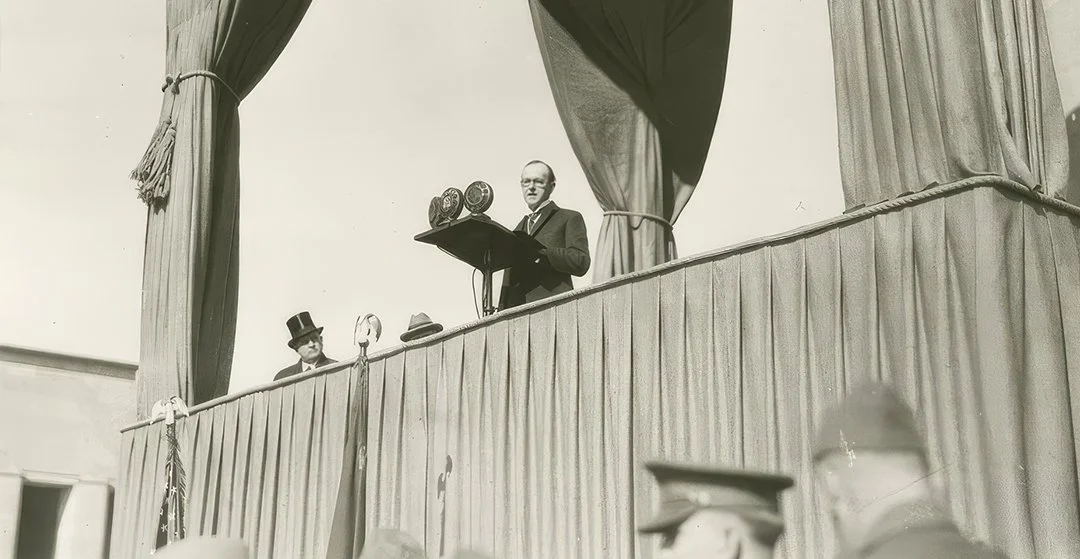
On November 11, 1926, President Calvin Coolidge appeared in Kansas City, Missouri, to dedicate the Liberty Memorial. Although created through the initiative and generosity of Kansas City citizens, this memorial to Americans who had served in the World War, and especially to those who had given their lives, was intended to be national in meaning.
The organizers had signaled this intention from the beginning. In 1921, as vice president, Coolidge had dedicated the site on which the Liberty Memorial would rise. Speaking before a crowd of more than 100,000, with planes circling overhead, the vice president said: “We are dedicating today a light on the land of America to the memory of those who have preserved it. We are dedicating it in the name of liberty, in the name of righteousness, in the name of all American institutions—that the example which your sacrifices have set may be an inspiration to those who shall come after, that life around the fireside may be sweeter, and that our national existence may be upon a higher plane.” When Kansas City laid the cornerstone of the Liberty Memorial three years later, Coolidge—by now president—sent a message that was read at the ceremony.
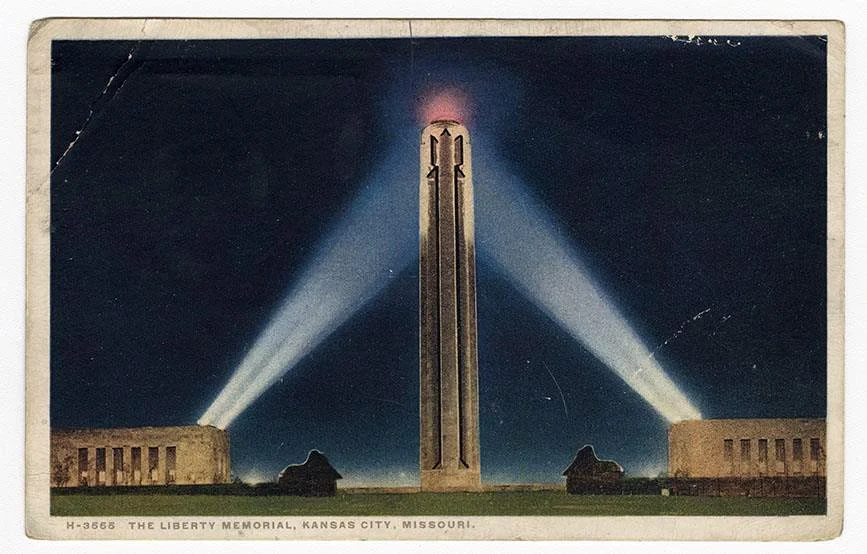
Now, in 1926, President Coolidge returned to Kansas City to dedicate the monument—a great tower crowned by the “Flame of Inspiration,” with four guardian spirits and two flanking buildings. Coolidge would speak for the nation on Armistice Day.
The President Comes to Town
The president’s visit was itself a major event for Kansas City. Presidential travel was still uncommon; the coming of the chief executive generated excitement throughout the community, and Kansas City intended to make the most of the occasion. For days the newspapers reported preparations for the visit in extraordinary detail. The city prepared an elaborate reception, crowds gathered along the presidential route, military units stood ready to render honors, and local business and civic leaders took part in the preparations.
Mayor Albert I. Beach captured the importance Kansas City attached to the occasion in a proclamation issued four days before the dedication. Because of the dedication and “the great honor of the presence of the President of the United States,” he declared that Armistice Day 1926 promised to be “one of the most eventful dates in the entire history of Kansas City.” Beach urged the people to turn aside from their everyday affairs and, so far as practicable, suspend business and industry for the day.
Coolidge had accepted the Liberty Memorial Association’s invitation on October 18. His secretary, Everett Sanders, then worked closely with John T. Harding, chairman of the Dedication Committee, to arrange the visit. Coolidge had several requirements: he would make no formal speech other than his dedication address; no airplanes were to fly overhead while he spoke (aircraft were a serious source of noise and disruption at outdoor ceremonies); and he and Mrs. Coolidge were not to be separated. The Secret Service joined local officials in working out the details, and the final schedule was drawn almost to the minute.
The presidential train left Washington late on November 9. Along the route west, crowds gathered at station stops to see the president and first lady. Coolidge declined invitations for formal receptions or speeches, but he and Mrs. Coolidge frequently appeared on the rear platform to acknowledge the people who had come to see them.
The Coolidges arrived at Kansas City’s Union Station at 8:30 on the morning of Thursday, November 11. Waiting to receive them were Mayor and Mrs. Albert I. Beach, R. A. Long and his wife, John T. Harding, and other representatives of the Liberty Memorial Association. The men, in formal morning dress and silk hats, gave the occasion an appropriately ceremonial appearance. Mrs. Coolidge, however, quickly softened the formality. The Kansas City Star particularly noticed her broad-brimmed sea-green velvet hat and her warm smile, reporting that the receiving line “lost its formality” as soon as she began returning the greetings of those who welcomed her.
Union Station had been decorated for the occasion, with huge American flags hanging over its doors and archways. Outside, in the crisp November morning, an even larger crowd waited for the presidential party. From there Coolidge had his first view of the Liberty Memorial rising on the hill beyond the station. As he emerged, a twenty-one-gun presidential salute boomed from Memorial Hill, fired by Battery F of the 128th Field Artillery of the Missouri National Guard.
Kansas City had gone to considerable lengths to make the president’s progress through the city part of the occasion. Nearly every automobile dealer in the city had offered the president finest car he could provide, and the dealers finally drew straws to determine whose automobiles would be used. Military units had also been assigned places in the procession. Black cavalrymen from the Army Service Schools at nearby Fort Leavenworth rode at the head of the president’s escort.
From Union Station the presidential party proceeded toward the Liberty Memorial. The size of the gathering soon became apparent. The Secret Service estimated the crowd at 150,000, while another contemporary estimate placed it at 175,000. More than 75,000 people were believed to be gathered before the Memorial and the speakers’ stand, with at least that many more massed along the approaches. The Star called it the Southwest’s “largest crowd” and described the gathering as “a solid mass of humanity.”
The ceremony combined military formality with popular participation. Government officials, military officers, veterans, representatives of the American Legion, and civic leaders occupied places near the president, while the great crowd spread outward across Memorial Hill.
Modern communications technology helped make the dedication a truly national event. Amplifiers carried the president’s words across Memorial Hill, enabling the vast crowd gathered there to hear him clearly. At the same time, radio carried the ceremony far beyond Kansas City. WDAF, the station of the Star, began its coverage at 10:15 that morning. Microphones at the speakers’ stand and before the chorus carried the ceremony itself, while a WDAF announcer, stationed in a telephone booth at the site, described for listeners what was taking place. The radio audience could hear the applause that greeted portions of the president’s address, while the five-hundred-voice chorus and fifty-piece band came through with remarkable clarity and volume. In the Star’s studio—and, no doubt, in many homes—listeners stood as the chorus sang “The Star-Spangled Banner.”
Five years earlier, at the 1921 site dedication, no such radio audience had been possible. By 1926, technology enabled the dedication to reach both the enormous gathering on Memorial Hill and an unseen audience far beyond it.
The day was cold, and at one point Coolidge was offered a blanket against the chill. After James B. Swinney’s prayer, “the silence of a church hung over the crowd.” At eleven o’clock the city’s bells tolled eleven times. Coolidge rose and removed his hat, as did those around him. Then, as the bells ceased, the president began his address.
The President’s Speech
Coolidge’s address was more than a ceremonial speech dedicating a war memorial. Speaking on Armistice Day before an enormous gathering and a wider radio audience, the president used the occasion to address some unresolved questions left by the Great War. What obligations did the nation owe those who had served? If another war came, should its burdens fall principally on those called to military service, while others profited at home? And could nations increasingly submit their disputes to law rather than settle them by force?
In discussing the conscription of wealth and American adherence to the Permanent Court of International Justice, popularly known as the World Court, Coolidge gave the Liberty Memorial address a significance extending well beyond the dedication ceremony itself, even beyond our borders.
Coolidge began by turning attention from the imposing monument before him to the men and women whose service it commemorated. The memorial, he observed, represented more than stone and architecture. “The magnitude of this memorial,” he said, “and the broad base of popular support on which it rests, can scarcely fail to excite national wonder and admiration.” He paid tribute to the living and the dead who had served in the Great War and reminded his listeners of the nation’s continuing obligation to its disabled veterans and their families. “Under no other flag,” he said, “are those who have served their country held in such high appreciation.”
Coolidge returned to the theme of national unity. The war had brought Americans of every section and background together in common service and sacrifice. “This is all one country,” the president declared. “It all belongs to us. It is all our America.”
But remembrance of war led naturally to the question of peace. Coolidge reaffirmed his administration’s determination to seek permanent international peace while making clear that the United States would not neglect its own defense. “We realize thoroughly,” he said, “that no one will protect us unless we protect ourselves.” He opposed competitive armaments, which he regarded as a source of international suspicion and conflict, and looked toward further limitations upon naval armaments.
The Burdens of Another War
But remembrance alone was not enough. Coolidge drew from the experience of the Great War a broader lesson concerning the obligations of citizenship in time of national emergency. The men who entered military service had placed their lives at the disposal of the nation. If the country were again compelled to fight, he argued, those who remained at home should not be permitted to profit disproportionately from their sacrifice.
For Coolidge, moreover, the nation’s ultimate strength rested less in the size of its military establishment than in the productive capacity behind it—in its people, its manufacturing power, its agriculture, and its wealth.
Coolidge then advanced one of the most striking proposals in his address. If the United States should again be drawn into war, he declared, the government should have authority to conscript not merely its manpower but its wealth and productive resources as well. The sacrifice demanded of the soldier should be accompanied by comparable sacrifice at home. The nation’s wealth and productive resources should be placed at the service of the country, and private individuals should not be permitted to enrich themselves from the conflict. No more war profiteers.
The proposal was less novel than it might appear. President Warren G. Harding had expressed much the same idea at Denver in 1923, declaring that in another war the government should draft not only the nation’s young men but also “every dollar and every resource and every activity for the national defense.” Coolidge himself had discussed problems of industrial mobilization with Bernard M. Baruch, who had directed the War Industries Board during the Great War and later prepared a memorandum on the subject for the president.
Nevertheless, coming from Calvin Coolidge, the declaration was sufficiently unexpected to attract immediate attention. The Star singled it out as being of “special interest” to the many members of the American Legion in the audience. Senator James A. Reed, a Missouri Democrat and a former mayor of Kansas City, was considerably less receptive. He called Coolidge’s proposal “the most astonishing statement which ever fell from the lips of an American President” and warned that it would produce “national paralysis and national defeat.”
Reed’s astonishment should not obscure the popular sentiment to which Coolidge was appealing. Memories of the Great War were still fresh, and many Americans believed that its burdens had fallen unequally: some had gone into uniform, suffered wounds, or died, while others had made extraordinary profits at home. The resentment was powerful and widespread. A 1920 cartoon in the conservative Saturday Evening Post captured it vividly, depicting chauffeur-driven automobiles filled with prosperous men and women passing by rows of crosses, widows, and orphans. The lead automobile bore a single word: “Profiteers.”
Coolidge later moderated this position. While continuing to believe that the burdens of war should be shared equitably, by 1931 he had moved away from the idea of literally conscripting wealth along with manpower.
The World Court
Coolidge’s concern, however, was not simply with how the nation should mobilize if another war came. His larger objective was to prevent another war. He reaffirmed his support for adequate national defense and further limitation of armaments, but he also believed that nations should increasingly settle their disputes through law rather than force. This brought him to the World Court, an institution he had supported throughout his presidency.
Coolidge was not an isolationist. Although he had come to oppose American membership in the League of Nations, he did not believe that the United States should withdraw from international affairs. He remained strongly attracted to the Wilsonian objective of substituting international law and orderly procedure for the settlement of disputes by force. The World Court particularly appealed to him because it was judicial in character rather than political. American adherence would permit the United States to support the development of international law without assuming the broader political commitments of League membership.
Earlier that year the Senate had approved American adherence to the Court, but with five reservations intended to protect the independent position of the United States. Acceptance required the agreement of the other nations adhering to the Court. By the time Coolidge reached Kansas City, serious difficulties had arisen over the fifth reservation. In his dedication address, the President made his position unmistakable. He would not ask the Senate to modify its terms. Unless the other nations accepted the Senate’s requirements, he declared, “I can see no prospect of this country adhering to the Court.”
The statement sounded final, and much of the press treated it that way. But Coolidge was not abandoning the World Court. His bluntness reflected another concern. He undoubtedly feared that reopening the question might cause the Senate to withdraw the approval it had already given to American participation in the Court. His purpose was, therefore, not to abandon the World Court but to hold firmly to the Senate’s reservations while preserving the possibility that an acceptable agreement might eventually be reached. His interpretation was supported by Senators Thomas J. Walsh of Montana and Claude A. Swanson of Virginia, both of whom had been closely involved in framing the reservations. Walsh said that the president’s Kansas City speech “accurately expresses the attitude of the senate.”
Two years later, following the presidential election of 1928, Coolidge revived the initiative. At a White House breakfast with Republican senators on November 24, he indicated his desire to reopen discussions with the other Court powers while leaving the Senate’s reservations intact. Secretary of State Frank B. Kellogg then renewed diplomatic efforts, and Elihu Root, the distinguished former secretary of state who had helped frame the original World Court plan, played the leading role in working out a compromise. The renewed effort followed closely upon the successful negotiation of the Kellogg–Briand Pact, which complemented the World Court initiative as another Coolidge administration effort to strengthen the peaceful settlement of international disputes. The resulting settlement, completed shortly after Coolidge left office, resolved the difficulties surrounding the Senate reservations. In September 1929 the revised protocols were adopted at Geneva.
But the U.S. Senate never ratified the World Court. President Herbert Hoover did not formally transmit the revised protocols to the Senate until December 10, 1930, by which time the Depression and urgent domestic legislation increasingly dominated Washington. The Senate failed to complete action on the proposal. President Franklin D. Roosevelt renewed the effort in January 1935, sending the Senate a strongly worded message favoring American adherence. His administration, however, did not follow up the message with a comparable political effort to secure ratification. On January 29 the resolution received a majority, 52 to 36, but failed to obtain the constitutionally required two-thirds vote.
The World Court initiative had overtaken by changing circumstances.
“The Most Beautiful Spectacle”
A “great burst of applause” greeted Coolidge at the conclusion of his address. After the ceremont, as the president departed by the north approach, the crowds again acclaimed him. Coolidge repeatedly removed his hat and bowed in acknowledgment. Observers thought they detected “evidence of deep emotion” in his face and bearing.
The well-known Kansas editor William Allen White later called the dedication “the most beautiful spectacle I ever witnessed, and I have seen many.” “Not a hinge creaked,” he added, “in the handling of the crowd or the human elements of the whole affair. It was a great dedication for a great memorial.”
Following the ceremony, President and Mrs. Coolidge attended a luncheon at the Hotel President. At 2:20 they left for a brief motor tour of Kansas City, Kansas. Although that visit had been arranged on only thirty hours’ notice, large crowds lined the route. Six hundred children from St. John the Baptist parochial school greeted the presidential party singing “America,” and the Star reported that the gathering was the largest ever assembled in the city.
At 3:30 that afternoon, exactly seven hours after their arrival, President and Mrs. Coolidge boarded their special train at Union Station and departed for Washington.
Kansas City’s Armistice Day events, however, were not over. At 6:30 that evening, Queen Marie of Romania arrived with her son and daughter. During her six-hour visit she laid a wreath at the newly dedicated Liberty Memorial, attended an Armistice Day concert at the American Royal Pavilion, and was entertained at a private supper and reception. The royal party departed early the following morning.
The timing of the Kansas City visits, which prevented the queen and the Coolidges from meeting, was almost certainly not accidental. Three weeks earlier, Queen Marie had called at the White House, an encounter that had not endeared the publicity-conscious queen to Coolidge.
A Century Later
The next morning, Kansas Citians looking toward the Liberty Memorial discovered an unexpected problem: the Eternal Flame was out. The memorial’s engineer had not been told that the flame was supposed to be eternal. Repairs were quickly made. “At 9:35 o’clock,” the Star reported, “the cloud appeared again for all time.”
The flame had gone out, but the purpose of the memorial had not changed. It had been built not to glorify war but to remember those who had served and sacrificed in the Great War and to preserve the ideals for which they believed they had fought.
Coolidge had asked Americans not merely to honor those who had served but also to consider what the nation had learned from their sacrifice: that the burdens of any future war should be borne more equally, and that the nation should continue seeking ways by which international disputes might be settled through law rather than force.
A century has now passed since Calvin Coolidge stood before the Liberty Memorial on Armistice Day 1926. The generation that fought the Great War is gone. But the Liberty Memorial remains.
So, too, does the obligation that Coolidge expressed so often—to remember those who served, to honor their sacrifice, and to preserve the principles and institutions they defended. In that sense, the great Liberty Memorial continues to perform the task for which Kansas Citians built it more than a century ago. It remains, in Coolidge’s words, “a light on the land of America.”
Jerry L. Wallace, a former Coolidge Foundation trustee, is a historian and an archivist who has written extensively on President Coolidge. He is the author of Calvin Coolidge: Our First Radio President.