
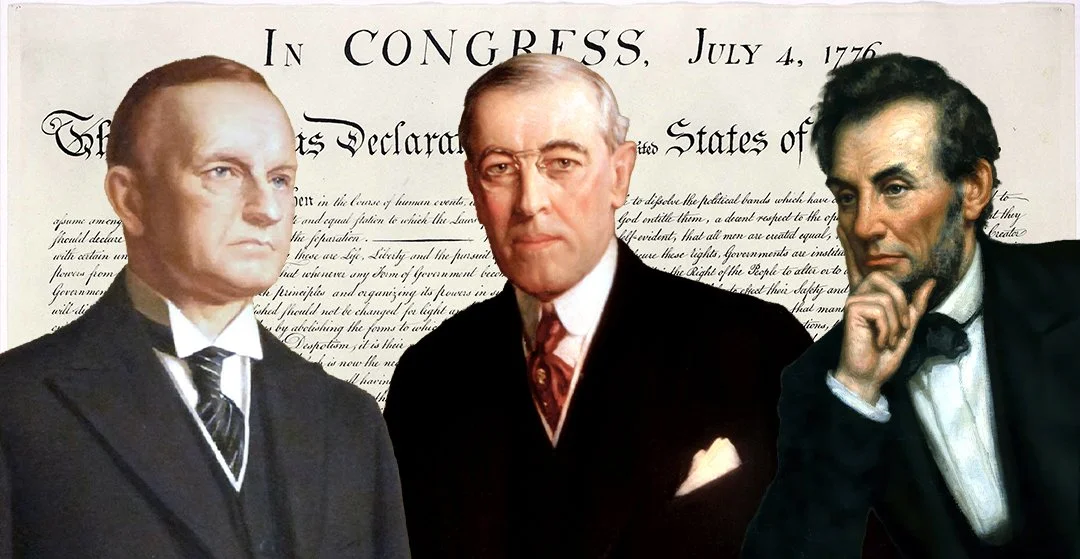
By Alitheia West
“As Jesus is to the Bible (the ideal to the limited reality), so is the Declaration to the Constitution.”
This line comes Garry Wills’s book Lincoln at Gettysburg (1992). Wills uses it to sum up a perspective that the American Transcendentalist Theodore Parker offered in the 1850s.
At first, the quotation gave me pause, especially as a Christian. It sounded like the deification of a document. But I realized that the words were meant only as analogy, not theology, and I breathed a sigh of relief. Heresy averted.
But I still had my doubts regarding the analogy’s accuracy. Is the Declaration of Independence that important to the Constitution? To find my answer, I looked to the lives of three presidents: Abraham Lincoln, Woodrow Wilson, and Calvin Coolidge.
Lincoln’s Apple of Gold
Lincoln believed in a strong relationship between the Declaration and the Constitution. In a fragment he wrote shortly before entering the White House, he argued that America would not have secured a free government without the Declaration. By expressing the principle of “liberty to all,” Lincoln said, the Declaration inspired the colonists with its “promise of something better than a mere change of masters.” To illustrate this point, Lincoln alluded to Proverbs 25:11, a verse that describes “a word fitly spoken” as “apples of gold in pictures of silver.” He framed the Declaration as the apple and the Constitution as the picture, intended to protect the centerpiece without overshadowing it: “The picture was made for the apple—not the apple for the picture.”
Ultimately, this view of the documents’ connection proved central to Lincoln’s arguments against slavery. Lincoln came to see abolition as the long-overdue fulfillment of the Declaration’s promises of liberty and equality. That fulfillment would come only after the end of the Civil War and a constitutional amendment, an amendment that Lincoln did not live to see.
Wilson Dismisses the Declaration
In contrast, Woodrow Wilson thought the Declaration–Constitution relationship was all but nonexistent. This is because he dismissed the Declaration’s idealistic preamble.
In his Fourth of July address in 1914, President Wilson argued that the preliminary part was not “the heart of the document.” Years prior, Wilson had contended that the Declaration’s ideals had no claim on modern people, who should instead “determine afresh” the principles that guided them. On another occasion, he summed up his interpretation quite clearly: “If you want to understand the real Declaration of Independence, do not repeat the preface.”
Wilson’s version of the Declaration can have no power over the Constitution, for it is only a relic, not a beacon. Wilson used this severed connection to defend his racist and sexist policies. He segregated the federal workforce for the first time since the Reconstruction era, and he opposed a constitutional amendment granting women suffrage for fear of endangering Jim Crow laws.
Wilson’s view of the two Founding documents as separate ended up undermining both.
Coolidge and the Finality of the Declaration
Calvin Coolidge, sworn in less than three years after the Wilson presidency, reaffirmed Lincoln’s belief in the Declaration–Constitution connection. In his 1926 speech “The Inspiration of the Declaration,” he restored the significance of the Declaration’s preamble. This passage is more than rhetoric, Coolidge argued; it establishes eternal values from which there cannot be progress, only regress. In the most frequently quoted passage of this speech, Coolidge proclaimed, “If all men are created equal, that is final. If they are endowed with inalienable rights, that is final. If governments derive their just powers from the consent of the governed, that is final.”
This perspective guided Coolidge’s actions as president. He advocated for the rights of black Americans, appointed the first woman to the federal judiciary, and signed the law granting full citizenship to all Native Americans. In recognizing the import of the Declaration, Coolidge allowed constitutional governance to flourish.
Guiding Principles
Is the Declaration of Independence as important to the Constitution as Theodore Parker once suggested? After surveying these three presidents, I say yes.
Jesus is the heart of the Bible, and the Declaration is the heart of the Constitution. Both are spiritual cores that animate their practical counterparts, detailing either religious living or democratic governance. These central organs may appear unnecessary when all is well, but if they are carved out, the bodies cannot function. Christians turn to hypocrites, and patriots turn to bigots. When Christians face decisions where no Bible verse dictates a clear right choice, they need the guiding principle of imitating Christ. When Americans cannot find an explicit provision in the Constitution to settle dispute, they need the immortal values expressed in the Declaration.
For all its hyperbole, the analogy is apt.
Alitheia West, a student at Patrick Henry College, is a 2025 Coolidge Senator and the winner of the 2026 Coolidge Cup, the Coolidge Foundation’s national debate championship. This article is adapted from West’s prize-winning essay in Constituting America’s 2026 We the Future contest.