
The Garage Where Silicon Valley Began
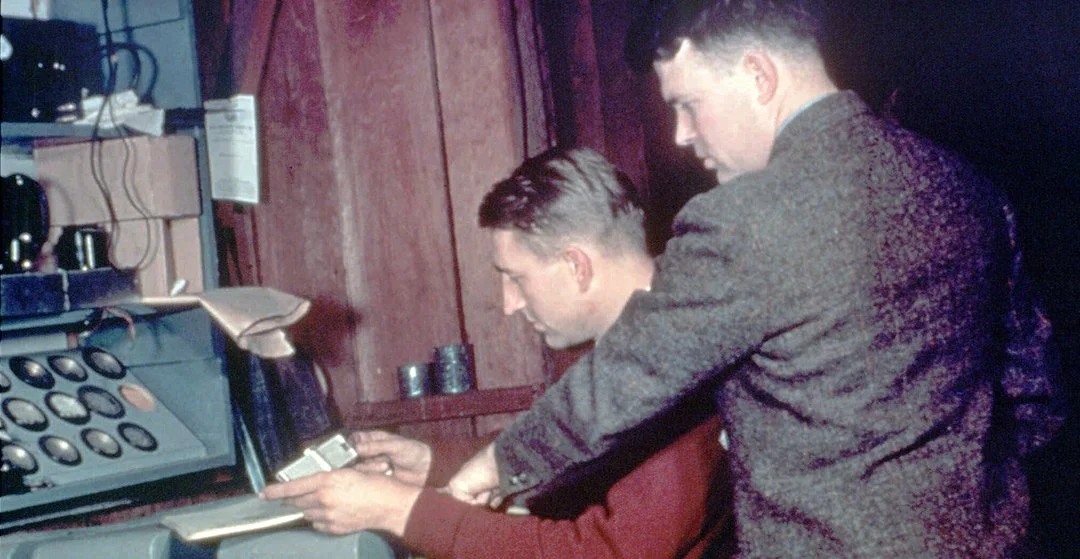
Dave Packard (left) and Bill Hewlett launched their company from Packard’s garage in Palo Alto, the birthplace of Silicon Valley
By Christopher DeMuth
This article appears in the Summer 2026 issue of the Coolidge Review. Request a free copy of a future print issue.
The 1960s and 1970s were decades of busy, bossy, Washington-centered government: Great Society programs. Wage-and-price controls. New national departments of Education and Energy. New agencies regulating health, safety, environmental quality, civil rights, and much else.
Most of those initiatives fell radically short of their promises, and many of them made matters worse.
As federal spending surged, the United States experienced “stagflation,” combining high inflation and high unemployment. By 1980 the “misery index” topped 20 percent—13.5 percent inflation plus 7.2 percent unemployment.
Even in the face of these impositions, the economy chugged along respectably. Gross Domestic Product doubled between 1960 and 1980, averaging 3.6 percent growth annually despite four recessions.
A critical driver was new-and-improved technology. Commercial jet airline service appeared in the early 1960s, speeding business and personal travel. The price of a five-minute coast-to-coast telephone call, measured in today’s dollars, fell from about $40 in 1960 to $2 in 1980.
But technology, to achieve its promise in full, required skilled technologists with a spirit of enterprise and a taste for adventure. These it found in California’s Santa Clara County, which would soon be known as Silicon Valley.
In the 1950s it was a Fruit Tree Valley, producing most of America’s apricots and one-third of the world’s prunes. By 2000 it would be the most dynamic center of business innovation in human history, and just getting started. Today it is home to five of the ten largest companies in the world by market capitalization—Nvidia, Apple, Alphabet (Google), Meta (Facebook), and Broadcom—plus runners-up Oracle, Netflix, Cisco, and Intel, all in the top fifty. Innumerable smaller outfits are plotting to join, and maybe overtake, the big boys.
Silicon Valley regularly absorbs more research investment and generates more patents than anywhere else. Its products—smartphones and laptops, search engines, streaming, social media, cloud computing, AI—are part of the daily lives of billions of people. If the region were a nation, its economy would rank with Switzerland’s; it would be the size of Israel’s and Norway’s combined.
The founding fathers of this transformation were David Packard and William Hewlett, who named their partnership Hewlett-Packard with a coin toss.
Packard and Hewlett were classmates at Stanford in the 1930s, with a shared interest in electronics and mathematics. The big electronics firms, such as General Electric, were on the East Coast, so Packard went east to work at GE for a time. But those firms were devoted to sustaining established markets in such things as power generation.
The two Stanford grads wanted to try new things.
Where It All Began
Their favorite professor, the legendary Fred Terman, was keen on commercializing academic ideas and developing the local economy. With his encouragement, Packard and Hewlett set up shop in a small garage behind Packard’s home in Palo Alto. Hewlett lived in an adjacent one-room shack, and Mrs. Packard kept the books at the kitchen table—books that were small potatoes but showed a profit in their first year.
Their first product was a superior audio oscillator that Hewlett perfected in a Stanford lab. They sold eight of them to Walt Disney Studios, where they contributed to the sonic innovations in Disney’s pathbreaking 1940 movie Fantasia.
That garage is now a National Historic Site—designated the “Birthplace of Silicon Valley.” But they soon outgrew it. During World War II, Bill Hewlett was drafted, while Dave Packard stayed behind to supervise production of sophisticated battlefield equipment—aviation instruments, counter-radar devices, proximity fuses. When Bill got back from the war, he discovered that Dave had been holding all HP salaries, including his own, to no more than Bill’s army pay.
That, like the coin toss to decide the firm’s name order, epitomized the duo’s principled devotion to their enterprise, which they proceeded to impart to growing ranks of employees. They called their business philosophy “The HP Way,” and it boiled down to one word, “contribution.”
The company’s aim was to produce quality products with advanced technology that solved customers’ problems and improved their work. Profits were not a purpose but rather feedback—the measure of the company’s contributions and the source of its investments in further contributions.
Inventing the Desktop Computer—by Accident
In the 1950s and 1960s, Hewlett-Packard specialized in measurement and testing instruments for business, medicine, and the military. Its product line grew to the hundreds, employment to the thousands, and revenues to the hundreds of millions. It deepened its alliance with Stanford, establishing research labs on university property and financing graduate studies for its employees that attracted young engineers from across the country.
In 1964 the company produced the world’s first solid-state cesium-beam atomic clock. HP flew the device around the planet, along the way synchronizing the world’s atomic clocks to within one-millionth of a second. That paved the way for the synchronous global and space communications we now take for granted.
And then, by accident, Hewlett-Packard invented the desktop computer. HP had designed electronic controllers for its measurement devices, but its engineers thought they could be repurposed to replace the noisy, cumbersome mechanical calculators then in every business office. Introduced in 1968, the HP Model 9100 desktop was called a calculator rather than a computer—to sound familiar and to avoid the attentions of IBM. But it was a true computer, with instant calculation of trigonometric, logarithmic, and hyperbolic functions, and capable of being programmed for extended procedures.
The 9100 was a technology landmark and immense commercial success. But an even bigger one soon followed.
HP’s high-tech neighbors in what was beginning to be called Silicon Valley (for the revolutionary silicon chip) were producing ever smaller and faster microprocessors. HP adapted them to create the first handheld computer, the HP-35, released in 1972. The venerable, ubiquitous slide rule, recently in service on the moon with Apollo 11, disappeared overnight. A succession of handhelds through the 1970s featured sophisticated scientific, financial, and math functions. You could write your own programs and store them on little magnetic strips. The devices popularized Reverse Polish Notation—more efficient than algebraic notation for calculations of any complexity, and a continuing nerd cult.
Many people of my age remember that the appearance of these devices in the 1970s was as miraculous as the iPhone in 2007. Millions upon millions were sold. The brilliant and powerful HP-12C, introduced in 1981, has been in continuous production for forty-five years and remains the industry standard for financial calculators.
HP has had its failures as well. The HP-01, a wristwatch-calculator introduced in 1977, was a miniature miracle but ahead of its time and soon discontinued. The 1990s and 2000s saw many product and management missteps. Yet HP is today the world’s leading supplier of office printers and is second only to China’s Lenovo in personal computers.
Pioneers of Entrepreneurial Culture
The story of Dave Packard and Bill Hewlett extends beyond the company they created. They led the way for the neighborhood firms that have come to even greater prominence.
Silicon Valley, though boosted by military spending on research and matériel, was not the result of any deliberate government policy. Indeed, California was a relatively high-tax, actively regulated state even in the 1960s and 1970s. But one of its laws, a legacy of the “free labor” movement of the late nineteenth century, banned non-compete clauses in employee contracts. In many other states, non-compete contracts were used to prevent restless employees from leaving for other companies or to start their own. In Silicon Valley, employees had greater agency.
Case in point: In the early 1970s, HP engineering genius Steve Wozniak conceived a new kind of personal computer aimed at hobbyists and gamers. HP officialdom, intently focused on professional and academic markets, rejected the idea. So Wozniak, with the encouragement of twenty-one-year-old Steve Jobs, a former HP summer intern, left on friendly terms in 1976 to form Apple Computer Company. The latter-day Hewlett and Packard set up shop, naturally, in Jobs’s family garage.
The deep explanation for the rise of Silicon Valley is its highly entrepreneurial culture pioneered by Dave Packard and Bill Hewlett. It was nurtured by the development-minded Stanford of yore, where the term “engineering scholar” was used without irony. It was a culture of invention, risk taking, intellectual networking, competitive mobility, decentralized management, hospitality to immigrants from across the Pacific, and continual translation of bull-session brainstorms into valuable products. HP was its proof of concept, and it spread through a process of intense mimesis that no other locality could match.
Dave Packard once directed an HP engineer to discontinue work on a speculative, idiosyncratic research project. But the work continued in secret, resulting in a highly successful new display monitor. Dave’s response was to present the rebel with an award at a company retreat. It read: “For extraordinary contempt and defiance beyond the normal call of engineering duty.”
America’s economic dynamism, which has propelled the nation through innumerable errors of government policy, is the result of a million such acts of damn-the-torpedoes initiative.
Christopher DeMuth served in the Nixon and Reagan administrations and spent more than two decades as president of the American Enterprise Institute. He is a trustee of the Coolidge Fund.
This article appears in the Summer 2026 issue of the Coolidge Review. Request a free copy of a future print issue.