
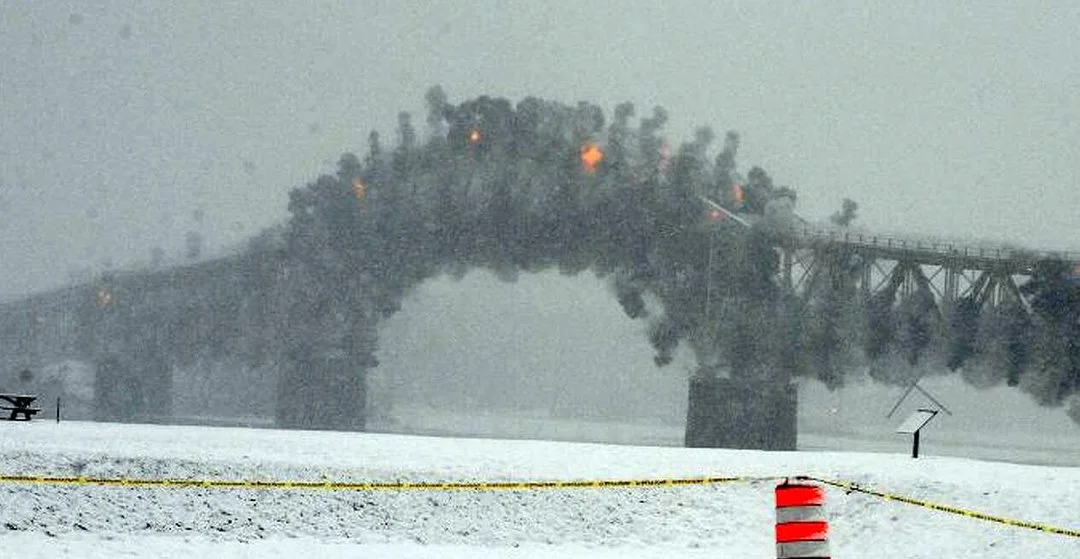
The old Champlain Bridge was demolished in late December 2009
By James H. Douglas
On October 16, 2009, officials abruptly closed the Champlain Bridge, an eighty-year-old span across Lake Champlain linking Vermont and New York. Inspectors had discovered deterioration in the bridge’s supports so serious that the bridge was no longer safe for travel.
The closure upended life for thousands of people in the Champlain Valley. Commuters suddenly faced detours of up to a hundred miles. Some businesses arranged accommodations for workers so they wouldn’t need to return home every night.
The closure harmed the local economy, too. Cut off from customers, many businesses saw their revenues plunge. The Bridge Restaurant, on the Vermont side of the lake, experienced such a dramatic decline in business that its owners renamed it the “No Bridge” Restaurant.
I was governor of Vermont at the time. We needed solutions, and quickly.
Fortunately, private businesses stepped up to help.
President Coolidge saw private enterprise as the key driver of our nation’s prosperity. He famously noted, “The chief business of the American people is business.” The historical record also suggests that in crises, private-sector actors can often respond more efficiently and effectively than government can.
Hence “Business to the Rescue,” the theme of the Coolidge Foundation’s conference earlier this year and of the Summer 2026 Coolidge Review.
It isn’t just large, national businesses that make a positive impact. Sometimes smaller enterprises rally to help.
The Champlain Bridge closure offers a case in point.
Closing the Bridge
Most of the state line between New York and Vermont lies along Lake Champlain. The lake stretches roughly 120 miles from Quebec in the north to near Whitehall, New York, at its southern point. Connected by a canal to the Hudson River and by the Richelieu River to the St. Lawrence River and Canada, the lake represents a major commercial and transportation artery. It facilitates trade vital to Vermont’s economy.
Ferries have long played an important role on the lake. The Lake Champlain Transportation Company was founded in 1826 to move people and vehicles between New York and Vermont. Originally the ferries were operated by teams of horses walking on turntables, but steam engines eventually replaced horsepower.
The steamboat industry attracted government oversight. In the 1880s, Andrew Goodhue of Burlington, Vermont, was appointed a federal steamboat inspector. Goodhue’s only child, daughter Grace, would later marry Calvin Coolidge.
As automobiles increased in popularity in the twentieth century, the need for a bridge crossing Lake Champlain became more apparent. In 1929, Governors John Weeks of Vermont and Franklin Roosevelt of New York dedicated a highway bridge spanning a narrow section of the lake.
The Champlain Bridge supplemented ferry service for the next eighty years. It shortened drivers’ journeys dramatically. The bridge made commuting between New York and Vermont more practical, allowed trucks to transport goods more easily, and encouraged tourism.
By the twenty-first century, however, the bridge was showing its age. In 2007, Vermont and New York began planning a replacement bridge. But the structural issues discovered in 2009 forced the bridge’s closure years before the target completion date.
This is when local businesses stepped in to help.
Business to the Rescue
Almost immediately, the Basin Harbor Club, a lakeside resort in Vermont, put its tour boat to work ferrying passengers across Lake Champlain.
A ferry service south of the bridge also came to the aid of stranded commuters. The Fort Ticonderoga Ferry dates to 1759, when Lord Jeffrey Amherst established it to connect British forts on either side of Lake Champlain. Back then, the service used rowboats and canoes. Today, underwater cables pull the ferry across the lake.
Normally a seasonal operation, the Ti Ferry, as it’s known, was getting ready to shut down for the winter when the Champlain Bridge closed. The business decided to keep the ferry running to accommodate the surge in demand. Ice on the lake forced the Ti to suspend service for a few days that December, but otherwise the ferry ran through the end of the year. The Ti provided an essential option for travelers needing to cross the lake.
The Champlain Bridge couldn’t be repaired. A few days after Christmas, I pressed the detonator that demolished the old bridge. It would take nearly two years for the replacement to be ready, which meant we needed a dependable ferry service for the longer term.
The Lake Champlain Transportation Company provided one. The company set up two vessels near the site of the bridge. The ferries soon operated twenty-four hours a day, seven days a week, with departures from each shore every half hour. In late February 2010, the ferry even began carrying heavy commercial and farming vehicles, increasing the flow of commerce.
Establishing this ferry service on short notice was no simple task. To pull it off required vessels, trained crews, operating expertise, and the ability to transport passengers and vehicles safely even in bad weather conditions. Government, starting from scratch, could not have set up an around-the-clock ferry operation as efficiently as an experienced business.
But the Champlain Bridge closure also illustrates how government can support private enterprise in an emergency. Unlike the Lake Champlain Transportation Company’s regular ferry routes, the temporary bridge crossing remained free to customers. Federal and state funding made this possible.
Stepping Up in a Crisis
In November 2011, a replacement bridge opened, restoring normal traffic across Lake Champlain. Let’s hope this span lasts at least another eighty years.
The Champlain Bridge closure had imposed serious hardships on the people of Vermont and upstate New York. It disrupted daily life, threatened livelihoods, hurt local businesses, and damaged the regional economy.
But the crisis would have been far worse had local businesses not responded so swiftly and with such ingenuity.
The situation reminds us that when trouble comes, we need not turn only, or even primarily, to government for answers. Often private businesses have the experience and initiative to help in difficult situations.
James H. Douglas served as governor of Vermont from 2003 to 2011. He is a trustee of the Coolidge Foundation.