
Oil: Venezuela’s Problem
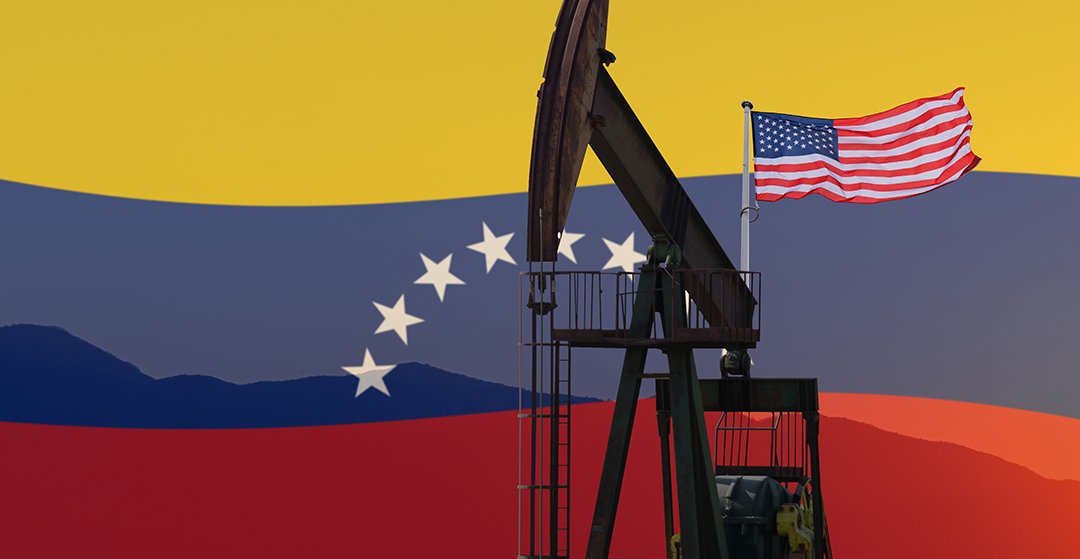
By Amity Shlaes
This essay is adapted from Amity Shlaes’s regular column “The Forgotten Book,” which she pens for “Capital Matters” as a fellow of National Review Institute.
The modern right-left battle is theater—with consequences.
But let us face it, many focus on the theater part.
Consider the drama currently unfolding in New York City. On one side stands New York’s new mayor, Zohran “warmth of collectivism” Mamdani, the most prominent representative of the new, millenarian, American left.
On the other side stand the fire-breathing rightists of the Trump administration, whose Justice Department has parked in Brooklyn’s Metropolitan Detention Center—the heart of Mamdani territory—one of the world’s most dangerous leftist dictators, Nicolás Maduro of Venezuela. Maduro, who initially rose to power on a platform of his and his predecessor Hugo Chávez’s version of millenarianism, “Socialism of the Twenty-First Century,” will now face charges of narcotics trafficking and terrorism. This, as the attorney general put it, will subject him to “the wrath of American justice.”
One can only imagine the reactions of the citizens of Sunset Park, who voted strongly for Mamdani, at finding the tyrant advocate of “Socialism of the Twenty-First Century” to be their new neighbor. And one can only imagine the multi-act play that will follow.
Mamdani won his election by campaigning as the anti-Trump. Now the Trump administration is forcing the mayor to play host to the Maduro show. Perhaps circumstances will force Mamdani to articulate the difference between his collectivism and the collectivism of Maduro. Perhaps, after an effort to distance himself from Operation Absolute Resolve, he’ll find himself identified with Maduro, which even New Yorkers, especially Venezuelan exiles in the city, may not be able to stomach.
Flush as it may be with the sheer achievement of extracting Maduro from Venezuela, the Trump administration must now both envision and sell a future for Venezuela beyond “running” Venezuela, the president’s term.
Doubtless, the Trump requirements for that Venezuelan future will start with “not socialist.” Beyond that, there is already some discussion among think-tank types of working with alternates to Maduro, such as Venezuelan “Chavistas,” politicians likewise in the tradition of Hugo Chávez. Secretary of State Marco Rubio took a first stab at the big topic when he spoke about building a “bright future for Venezuela.” The secretary also left open the suggestion that turning Venezuela around might be easier than skeptics imagine. Venezuela, Rubio noted, is in our own hemisphere, one of the “Western countries with long traditions” and affiliation with the United States. To underscore his point, the secretary warned that the public shouldn’t listen to “experts” who predict permanent Middle East–style trouble for Venezuela. “Venezuela looks nothing like Libya. It looks nothing like Iraq.”
But in one respect, Venezuela does look like Libya and Iraq, only more so. That respect is oil. Venezuela controls about a fifth of the world’s proven oil reserves, about double those of Iraq and over six times those of Libya. And the record of what such commodity wealth does to nations such as Venezuela is one topic that cannot be explained by mutual right-left vilification.
Indeed, commodity wealth—and even what to do with it—is an area where the “experts” and “elites” of both right and left have, after long consideration, come to a powerful consensus. Natural resources bring trouble to developing nations. Deals over natural resources bring trouble. Cronyism involving natural resources brings trouble. An understanding of this reality is the most important basis for a better future for the country that we have so spectacularly liberated.
The Commodity Curse
Consider the record of modern Venezuela, starting, say, in the 1920s, a time when the blowout at the Barroso Well and further discoveries at Lake Maracaibo Basin confirmed Venezuela’s petro-potential. The culture evolved into one of public-private partnership, the “public” being various Venezuelan governments and the “private” being largely non-Venezuelan—British, American—oil companies. U.S. oil companies lauded the country’s petroleum laws as “the best in the world,” though, as Wall Street Journal reporter Everett Martin noted many decades later, that was probably because foreign companies’ attorneys wrote those laws. It was to the friendlier Venezuela that, after Mexico’s Álvaro Obregón expelled him, William F. Buckley Sr. moved his business. From Standard Oil of New Jersey to Royal Dutch Shell, Mobil, and Gulf, mid-century oil companies invested billions in Venezuelan oil, making the industry the region’s powerhouse. In short, Brits and then, increasingly, Americans, to use President Trump’s verb, “ran” things.
The basis for this was a tacit deal. Foreign investors made profits. Foreign consumers and foreign governments—most especially the United States—got the oil they needed and regional stability. Venezuelan authorities—whether outright tyrant dictators, like General Juan Vicente Gómez, or softer reformers—got their share in jobs, royalties, and taxes. They, in turn, built roads and hospitals. Reckoned as an aggregate, growth in Gross Domestic Product, the outcome looked strong. And the economists who observed and monitored Venezuela did not believe it mattered so much that the growth came from a single commodity. “All growth is good” became the rule, taught and enforced after World War II by both the World Bank and the International Monetary Fund.
For a while, these presumptions appeared to hold true. By 1950, Venezuela’s GDP per capita was the fourth-highest in the world. As a World Bank report noted in 1961, Venezuela was “one of the world’s most prosperous ‘less developed’ countries.” There were periods of violence, periods of injustice, periods of expropriation for the foreign robber barons. But with enough growth, observers believed, Venezuela would—like, say, Texas—outgrow its cowboy days, its habit of torturing regime opponents, and become prosperous, decent, and stable.
Throughout the 1960s, foreign observers continued to tell themselves that once Venezuela got rich enough in the aggregate, individual Venezuelans would find themselves in a happy democracy. The key was keeping the foreign investors. As late as 1971, Venezuela’s mining minister, Hugo Pérez La Salvia, was therefore assuring the Journal’s Martin, “Venezuela is a showcase to the world on treatment of foreign investors.”
A few contrarians, however, managed to make themselves heard. Perhaps aggregates like GDP were the wrong measure of individual Venezuelans’ welfare. Some of the critics were the usual socialists and communists. Others, however, were statesmen or practitioners of international finance from other lands. What if, they asked, commodity wealth differed from other wealth and was somehow pernicious? What if commodity wealth didn’t trickle down, or even sideways, but merely clumped in a few hands? What if individual ownership mattered more than collective benefits?
Recognition of the resource challenge started with those who identified a narrower phenomenon relating to currency: “Dutch Disease.” Named after the Netherlands’ troubles in the wake of natural gas discoveries in the 1950s, the dynamic starts with good news: a windfall commodity discovery. Strong demand for exports of that commodity appears to elevate the nation’s overall prospects. The natural gas—or oil, or gold—will so enrich the nation that its economy can diversify and grow. Or so the thought.
But demand for the windfall commodity causes the nation’s currency to appreciate. That appreciation renders other exports by the same nation less competitive. Profit margins across multiple sectors narrow; hard times and joblessness follow. A nation that had hoped to use its windfall to diversify its economy finds itself weaker—and more dependent than ever on the exports of the windfall commodity.
Soon enough, the idea of commodity or resource curses spread beyond the narrow Dutch Disease. What if commodity wealth strengthened cronyism or prevented democracy? What if it suppressed enterprise in other areas? What if it enabled suppression of individuals, or a whole class of them—say, women? In the Middle East, the oil racket gave fundamentalists in power the clout to enforce sharia law. Oil wealth provided the world’s best license for cronyism and corruption. One of the most eloquent critics of the “all growth is good” argument turned out to be, of all people, one of the founders of OPEC, the Venezuelan Juan Pablo Pérez Alfonzo. “It is the devil’s excrement,” he concluded of oil. “We are drowning in the devil’s excrement.”
The Resolve Needed After Operation Absolute Resolve
In the early 2000s, any number of scholars and authors studied the commodity curse further, and not only in the Netherlands and Venezuela. At the Council on Foreign Relations, my colleague Gaurav Tiwari and I looked at oil-exporting nations to see whether heavy oil exports correlated with entrepreneurship or good relations with the United States. Our survey found that “oily nations” were neither particularly entrepreneurial nor—President Trump’s concern—particularly friendly to the United States. (A podcast recording of our survey is here.) Jeffrey Sachs and colleagues delved more deeply into the subject in their book Escaping the Resource Curse. “The Paradox of Plenty” was popularized by Terry Lynn Karl of Stanford. Others noticed that a few places managed to escape the resource curse—most notably those where the rule of law was established well before the windfall: Norway, Britain, and Alaska.
Meanwhile, contrary to the assertions of “all growth is good” philosophers, Venezuela had long since nationalized its oil; in January 1976, President Carlos Andrés Pérez proclaimed—after a ceremony featuring fighter jets and cannon—that nationalization represented “fixing the destiny of the nation.”
Destiny, yes, but no good one. Succeeding regimes mismanaged the oil. Nationalization began further efforts to nationalize outside the oil sector. Yet another populist leader, Hugo Chávez, declared “economic war on the bourgeoisie.” Thanks to oil, Chávez, and the advent of Maduro, Venezuela became the catastrophe state of its region. On recent property-rights indexes, it ranks at the very bottom, way down there with Yemen and Haiti.
What does this tell us about Venezuela after Operation Absolute Resolve? First, that an “oil arrangement” or “running Venezuela” can, at the very most, be only a start. The second is that fixing Venezuela, if that is what the president seeks to do, requires time and commitment, not only from the president but also from the U.S. Congress. “Soft power,” so deeply unpopular among Republicans at the moment, is also necessary. So are property rights, for as Ricardo Hausmann wrote: “Prosperity does not come from oil, decrees, or even benevolent rulers. It comes from rights. Rights create private property. Rights create security. Rights create debate. Rights allow people to invest, to innovate, to dream—and to transform reality.”
To enjoy those rights, Venezuelans need low taxes, however retro-Reaganite the notions may appear to some of the young conservatives around the president. Though President Trump is a deal man to his core, Venezuela is not the place to cut big deals, for deals will resemble more of the same to the Venezuelan population.
It would be a miracle as big as an oil geyser if the Trump administration, in its frantic study of Venezuela, saw the hazard in its own habit of cozying up to individual tech giants.
But that is, still, an aside.
Venezuela is more important.
And hope lies in the fact that individual advancement in any country today depends less on commodities than it did in Venezuela’s heyday. The key truth requiring recognition is that Venezuelan business cronyism, its history of that tacit deal, is as much an obstacle as Venezuelan socialism. Right or left, Venezuela’s future hangs on the future of its individuals, not Venezuela in aggregate. And on those individuals’ ability to produce and invest in something other than oil.
Amity Shlaes chairs the Coolidge Foundation, is the author of Great Society, and is a fellow of National Review Institute. She is at work on a history of the Gilded Age.
The Coolidge Review has republished this article courtesy of National Review. The original version of the article appeared in National Review’s “Capital Matters.”