
The Forgotten Lawmaker Behind the Venture Capital Revolution
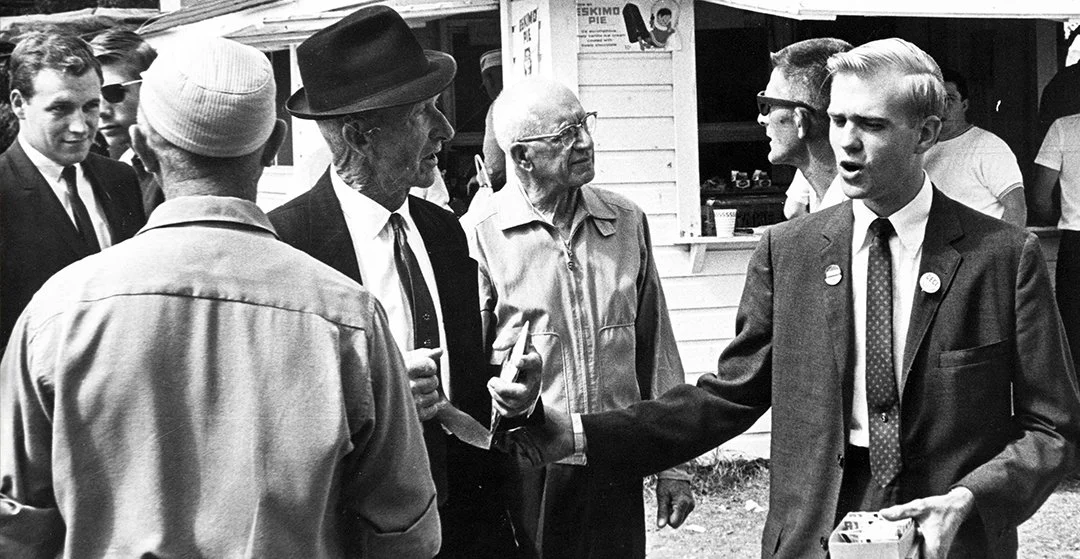
Congressman William A. Steiger campaigning in the late 1960s, with his intern Dick Cheney (far left) looking on
(Wisconsin Historical Society)
By James Lucier
This article appears in the Summer 2026 issue of the Coolidge Review. Request a free copy of a future print issue.
One of the most important figures in modern American history is largely forgotten today. His name was William A. Steiger.
Born in Oshkosh, Wisconsin, Steiger started his career in real estate, as a part owner of the Oshkosh Motor Lodge. In his early twenties, he won election to the state legislature. Then, in 1966—when he was just twenty-eight—Steiger won a seat in the U.S. Congress.
In the House of Representatives, Steiger became known for fighting to protect the Great Lakes. One of his interns was a young Dick Cheney.
But Steiger’s most important contribution came during the economic doldrums of the late 1970s.
America had no shortage of talented engineers and innovators. Many had trained at large firms like Hewlett-Packard and Fairchild Semiconductor. In Silicon Valley, hobbyists and programmers gathered each month for the Homebrew Computer Club. The group’s members included Steve Jobs and Steve Wozniak, Hewlett-Packard alumni who were building Apple Computer Company out of a garage.
But with inflation soaring and capital scarce, entrepreneurs struggled to secure backing for new ventures. Silicon Valley lacked investment capital precisely when breakthroughs in computers, electronics, and biotech were emerging.
The Tax Cut That Reshaped America
Steiger heard about this shortage of capital. Alert to the problem, he seized on a good solution as soon as he spotted it.
In March 1978, the House Ways and Means Committee was holding hearings on potential tax reforms. Steiger served on that committee. Ed Zschau, who later became a member of Congress representing Silicon Valley, pitched Steiger on reducing the capital gains tax.
Zschau had developed the proposal with Richard Rahn and Mark Bloomfield of the American Council for Capital Formation.
The effective top rate of the capital gains tax then stood at 49 percent. Almost immediately, Steiger proposed an amendment to cut it to 28 percent.
The Steiger Amendment seemed unlikely to advance out of the Ways and Means Committee. Steiger was a Republican, and Democrats—with a two-thirds supermajority in the House—controlled twenty-five of the committee’s thirty-seven seats. President Jimmy Carter, a Democrat, wanted to raise capital gains tax rates and publicly opposed the Steiger Amendment.
But Steiger had already shown his ability to build coalitions and move legislation through Congress. The intelligent, energetic, likable congressman—“one of the brightest minds and most personable members of the House,” Speaker of the House Tip O’Neill later called him—approached Democrats to ask them to reconsider their support for high capital gains taxes.
The Wall Street Journal laid out the case: “With most taxes, you have to argue about the possible dynamic effect. But on the capital gains tax it is written in black and white: In 1968, the last year of the lower capital gains rate, the tax pulled in $7.2 billion in revenues. In 1969, at the higher rate, the tax took in $4.8 billion. After a decade, it is only now getting back to the 1968 level, and in inflated dollars.”
So Steiger asked Democrats: Was soaking wealthy investors so important that they would maintain a high tax rate that had demonstrably reduced government revenue? Or as the Journal put it, Steiger “is asking the liberals whether they want to cut off their nose to spite their face.”
Steiger persuaded many Democrats to break with the president and support the capital gains tax cut. That summer the Washington Post reported that his amendment enjoyed “wild popularity” among Democrats on Capitol Hill. The Journal was so impressed by the congressman’s progress that the paper titled its editorial “Stupendous Steiger.”
Steiger moved quickly. He pushed the amendment through the Ways and Means Committee in early August. Ten days later it won full House approval. Congress passed the broader package in October. And President Carter, despite his opposition to cutting the capital gains tax, signed the Revenue Act of 1978 into law on November 6.
The Venture Capital Revolution
Just as Steiger predicted, cutting the capital gains levy triggered a boom. The effects appeared almost immediately. More venture capital was raised in the final quarter of 1978 than during the entire decade up to that point.
Other policymakers soon followed Steiger’s lead.
The next year brought another major change. The Employment Retirement Income Security Act, or ERISA, required pension- and retirement-fund managers to invest with the “care, skill, prudence, and diligence” of a “prudent man.” That language had led many pension-fund managers to avoid venture capital in favor of safer assets such as bonds. But in 1979 the Labor Department clarified that prudent investing could include venture capital.
This decision sent new flows of money from insurance and pension funds into emerging technology companies.
The scale of the transformation was astounding. In 1977 the U.S. venture capital community brought in only $39 million in new money. Now venture capital raises tens or even hundreds of billions annually.
Two years after the Steiger Amendment became law, Apple went public. Its December 1980 initial public offering was the biggest since Ford Motor Company’s decades earlier. The twenty-five-year-old Steve Jobs made $217 million overnight, and more than forty Apple employees became millionaires.
Many venture-backed innovators followed: Cisco, Amazon, Google, Facebook, Instagram, Netflix, Tesla, Intel, Nvidia, and many more. The iPhone, laptop computers, tablets, Google, social media, electric vehicles, extraordinary advances in biotechnology—the Steiger Amendment helped make all of them possible.
These successes did not arise by accident. They happened because a congressman saw a problem, identified a solution, and had the optimism and political skill to push that solution through Congress.
The Legacy Steiger Never Saw
The tragedy in the story is that Steiger did not live to see the impact of his achievement. Less than a month after the capital gains cut became law, he died suddenly of a heart attack. He was only forty.
But lawmakers influenced by Steiger continued reducing capital gains taxes. Democrats such as Richard Gephardt and Dan Rostenkowski worked with President Ronald Reagan on the tax cuts of 1981, which lowered the capital gains rate to 20 percent. The rate returned to 28 percent under the Tax Reform Act of 1986, which slashed ordinary income tax rates. Then the Taxpayer Relief Act of 1997, signed by President Bill Clinton, took the capital gains rate back down to 20 percent.
Steiger must have known that he was onto something big. In his last public appearance, only three days before he died, he proposed cutting the capital gains tax rate to zero on money held in investment accounts. His goal was to eliminate the “lock-in effect,” by which people held onto assets rather than selling them so they could avoid paying capital gains taxes. Steiger wanted to encourage investment.
Today, the American economy stands as the envy of the world because of its unmatched ability to channel investment capital into innovation. This status owes a great deal to the intelligence, energy, and charm of a person few Americans now remember.
Next time something seems politically impossible, think of Bill Steiger.
James Lucier is a cofounder of Capital Alpha Partners, a public policy research and advisory firm. He has more than thirty years’ experience working in Washington on tax and trade issues.
This article appears in the Summer 2026 issue of the Coolidge Review. Request a free copy of a future print issue.