
Detroit’s Forgotten Assimilation Machine
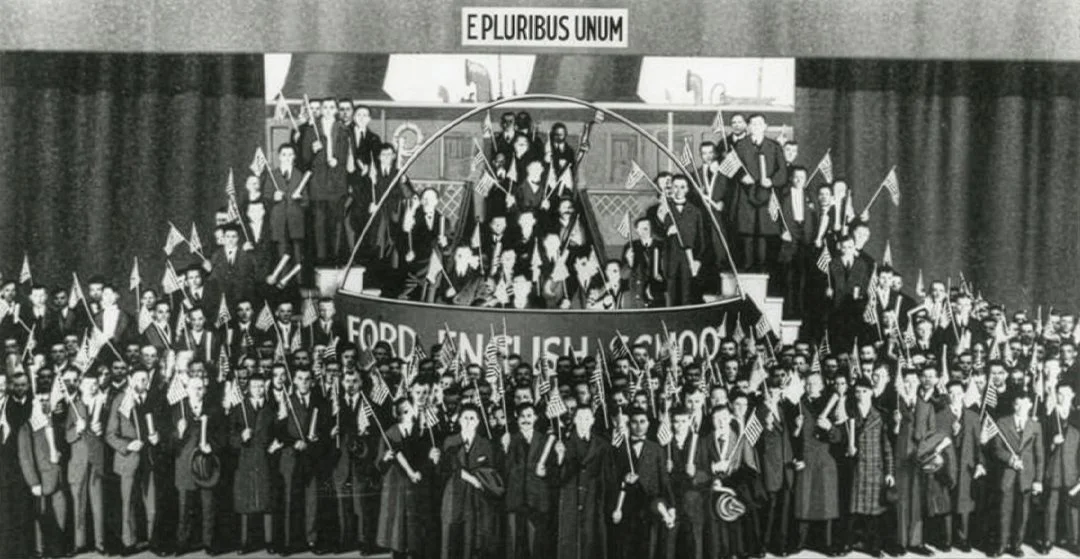
Ford English School graduates emerge from the “melting pot,” 1916
(Henry Ford Museum)
By Gene Dattel
In the early twentieth century, Detroit was a boomtown. The city’s population exploded from 285,704 people in 1900 to 993,678 in 1920, and then to 1,568,662 in 1930. Fueling this influx was Ford Motor Company’s now-legendary announcement on Monday, January 5, 1914: each worker would receive the generous payment of five dollars per day. Within twenty-four hours, ten thousand men appeared at Ford’s employment office in nine-degree weather.
By that time, the Motor City had already become a magnet for immigrants. As David Allan Levine documents in Internal Combustion, a 1915 report commissioned by the Detroit Board of Commerce found that 74 percent of the city’s population were either foreign-born or the children of foreigners. And 43 percent of the population were either born in non-English-speaking countries or the children of parents who didn’t speak English. A significant number of Detroit’s immigrants came from poor backgrounds.
To understand the scope of this immigration, consider that immigrants and their U.S.-born children make up about 29 percent of the American population today, and about 22 percent of U.S. residents speak a language other than English at home.
How did Detroit respond in 1915? Private industry cooperated with local government and civic organizations to accomplish the monumental task of absorbing huge numbers of non-English-speaking immigrants. For Detroit, the goal was assimilation into American society and the economic mainstream. This private-sector program shaped productive workers and citizens.
A Citywide Push for Citizenship
Ford Motor Company became the driving force behind this initiative, though it was hardly alone: 386 Detroit companies participated. In 1915, Ford produced a document titled “Helpful Hints and Advice to Employes [sic].” In the “Citizenship” section, the document set forth the goal: “The company believes it to be for the best interest of all employes born in other countries, that they become citizens of the United States as soon as possible, in order that they may enjoy the benefits, and protection offered by this form of government, and to take an intelligent part in the conduct of its affairs.”
“Helpful Hints” explained that Ford’s legal department was expected to advise employees of the “quickest and easiest” ways to obtain citizenship and guide them through the process. The handbook noted that employees could avail themselves of company lawyers “from 8:00 A.M. to 5:00 P.M. daily, except Saturdays.”
Ford and other companies placed the utmost importance on rudimentary proficiency in English. As a practical matter, English skills promoted efficiency and safety in the factory. But Ford did not leave language learning to the employees alone. The company developed an English school, and 163 people volunteered as instructors, teaching without pay.
Thousands of Ford employees took advantage of this offering. Those who successfully completed the program received an official diploma from the “Ford English School.” And that was not all. Ford held elaborate graduation ceremonies.
Thousands of spectators, including Detroit business leaders, gathered in an auditorium for the event. As Levine describes, Ford placed a huge ship on stage with a gangway leading to a cauldron labeled “Ford English School Melting Pot.” The newly minted English speakers, dressed in their native garb, filed into the ship. Each carried a flag designating his country of origin—Syria, Poland, Austria, Romania, Russia, Norway, and so on. Transformed in the melting pot, the graduates emerged dressed in American attire and, of course, waving American flags.
For Ford, Americanization was the operative word. As many as six thousand Ford employees marched in an Americanization Day parade in 1915.
Thousands of citizenship-seeking employees from other industrial firms took English courses in the evening at public schools. The city encouraged such study as much as possible. When children of immigrants checked out books from the public library, they were given a note asking whether their parents spoke English well. Directions to language classes were appended.
Assimilation with Strings Attached
Detroit ensured that immigrants had ample opportunity to improve their English, and employees had strong incentives to avail themselves of these programs. In slack business periods, companies often gave preference to workers proficient in English. Ford’s “Helpful Hints for Employes” emphasized the incentives for workers right in its subtitle, which explained that the handbook was designed “To Help Them Grasp the Opportunities Which Are Presented to Them by the Ford Profit-Sharing Plan.”
Some company initiatives were heavy-handed. Ford charged inspectors from its Sociological Department with “teaching Ford employees how to live.” The inspectors could enforce mandates from “Helpful Hints,” which included sections on cleanliness—bathing, dental hygiene, the proper use of garbage cans, and more. The document also stressed the necessity for “all children between the ages of 7 and 16 years to attend school.”
If employees did not meet these standards, Ford inspectors had the authority to place them on probation. The inspectors would monitor the employees and, absent improvements, could reduce their pay. If an employee failed to reform after six months, he would be fired.
At the time, neither laws nor labor unions stood as obstacles to exerting such extensive social control over employees. Clearly, no company would attempt these paternalistic interventions today.
Still, there are lessons to be learned from Detroit’s historical experience. Companies and civic organizations came together to help immigrants—many unskilled, illiterate, from backgrounds of poverty—transition to a new country, a new language, new jobs, a new culture. And their efforts helped integrate immigrants into the workforce and into the larger community.
Detroit in 1915 treated basic communication in English as a steppingstone to the economic mainstream and citizenship.
Gene Dattel is the author of Reckoning with Race: America’s Failure (Encounter, 2017), from which this essay is adapted.