
A Season of Error: Coolidge in 1925
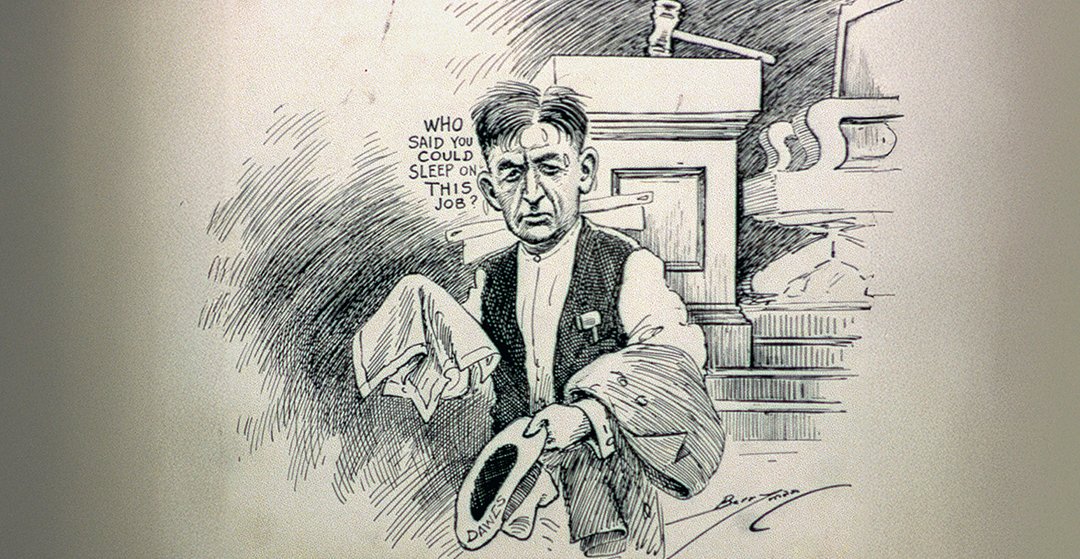
Vice President Charles Dawes’s nap kept him from casting the tie-breaking vote for Coolidge’s attorney general nominee
By Walter Stahr
Even Calvin Coolidge made mistakes. He made two after being elected president in his own right in 1924. Both mistakes related—one directly, the other indirectly—to the U.S. tariff on sugar.
The sugar tariff was a contentious issue in the 1920s. The 1922 Fordney-McCumber Tariff, signed by President Warren Harding, raised duties on imported sugar. Democrats and Progressives charged that this high tariff was meant to protect the powerful American sugar beet industry, which lobbied extensively in Washington.
Although Coolidge was keenly aware of the burdens that income taxes imposed on Americans, he never fully appreciated how tariffs burdened consumers with higher prices. Sugar was also personal for Coolidge. His family was part of the Vermont maple sugar industry, which had produced fourteen million pounds of sugar in 1890, a quarter of the domestic supply. By the 1920s, however, competition from imported cane sugar and other forms of sugar had largely forced Vermonters to shift their focus to maple syrup.
The sugar tariff became a political issue for Coolidge during the 1924 presidential campaign. In August, the U.S. Tariff Commission urged Coolidge to reduce the duty on sugar by a half cent per pound. But the president did not act on the commission’s recommendation, opening himself up to the criticism that he was beholden to sugar interests.
The chairman of the Democratic National Committee, Clem Shavers, said, “Although the President’s inaction is costing the American people, including millions of housewives, not less than $145,000 a day, it is a great boon to the sugar barons.” The Progressive presidential candidate, Senator Robert La Follette of Wisconsin, sounded a similar theme. On the campaign trail, La Follette declared that Coolidge was doing “what the Sugar Trust wants.” In failing to act on the Tariff Commission’s recommendation, the president was costing “American housewives $1,000,000” every week.
Coolidge did not respond to these attacks, and perhaps silence was the right response, for he won the November election without much difficulty, carrying thirty-five states.
The sugar issue would not go away, however.
The Warren Debacle
On January 6, 1925, Coolidge nominated his attorney general, Harlan Fiske Stone, for a seat on the Supreme Court. This meant that Coolidge would need a new attorney general. One of the names on the president’s list was that of Charles Beecher Warren, a former ambassador to Japan and Mexico, a member of the Republican National Committee, and a close friend of Coolidge.
Warren was also president of both the Michigan Sugar Company and the Toledo Sugar Company. Critics like Shaver and La Follette had specifically called out “Beet Sugar Charley,” as Warren was known, among the sugar barons who benefited from Coolidge’s refusal to lower the tariff.
Coolidge received a warning from William Howard Taft, the former president who was now chief justice of the United States. Taft had initially included Warren on a list he provided Coolidge of possible attorneys general. “Then I had a talk with [Henry] Ford’s attorney,” Taft wrote to a Republican friend, “who told me that while Warren was very able, he was as unscrupulous as the devil, and that he could give me a great many instances.”
Taft shared this information with Coolidge, who should have taken the warning seriously. After all, corruption concerns had already forced the president to request the resignation of his first attorney general, Harry Daugherty.
Congressional Republicans from Michigan, Warren’s own state, went to the White House to inform Coolidge that they did not support Warren’s quest to become a cabinet member. They told the president their concerns about the former ambassador.
Coolidge ignored all these warnings and nominated Warren on January 11.
The nomination was in trouble from the start. Senator Thomas Walsh, Montana Democrat, raised troubling questions about Warren’s sugar interests and prior testimony in sugar investigations. The New York Times reported on February 12 that Warren’s nomination might not make it out of the Senate Judiciary Committee, owing to opposition from six Democrats and two Republicans on the committee.
Papers also revealed that Warren was the subject of not only past investigations but also a current Federal Trade Commission case against his Michigan Sugar Company and Toledo Sugar Company. The FTC alleged that Warren’s businesses had an agreement with another company that violated antitrust laws. Coolidge was so determined to secure Warren’s confirmation that he issued, from the White House, a defense of the sugar companies. This was, the Times noted, an “unprecedented action.”
Coolidge had to fight so publicly for his nominee in part because he had failed to consult Republican senators before nominating Warren. As a result, the political columnist Mark Sullivan noted, Republican senators who usually voted with the administration were for Warren, but they were not prepared to work for his confirmation.
Facing opposition, Coolidge decided to have the full Senate vote on Warren’s nomination in the short special session that began on inauguration day, March 4. Coolidge would have two advantages in this session. First, the Senate would have a few more Republicans, for a total of fifty-five. Second, he would have a vice president, Charles Dawes. At the time there was no constitutional mechanism for selecting a new vice president after the death of a president, so after Harding’s death, Coolidge had governed without a vice president. Once Dawes was sworn in, however, he would have the right to preside over the Senate and break any Senate ties.
The Senate vote was set for March 10. That afternoon, Vice President Dawes, the press reported, “retired to his hotel a mile away for a rest, having received assurances, his friends said, from leaders on both sides that there would not be a vote before adjournment.” Even as the roll call vote on Warren started, “administration leaders apparently were confident that they would have a vote or two, at least, to spare and they made no move to summon Mr. Dawes, concerning themselves merely with rounding up senators from the corridors.”
The first vote on Warren’s nomination ended in a 40–40 tie. If Dawes had been presiding, he could have broken the tie and confirmed Warren. But Dawes was in a taxi, on Pennsylvania Avenue, racing from the Willard Hotel to Capitol Hill.
The vice president arrived too late. By the time Dawes entered the chamber and took his place, the Senate was voting on a motion to reconsider the vote. The sole Democrat who had voted with the administration, Lee Overman of North Carolina, now changed his stance and sided with his Democratic colleagues. The Warren nomination thus failed, 41–39.
Newspapers blamed Dawes for his absence, and he surely deserves blame. But Coolidge and his aides should have ensured that Dawes was presiding over the Senate rather than napping at his hotel. Similarly, Coolidge and his aides should have ensured that every favorable Republican senator was in his place and voting “aye.” One more vote on the initial ballot would have sufficed.
Doubling Down
Coolidge now faced a difficult decision. Should he submit the Warren nomination to the Senate a second time?
Senate Republican leaders visited Coolidge at the White House to warn against that move. The New York Times reported that they told president “a second rejection would be certain and by a much more emphatic vote than marked yesterday’s action.” Coolidge complained that the senators had not been sufficiently “organized” for Warren, while the lawmakers responded that the president should have personally lobbied reluctant senators. Newspapers predicted that Coolidge would select another attorney general.
The next day, however, Coolidge resubmitted the Warren nomination to the Senate. “President Coolidge today defied the Senate and ignored the advice of the Republican leaders,” the Times reported.
Coolidge raised the stakes when he declared that if the Senate again rejected the nominee, he would give Warren “a recess appointment in the office which the Senate has declared he must not serve.” Senate Democrats reacted with rage. As the Times put it, they said that the “constitutional rights of the Senate had been invaded by the Executive” and hinted that “President Coolidge had laid the foundation for impeachment proceedings.”
The Senate again rejected the Warren nomination, this time by a vote of 46–39. Ten Republicans voted against the nominee, including some who usually voted with the administration, such as Reed Smoot of Utah and James Couzens of Warren’s Michigan.
President Coolidge did not follow through on his threat to give Warren a recess appointment. Warren himself rejected this approach.
Instead, Coolidge decided to “look homeward,” writes biographer Amity Shlaes. The president turned to John Sargent, the former attorney general of Vermont and a friend of the Coolidge family. Sargent had served as attorney to Coolidge’s father.
The Senate—eager to leave town—unanimously confirmed Sargent.
After this fiasco, Taft commented that Coolidge “does not consult enough people with reference to what he is going to do and he often consults the wrong people.” Taft also believed that Coolidge was better off with Sargent, who was honest if not brilliant, than he would have been with Warren, who lacked “sturdy honesty,” in Taft’s view.
The Second Mistake
Warren’s role in the sugar industry, and the investigations into his companies, made confirmation difficult from the beginning. They also reinforced the claims of political opponents that Coolidge was too closely aligned with sugar interests.
The tariff controversy led directly to Coolidge’s second mistake. Since 1924, the president had done nothing in response to the Tariff Commission’s recommendation. Finally, in June 1925, he announced a formal decision: he would not reduce the tariff. Coolidge observed that the wholesale price of sugar was only 5 ½ cents per pound—“scarcely over” what it had been before the First World War. “I do not believe that we can maintain such reasonable prices if we destroy our domestic industry,” he argued.
Coolidge’s critics were not persuaded. “He overlooks the fundamental economic principle,” one letter to the editor commented, “that indirect taxation is just as burdensome as direct taxation and far more costly in its operation.”
Indeed, Coolidge’s argument ignored the fact that rejecting the Tariff Commission’s recommendation required American consumers to pay 10 percent more for sugar than necessary. The sugar tariff also hurt Cuba badly. The island nation’s one export industry was sugar, and come the Great Depression, the U.S. tariff contributed to a massive downturn in the Cuban economy and in the wages of Cuban sugar workers.
Back in 1920, as governor of Massachusetts, Coolidge had articulated his understanding of economic protectionism. “My observation of protection is that it has been successful in practice, however unsound it may appear to be in theory,” he wrote to a friend. “That must mean that the theories have not taken account of all the facts.”
But America’s experience with the sugar tariff suggests that protection proved less successful in practice than Coolidge had imagined.
Walter Stahr, a retired Washington lawyer, is the author of biographies of several American leaders, including the forthcoming book William Howard Taft: A Great American Life.