
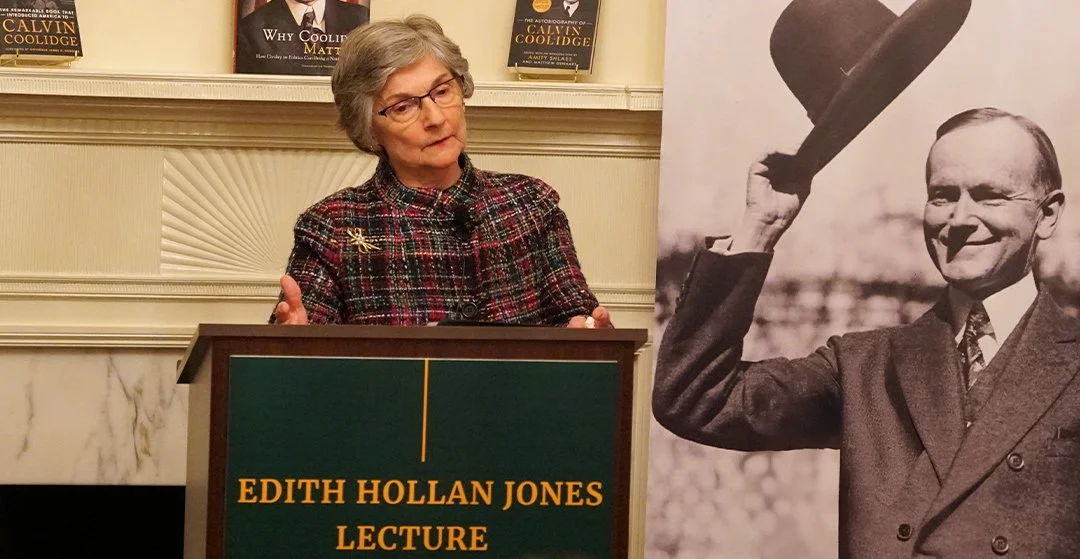
Judge Edith H. Jones inaugurates the Jones Lecture
By Edith H. Jones
This past November, the Coolidge Foundation hosted the inaugural Judge Edith Hollan Jones Lecture. The speaker was Judge Jones herself, a distinguished jurist appointed to the federal bench by President Ronald Reagan in 1985. Jones’s former clerks helped fund this annual lecture series to honor her forty years as a federal judge.
The Coolidge Review is pleased to share Judge Jones’s remarks from that evening.
Calvin Coolidge became a lawyer in nearly the last generation of American lawyers who read for the bar in a centuries-old tradition that preceded formal law school education. He then practiced law for about twelve years until he became a full-time public officeholder. When he spoke about the law or the rule of law, his remarks illustrated a perspective that even then, in the early part of the twentieth century, was being challenged by progressives and legal realists. I will call President Coolidge’s views the “Founders’ law.” Eventually, the perspectives of progressives and legal realists took over. With their increasingly radical descendants, they have dominated legal thinking to the present day. Yet the legal system founded on the “modern” perspectives has failed in significant areas to assure social stability and protect personal freedom.
It is my hope that this lecture series will serve two purposes. First, future speakers should enlighten the public and especially aspiring young lawyers about the Founders’ legal heritage that shaped Coolidge. In broadest terms, this traditional framework understood the connection between law and objective standards of morality. Second, speakers can suggest how a renascence of the Founders’ law, the fundamental principles that Coolidge stood for, can remedy the failures of late nineteenth- and twentieth-century legal scholarship.
To inaugurate this series, I will review the authors whose work educated Coolidge in the law, explain how he responded to this training, and sketch the divide between the Founders’ law and “modern” thinking about the law.
Coolidge’s Legal Training
When Coolidge decided to study law, paying to attend a formal law school would have been a hardship. Another option, however, was to “read the law” while he served an apprenticeship in an established firm. Coolidge secured a position with Hammond & Field in Northampton, Massachusetts. The town’s thriving businesses, its hospitality to innovators, its educational institutions, and its status as the county seat assured a varied and interesting law practice. Coolidge read law from 1895 to 1897 and passed his licensing examination a year earlier than was usual.
How did one learn the law by reading? Since colonial times, the principal mode of legal education in America had been apprenticeship. Under the tutelage of Hammond & Field’s partners, Coolidge drafted pleadings, studied Massachusetts law, and routinely attended court hearings. But for general legal knowledge, he read treatises. In particular, like nearly all American lawyers before the twentieth century, he absorbed Chancellor James Kent’s Commentaries on American Law (published 1826–1830) and Sir William Blackstone’s Commentaries on the Law of England (originally published 1765–1769).
Both commentaries were seminal to the way Coolidge thought about the law. They covered the entire scope of legal topics in England and the United States. Written in accessible language, they were not daunting to the nonlegal reader. In fact, they were written to educate “gentlemen” and all who wished to participate in government, whether as trained lawyers or as active citizens. Both treatises enunciated and supported legal propositions with encyclopedic citations of European and English sources.
Blackstone’s Commentaries
Blackstone’s four-volume work was not the first to address English common law developments over hundreds of years. But as Chancellor Kent wrote, Blackstone is “justly placed at the head of all the modern writers who treat of the general elementary principles of the law.” Blackstone’s task was to organize and synthesize centuries of the common law, the legal relationship between Crown and Parliament, and what there was of statute law. Before Blackstone’s Commentaries, and despite the efforts of earlier chroniclers, the common law was disorganized and difficult to fathom. Chancellor Kent praised the “excellence of [Blackstone’s] arrangement, the variety of his learning, the justness of his taste, and the purity and elegance of his style.”
For these achievements, Blackstone’s Commentaries were an immediate hit in England, but they became even more successful over here. By 1772, when its American edition premiered, Blackstone had sold more than 2,400 copies in the American colonies, nearly as many as in England, in large part because colonials lacked access to the mother country’s abundant sources of legal research. The Commentaries graced Americans’ libraries and were relied on by signers of the Declaration of Independence and the Constitution. Not much later, Blackstone influenced and inspired both Chancellor Kent and Supreme Court justice Joseph Story. As a professor of law at Harvard, Justice Story wrote treatises that are still consulted on the U.S. Constitution and more than a half dozen other areas of law.
To be sure, American lawyers did not share Blackstone’s adulation of the English constitutional monarchy or his dismissive view of the rights of colonial citizens. Nor would they adopt other aspects of law unsuited to our constitutional government and circumstances. Americans, however, agreed with Blackstone’s ideals. Those include, in the words of legal scholar Stephen Presser, “the systemic nature of law, its divine origin, its moral superiority and moral clarity, and its notion that precedent should govern.”
After an introduction, volume 1 of the Commentaries begins with a description of the “Nature of Laws in General.” Blackstone writes: “Law, in its most general and comprehensive sense, signifies a rule of action; and is applied indiscriminately to all kinds of action…. Thus we say, the laws of motion, of gravitation, of optics, or mechanics, as well as the laws of nature and of nations.”
According to Blackstone, law exists in a hierarchy. At the top are God’s physical laws: “When the supreme being formed the universe, and created matter out of nothing, he impressed certain principles upon that matter, from which it can never depart, and without which it would cease to be. When he put that matter into motion, he established certain laws of motion, to which all movable bodies must conform.” Next are the fixed and invariable laws that govern the natural world, vegetable and animal life.
For man, God prescribed the law of human nature: “As man depends absolutely upon his maker for every thing, it is necessary that he should in all points conform to his maker’s will.” In essence, the Creator gave man the faculty of reason to discover nature’s laws, and the law of nature regulates and restrains human free will. God in his wisdom laid down laws of good and evil. Blackstone summarizes God’s law for man by citing three precepts from Justinian: we should live honestly, hurt nobody, and render to every man his due. Finally, the law governing human nature is binding all over the globe, at all times. Blackstone explains: “No human laws are of any validity, if contrary to this.”
Accordingly, manmade laws must conform to both the law of revelation, which is given in scripture, and natural law, which is ascertainable by reason and prescribes moral conduct. These twin pillars of reason and revelation, Blackstone writes, are the foundation of all human law.
Although on many points both divine and natural law “leave a man at his own liberty,” some human regulations of conduct benefit society. Blackstone avers, as did Aristotle, that man was formed for society. And among human societies, which have arisen distinctly in different places, there is a law of nations to regulate their mutual intercourse. The law of nations is founded on rules of natural law or positive law and consists of compacts, treaties, leagues, and similar structures.
In sum, Blackstone’s explanation of a divinely created hierarchy of law prefaced the Commentaries’ topical discussions and set the framework for legal education for over a hundred years in America.
It is not my purpose to analyze the political theory behind Blackstone’s hierarchy of law. I will not debate his philosophical consistency, or whether he was more inclined to the views of Locke or of classical natural law. No doubt, Coolidge, skilled in Greek and Latin and educated at Amherst in the Western world’s classics, was familiar with Aristotle, Cicero, Hobbes, and Locke. But for the purposes of legal training, Coolidge, like most American lawyers who studied Blackstone’s Commentaries, could comfortably assimilate Blackstone’s amalgam of natural law and natural rights.
Blackstone’s general hierarchy of law is followed by his general explanation of municipal law. Municipal law is the law by which districts, communities, or nations are governed. Blackstone defines the elements of municipal law as a rule of civil conduct, prescribed by the supreme power in a state, commanding what is right and prohibiting what is wrong.
He expands upon each component of municipal law. As a rule of civil conduct, municipal law regards a person as a citizen bound to duties to his neighbor, which means that he contributes to a society’s subsistence and peace. And as a rule, a municipal law is not a “promise”; it obliges one to act, or not to do something. That the law must be prescribed means it must be publicly known, and it must be promulgated by the sovereign (the King in Parliament, in his exposition). As to “commanding what is right and prohibiting what is wrong,” the law must decide on and declare the rights to be observed and the wrongs to be eschewed. Blackstone, however, explains that those rights “which God and nature have established, and are therefore called natural rights, such as life and liberty, need not the aid of human laws”; these rights are invested in every person.
The bulk of Blackstone’s Commentaries details England’s common and customary law. The first volume is titled “Rights of Persons”; volume 2 covers “Rights of Things” (real and personal property); volume 3 describes the law of “Private Wrongs” (which covers pleading and practice relating to what we now call torts); and volume 4 treats “Public Wrongs” (criminal law).
Important here is Blackstone’s treatment of the rights, or liberties, of Englishmen, which opens his discussion of the law of persons. Those rights consist in the free enjoyment of personal security, of personal liberty, and of private property. So long as these rights remain “inviolate,” although subject to reasonable restraints for the benefit of society, a person is perfectly free. Both Parliament and the king must protect these rights from violation. But to vindicate those rights, if violated, English subjects have recourse, in order, to the courts, to the right of petitioning the king and Parliament, and finally to having and using arms for self-preservation and defense.
Blackstone’s exposition of individual rights contributed, as Presser writes, “to emerging American ideas about the primary purpose of society.” That purpose, in Blackstone’s words, was “to protect individuals in the enjoyment of those absolute rights, which were invested in them by the immutable laws of nature.” Through Blackstone, Americans came to venerate trial by jury, the writ of habeas corpus, notions of limited government and sovereignty, and judicial independence (though not a concept of modern judicial review). Blackstone considered rights of property “absolute,” because they were derived from natural law and natural rights. Society, he wrote, had adopted property rights to encourage human productivity and relieve necessity. But property rights were subject to regulation, albeit with compensation for takings. Moreover, those with a “more opulent” status owed duties to the poor.
To be sure, from the time Blackstone’s Commentaries appeared in America, they were subjected to various criticisms. James Wilson, an eminent American legal scholar, thought that Blackstone inadequately expressed the natural law foundation of British subjects’ rights. Thomas Jefferson considered Blackstone a judicial activist in the mold of Lord Mansfield. St. George Tucker authored a lengthy commentary on the Commentaries to prove Americans’ evolving differences from some of Blackstone’s propositions.
But the essential brilliance of his compilation was acknowledged by all these men. As one author wrote, “All of our formative documents—the Declaration of Independence, the Constitution, the Federalist Papers, and the seminal decisions of the Supreme Court under John Marshall—were drafted by attorneys steeped in Sir William Blackstone’s Commentaries on the Laws of England.” Chief Justice Marshall, for instance, had read Blackstone four times by the age of twenty-seven.
As Professor Mary Ann Glendon notes, Blackstone’s work was “the law book” during America’s formative period; “it would be hard to exaggerate the degree of esteem in which” the Commentaries were held. Professor Albert Alschuler points out that “before 1900, almost every American lawyer read at least part of Blackstone.”
Blackstone inculcated in American lawyers the premise that human law derives from, is subordinate to, and answers to God and the moral law, which may be known from revelation in scripture and from nature by human reason. Blackstone was convinced that English common law was founded on principles that are permanent, uniform, and universal. The role of the common law judge was to apply these fixed principles at law or, as others would demonstrate, in equity. But contrary to later critics, Blackstone’s common law was not inflexible and unrealistically mechanical. It “did not dictate answers to all or most legal questions,” as Alschuler summarizes. “It simply indicated the essential needs of human beings and demanded that people respect the essential needs of others.”
Kent’s Commentaries
Reading Blackstone’s Commentaries “with awe” inspired James Kent at the age of sixteen to become a lawyer. Kent would spend fourteen years on New York’s highest bench, then called the Supreme Court (now the Court of Appeals). Following that, he became the chancellor of New York’s Chancery Court, a post in which he almost singlehandedly developed American equity law. He also taught law at Columbia, and from his lectures evolved his Commentaries on American Law, published between 1826 and 1830. Kent’s ambitious four-volume work undertook to describe American law topically throughout the states. It had gone through six editions by the time of Kent’s death in 1847. The fifteenth edition was published as late as 1902.
In the 1920s, a tablet was placed at the New York Court of Appeals in Kent’s honor, and a contemporary American Bar Association law review article deemed Kent the “American Blackstone.” Justice Joseph Story dedicated a treatise to his friend Kent, describing his Commentaries as a “juridical classic” that “placed their author in the first rank of the benefactors of the profession.”
Kent does not need to engage in a taxonomy of law or its moral and universal basis because, while surveying each specific legal topic, his work coincides with Blackstone’s approach.
To begin, Kent’s Commentaries addresses the law of nations. Kent recounts the debate as to whether the law of nations derives from positive law or the law of nature. He concludes that “there is a natural and a positive law of nations.” Like Blackstone, he says that “states or bodies politic, are to be considered as moral persons, having a public will, capable and free to do right and wrong, inasmuch as they are collections of individuals, each of whom carries with him into the service of the community, the same binding law of morality and religion which ought to control his conduct in private life.”
Concerning the “Absolute Rights of Persons” (Lecture 24), Kent derives from Blackstone that the “absolute rights of individuals may be resolved into the right of personal security, the right of personal liberty, and the right to acquire and enjoy property. These rights have been justly considered, and frequently declared, by the people of this country, to be natural, inherent, and unalienable.” He follows with a series of historical examples and then the insight that there is a “real efficacy” in a Bill of Rights, to control excesses of “party spirit,” “to guide and enlighten public opinion, and to render it more quick to detect, and more resolute to resist, attempts to disturb private right.” Kent reminds citizens that knowing their unalienable rights is important because “when the spirit of liberty has fled, and truth and justice are disregarded, private rights can easily be sacrificed under the forms of law.”
Writing about the “absolute” rights of property (Lecture 34), Kent holds that “the sense of property is inherent in the human breast.” Perhaps more forcefully than Blackstone, Kent puts the case for the natural right of property: “Man was fitted and intended by the author of his being, for society and government, and for the acquisition and enjoyment of property. It is, to speak correctly, the law of his nature; and by obedience to this law, he brings all his faculties into exercise, and is enabled to display the various and exalted powers of the human mind.”
Because man’s creative impetus is both encouraged and satisfied by means of property, “A state of equality as to property is impossible to be maintained, for it is against the laws of our nature; and if it could be reduced to practice, it would place the human race in a state of tasteless enjoyment and stupid inactivity, which would degrade the mind, and destroy the happiness of social life.” In simplest terms, forced equality of property destroys a person’s incentive to create and be productive. Consequently, “Every person is entitled to be protected in the enjoyment of his property, not only from invasions of it by individuals, but from all unequal and undue assessment on the part of government.”
Professor Lawrence Friedman, the eminent legal historian, says that Kent “had a deep respect for property rights, but a tremendous concern for enterprise as well.” In congruence with Blackstone, Kent acknowledges: “There are many cases in which the rights of property may be made subservient to the public welfare. The maxim of law is, that a private mischief is to be endured rather than a public inconvenience. On this ground rest the rights of public necessity.” He adds that if, through the constitutional exercise of law, the lawmaker must deprive a person of his property, “a provision for compensation is a necessary attendant.” This principle, he says, “is laid down by jurists [Grotius] as an acknowledged principle of universal law.” Kent further explains that private property should be taken only for public uses; if, for example, “the legislature should take the property of A., and give it to B., the law would be unconstitutional and void.”
And like Blackstone, Kent declares that the “absolute” and “unalienable” rights of individuals exclude the “right” to do things that are morally wrong, or harmful to society as prescribed by the common law or a legislature.
Calvin Coolidge and the Founders’ Law
The Founders’ law, resonant with the principles articulated in Blackstone’s and Kent’s Commentaries, was premised on natural and universal precepts. Judeo-Christian morality, objective standards of right and wrong, and unalienable individual rights were inseparable from these precepts. Blackstone’s discussion presaged to an uncanny degree the Declaration of Independence, as he announced that the Laws of Nature and Nature’s God revealed self-evident truths that all men are created equal before the law, and all men are endowed with unalienable rights to life, liberty, and the pursuit of happiness. In both Commentaries, it is evident that government exists not as an end in itself but as a guarantor of individual rights and property rights within a framework in which government serves to protect both society and the individual.
President Coolidge espoused the Founders’ law as a product of reason and revelation. His speeches consistently reflect the Commentaries’ influence, and it is important to recall that Coolidge was nearly the last president who wrote his own speeches.
On becoming president of the Massachusetts state senate in 1914, Coolidge paraphrased Blackstone: “Men do not make laws. They do but discover them. Laws must be justified by something more than the will of the majority. They must rest on the eternal foundations of righteousness.” Legislation has a higher goal than appealing simply to selfishness, Coolidge said. Hence the laws of the Commonwealth must appeal to man’s “spiritual nature” and must recognize “the immortal worth and dignity of man.” Such is the path to equality before the law and the foundation of liberty under the law. Like Blackstone and Kent, Coolidge knew that equality and liberty under law depend on men’s spiritual nature, which calls them to duties as well as rights under Judeo-Christian principles.
Speaking at the Amherst College Alumni Dinner in November 1920, Coolidge extracted from Blackstone that the “process of civilization consists of the discovery by men of the laws of the universe, and of living in harmony with those laws.” He added that, for men, the laws of human nature are the most important.
Not long before he became president upon the sudden death of Warren Harding, Coolidge quoted Blackstone directly. He told the New York state convention of the YMCA, “By law is meant a rule of action.” He expanded on the definition: “Action depends upon intelligence and motive. If either of these be lacking, the action fails and the law fails.” A law is useless to accomplish its purposes, in other words, if it isn’t obeyed or enforced.
Coolidge expressed similar thoughts in his famous 1922 speech to the American Bar Association, “The Limitations of the Law.” There he noted, “When a broad rule of action is laid down by law it is [the people] who must perform.” Law must be obeyed and enforced, as Blackstone also stated.
In his inaugural address of March 1925, President Coolidge grounded “the science of government” in past experience and human nature. “It is necessary to keep the former experiences of our country both at home and abroad continually before us if we are to have any science of government. If we wish to erect new structures, we must have a definite knowledge of the old foundations. We must realize that human nature is about the most constant thing in the universe and that the essentials of human relationship do not change.” Blackstone and Kent would have agreed.
President Coolidge also believed that people are entitled to rights of property. His speeches consistently promote the benefits of free enterprise for the well-being of all citizens. He favored lower taxes, he said, because he favored the people; taxes are paid from the people’s substance. This echoed Kent’s idea that taxpayers should be spared from undue and unnecessary assessments. In his inaugural speech to the Massachusetts senate, Coolidge drew on natural law to connect individual liberty and property rights:
Self-government means self-support. Man is born into the universe with a personality that is his own. He has a right that is founded upon the constitution of the universe to have property that is his own. Ultimately, property rights and personal rights are the same thing. The one cannot be preserved if the other be violated. Each man is entitled to his rights and the rewards of his service be they never so large or never so small.
Even the most famous passage of Coolidge’s most famous speech implicitly recalls Blackstone. In July 1926, President Coolidge celebrated the 150th anniversary of the Declaration of Independence with his speech “The Inspiration of the Declaration.”
Thomas Jefferson has been said to have paraphrased John Locke when he wrote of the self-evident truths that all men are created equal, that they are endowed by their Creator with unalienable rights, among which are life, liberty, and the pursuit of happiness. But as we have seen, these are premises of Blackstone as much as Jefferson or Locke, and Blackstone’s phrasing of these truths is remarkably like that used by Jefferson.
Coolidge explained these propositions in his speech by asserting that the Declaration’s ideals are “final.” He succinctly characterized the Founders’ law by saying: “If all men are created equal, that is final. If they are endowed with inalienable rights, that is final. If governments derive their just powers from the consent of the governed, that is final. No advance, no progress can be made beyond these propositions.”
Responding to those who advocated more “modern” approaches, he insisted that any other attempt to organize government would represent not progress but regress to a period when there was no equality, no rights, and no consent. Those advocates of “modernity,” he said, were the reactionaries.
Blackstone and Kent would have agreed.
The Modernists
Coolidge’s traditional approach to law, rooted in Blackstone and Kent, was still widely accepted within the legal profession during the first part of the twentieth century. But Coolidge recognized that the Founders’ view of law and indeed of American political institutions was under assault from various directions.
The full tale of the decline of Blackstone and Kent in American legal education is too long for this occasion, but it started in political and religious discourse of the seventeenth century. In Blackstone’s own time, Jeremy Bentham, the expositor of utilitarianism, became an enemy of his former teacher. By the nineteenth century, skepticism, positivism, and theories created by Marx, Hegel, and Darwin each played a part in undermining the traditional underpinning of American law.
In 1872 the young law graduate Oliver Wendell Holmes Jr. was tasked with editing the twelfth edition of Kent’s Commentaries. In a letter to a friend, Holmes complained: “I…have to keep a civil tongue in my head while I am his [Kent’s] valet…. He has no general ideas except wrong ones and his treatment of special topics is often confused to the last degree.”
These modernist ideas inspired the development of progressivism and legal realism. Generally, the legal realist movement threw over the concept that law is tied to moral judgment and right reason. Legal realists contended that the Founders’ law had become stultified, mechanistic, outdated, and unresponsive to social problems created by industrialization. They also embraced the claim that Governor (and later Supreme Court justice) Charles Evans Hughes made in 1907: “The Constitution is what the judges say it is.”
At their best, legal realists and progressives advocated incremental changes that would simplify legal concepts and adapt common law principles to the needs of society. At their worst, progressives, led by intellectuals like Woodrow Wilson, deliberately sought to undermine the government created by the Constitution and to supplant it with government by administrative “experts.” And at their worst, legal realists and subsequent nontraditional theorists were responsible for what Alschuler calls “the skeptical jurisprudence of the twentieth century,” which “rested on defaming the thought that preceded it.”
Perhaps the most famous example of such defamation came from Holmes, who joined the Supreme Court three decades after scorning Chancellor Kent. In a 1917 dissent, Justice Holmes dismissed natural law as a “brooding omnipresence in the sky” that oppressed the legal system. And ten years later, in Buck v. Bell, Holmes coined the phrase “three generations of imbeciles are enough” when, unshackled by the brooding omnipresence of natural rights, the Supreme Court condoned forced sterilization of mentally disabled individuals.
Twentieth-century legal theorists essentially abandoned any relation to the Founders’ law in favor of raw positivism. Positivism means that the lawgiver, led by his internal compass alone, dictates the rule of action, in Blackstone’s terms, which must be obeyed. Transforming legal education by the widespread adoption of the case study method in place of lectures and treatises reinforced relativism over the Founders’ law. In the give and take of Socratic discussion of cases, law students are led to infer that case law can stand for any, even conflicting, propositions, and that all propositions are equally valid so long as a judge finds them persuasive. Modernists dismissed as self-contradictory the traditional canons of interpretation that had governed legal texts. Along with devaluing texts and rules of grammar, they claimed that the words of the Constitution and statutes were “vague generalities” into which modernist judges could and did pour their personal ideas of social reform.
How far have the modern legal theories departed from the Founders’ law? That would be subject of a very long discourse. But here are some examples.
Their theories are utterly disconnected from revelation and have foresworn that human law is answerable to God in any way.
They have abandoned the concept of universal, changeless human nature.
They refuse to acknowledge rules of moral conduct or objective tests of good and evil. (Holmes, in a 1918 Harvard Law Review article, rejected “the supposed a priori discernment of a duty or the assertion of a preexisting right.”)
They deny that property rights are an essential aspect of personal liberty.
They have devalued rules of precedent and therefore the imperative of stability in the rule of law.
They have elevated government without the consent of the governed by empowering administrative bodies and judges.
They use law as a weapon for transient political gain.
Their theories are malleable and unstable: legal realism, in the early twentieth century, was followed by sociological jurisprudence, followed by process jurisprudence, followed by critical legal studies, followed by feminist, LGBT, and environmental theories.
They disavow the U.S. Constitution. Harvard and Yale scholars editorialize and teach in opposition to the Constitution. The modernists promote nullification of federal law and deride the constitutional separation of powers. They refuse to enforce laws for public security. They replace individual rights and equality before the law with tribal allegiances. They justify political violence, vandalism, even assassinations.
Their theories have resulted in Supreme Court decisions that undercut the Founders’ connection between law and unalienable rights. The Court has:
undermined public discourse by saying that “one man’s vulgarity is another’s lyric”; in that case, Cohen v. California (1971), the Court authorized a man to wear on his jacket in a courthouse the phrase “F— the Draft.”
removed limits on libel and defamation, two species of attack on persons’ unalienable liberty that Blackstone and Kent condemned.
severely undercut the traditional idea of state and local police power, which served to protect the health, morals, and physical security of citizens.
enabled takings of private property to serve other private interests.
President Coolidge said, “Governments do not make ideals, but ideals make governments.” The ideals of the Declaration and Constitution were based on the ideals expressed in the Founders’ law by Blackstone and Kent. If those ideals have lost force in the hearts of our citizens, can government founded on these ideals survive? This is the overriding question of our time. Assuring the preservation of these ideals is the challenge our younger citizens face.
But difficult as things may seem, despair is a sin. It took an entire century for legal realism and its mutant descendants to arrive at their present state of nihilism. The revolt against its premises began with Supreme Court justice William Rehnquist in 1976 and Attorney General Edwin Meese in 1985.
Coincidentally, I was sworn onto the bench in 1985, one month before General Meese’s speech urging a return to the original meaning of the Constitution. For forty years I’ve been privileged to try to adhere to the Founders’ law. Despite setbacks, the Supreme Court and federal bench have seen a transformation in that direction. Brilliant scholars have restored a sense of gratitude for our precious heritage of the Founders’ law.
I believe we are in the process of restoring institutions in conformity with its principles. I hope and pray that this lecture series will offer a podium for further recovery of the Founders’ law, as would have pleased President Coolidge.
Edith H. Jones is a judge on the United States Court of Appeals for the Fifth Circuit. She is a trustee of the Coolidge Foundation.